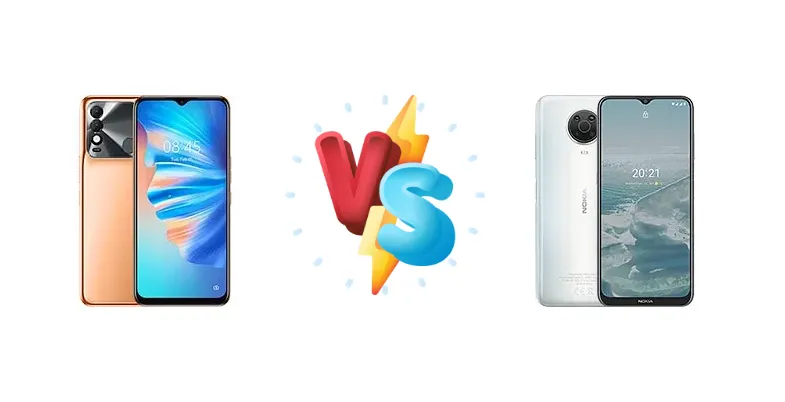
The Tecno Spark 8T and Nokia G20 represent the fiercely competitive sub-$200 smartphone market. Both devices aim to deliver essential smartphone functionality at an accessible price point. However, despite sharing the same Mediatek Helio G35 chipset, subtle differences in features and design cater to distinct user needs. This comparison dissects these nuances to determine which phone offers the best value.
🏆 Quick Verdict
For the average user prioritizing a slightly more streamlined experience and potentially faster charging (though specifics are missing for the Spark 8T), the Tecno Spark 8T emerges as the better choice. The Nokia G20’s strength lies in its brand reputation for software support, but the identical chipset means performance will be nearly indistinguishable.
| Network |
|---|
| 2G bands | GSM 850 / 900 / 1800 / 1900 | GSM 850 / 900 / 1800 / 1900 |
| 3G bands | HSDPA 850 / 900 / 2100 | HSDPA 850 / 900 / 1900 / 2100 - International |
| 4G bands | LTE | 1, 3, 5, 7, 8, 20, 28, 38, 40, 41 - International |
| Speed | HSPA 42.2/5.76 Mbps, LTE Cat4 150/50 Mbps | HSPA 42.2/5.76 Mbps, LTE Cat4 150/50 Mbps |
| Technology | GSM / HSPA / LTE | GSM / HSPA / LTE |
| | - | 1, 2, 3, 4, 5, 7, 8, 12, 17, 28, 66 - LATAM |
| Launch |
|---|
| Announced | 2021, December 15 | 2021, April 08 |
| Status | Available. Released 2021, December 15 | Available. Released 2021, May 17 |
| Body |
|---|
| Build | Glass front, plastic frame, plastic back | - |
| Dimensions | 164.3 x 75.9 x 8.9 mm (6.47 x 2.99 x 0.35 in) | 164.9 x 76 x 9.2 mm (6.49 x 2.99 x 0.36 in) |
| SIM | Nano-SIM + Nano-SIM | · Nano-SIM· Nano-SIM + Nano-SIM |
| Weight | - | 197 g (6.95 oz) |
| | - | Splash protection |
| Display |
|---|
| Resolution | 1080 x 2408 pixels, 20:9 ratio (~400 ppi density) | 720 x 1600 pixels, 20:9 ratio (~269 ppi density) |
| Size | 6.6 inches, 104.9 cm2 (~84.1% screen-to-body ratio) | 6.52 inches, 102.6 cm2 (~81.9% screen-to-body ratio) |
| Type | IPS LCD | IPS LCD |
| Platform |
|---|
| CPU | Octa-core (4x2.3 GHz Cortex-A53 & 4x1.8 GHz Cortex-A53) | Octa-core (4x2.3 GHz Cortex-A53 & 4x1.8 GHz Cortex-A53) |
| Chipset | Mediatek MT6765G Helio G35 (12 nm) | Mediatek MT6765G Helio G35 (12 nm) |
| GPU | PowerVR GE8320 | PowerVR GE8320 |
| OS | Android 11, HIOS 7.6 | Android 11, upgradable to Android 13 |
| Memory |
|---|
| Card slot | microSDXC (dedicated slot) | microSDXC (dedicated slot) |
| Internal | 64GB 4GB RAM | 64GB 4GB RAM, 128GB 4GB RAM |
| | eMMC 5.1 | - |
| Main Camera |
|---|
| Features | Quad-LED flash, HDR, panorama | LED flash, HDR, panorama |
| Quad | - | 48 MP, f/1.8, (wide), PDAF
5 MP, (ultrawide)
2 MP (macro)
Auxiliary lens |
| Single | 8 MP, f/2.0, 26mm (wide) | 8 MP, (wide) |
| Triple | 50 MP, f/1.6, (wide), PDAF
Auxiliary lens | - |
| Video | 1080p@30fps | 1080p@30fps |
| Selfie camera |
|---|
| Features | Dual-LED flash | - |
| Single | 8 MP, f/2.0, 26mm (wide) | 8 MP, (wide) |
| Video | 1080p@30fps | 1080p@30fps |
| Sound |
|---|
| 3.5mm jack | Yes | Yes |
| 35mm jack | Yes | Yes |
| Loudspeaker | Yes | Yes |
| Comms |
|---|
| Bluetooth | Yes | 5.0, A2DP, LE |
| NFC | No | Yes (market/region dependent) |
| Positioning | GPS | GPS, GLONASS, BDS |
| Radio | FM radio | FM radio |
| USB | Yes | USB Type-C 2.0, OTG |
| WLAN | Yes | Wi-Fi 802.11 b/g/n |
| Features |
|---|
| Sensors | Fingerprint (rear-mounted), accelerometer, proximity | Fingerprint (side-mounted), accelerometer, gyro, proximity |
| Battery |
|---|
| Charging | - | 10W wired |
| Type | 5000 mAh | Li-Po 5050 mAh |
| Misc |
|---|
| Colors | Atlantic Blue, Turquoise Cyan, Iris Purple, Cocoa Gold | Glacier, Night |
| Models | KG6p | TA-1336, TA-1343, TA-1347, TA-1372, TA-1365 |
| Price | About 120 EUR | About 90 EUR |
| SAR | - | 1.01 W/kg (head) 1.02 W/kg (body) |
| SAR EU | - | 0.49 W/kg (head) 1.13 W/kg (body) |
Tecno Spark 8T
- Potentially faster charging (unconfirmed)
- Likely more aggressive image processing for vibrant photos
- Tecno’s focus on value-for-money features
- Software update commitment may be shorter than Nokia
- Brand perception may be lower than Nokia
Nokia G20
- Clean Android experience with guaranteed updates
- Nokia’s reputation for build quality and durability
- 10W charging provides a reliable, if slow, charging solution
- Slower charging speed compared to potential Tecno Spark 8T offering
- Performance is identical to the Tecno Spark 8T despite potential price difference
Display Comparison
Both the Tecno Spark 8T and Nokia G20 lack detailed display specifications in the provided data. However, given their price bracket, it’s safe to assume both utilize LCD panels. The absence of information regarding refresh rates suggests both are likely capped at 60Hz. The user experience will likely be similar, with color accuracy and peak brightness being key differentiators not specified here. Bezels are also likely to be substantial on both devices, typical for this segment.
Camera Comparison
Camera details are sparse. Without sensor size or aperture information, a direct comparison is difficult. Both phones likely feature multiple rear cameras, but the provided data doesn’t allow for an assessment of image quality. The inclusion of a 2MP macro camera on either device is likely a marketing tactic, as such low-resolution sensors rarely produce usable images. Image processing will be a key differentiator, with Tecno often employing more aggressive sharpening and saturation, while Nokia typically aims for a more natural look.
Performance
Both devices are powered by the Mediatek MT6765G Helio G35 (12 nm) chipset, featuring an identical octa-core CPU configuration (4x2.3 GHz Cortex-A53 & 4x1.8 GHz Cortex-A53). This means raw processing power will be virtually identical for everyday tasks. The Helio G35 is an entry-level chipset, suitable for light gaming and multitasking, but will struggle with demanding applications. The lack of information regarding RAM configuration is a significant omission; however, the chipset’s performance will be bottlenecked regardless of RAM capacity beyond a certain point. Thermal management will likely be passive on both devices, relying on the chassis to dissipate heat, potentially leading to throttling during prolonged intensive use.
Battery Life
The Nokia G20 includes 10W wired charging, a relatively slow charging speed in today’s market. The Tecno Spark 8T’s charging speed is not specified, but it’s reasonable to expect a similar or slightly faster rate. Battery capacity is not provided for either device, but given the target market, both likely feature batteries in the 5000mAh range. The slower charging speed of the Nokia G20 means a longer time to reach a full charge, potentially impacting usability for users who require quick top-ups.
Buying Guide
Buy the Tecno Spark 8T if you need a phone primarily for basic tasks like social media, messaging, and light web browsing, and value a potentially faster charging experience. Buy the Nokia G20 if you prioritize a clean Android experience with guaranteed software updates and a brand known for durability, even if it means accepting slower charging speeds and similar performance.
Frequently Asked Questions
❓ Will the Helio G35 in either phone struggle with popular games like PUBG Mobile?
Yes, the Mediatek Helio G35 is an entry-level chipset. While it can run PUBG Mobile, you’ll likely need to use the lowest graphics settings and accept frame rate drops, especially during intense action. It’s not designed for demanding gaming experiences.
❓ How important is software support for these phones, and which brand is better in this regard?
Software support is crucial for security updates and bug fixes. Nokia generally provides a more consistent and longer-term software support commitment than Tecno. The Nokia G20 is likely to receive more Android version updates and security patches over its lifespan.
❓ Is the 10W charging on the Nokia G20 significantly slower than other phones?
Yes, 10W charging is relatively slow compared to modern smartphones, many of which offer 18W, 33W, or even faster charging. Expect a full charge to take several hours, making it less convenient for users who need quick top-ups.