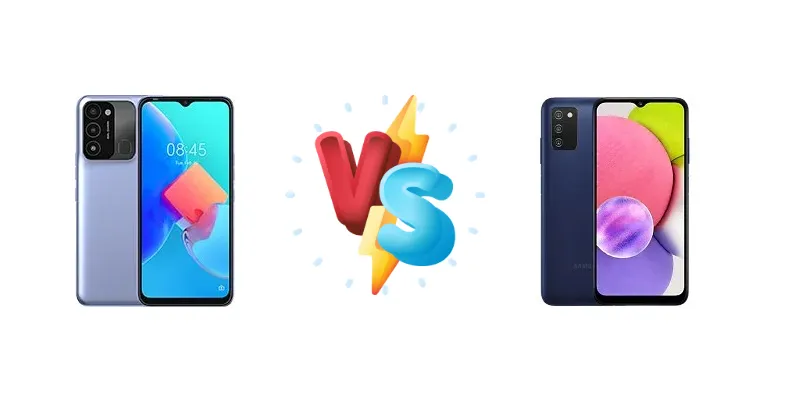
The budget smartphone market is fiercely competitive, offering incredible value for money. Today, we're pitting two contenders against each other: the Tecno Spark 8C and the Samsung Galaxy A03s. Both promise affordability, but which one delivers the better overall experience?
🏆 Quick Verdict
The Samsung Galaxy A03s edges out the Tecno Spark 8C thanks to its slightly better display brightness and Samsung's brand reputation. While the Spark 8C has a marginally faster chipset, the A03s' overall package provides a more polished and reliable user experience for most users.
| Network |
|---|
| 2G bands | GSM 850 / 900 / 1800 / 1900 | GSM 850 / 900 / 1800 / 1900 |
| 3G bands | HSDPA 850 / 900 / 2100 | HSDPA 850 / 900 / 2100 |
| 4G bands | LTE | 1, 3, 5, 7, 8, 20, 28, 38, 40, 41 |
| Speed | HSPA 21.1/5.76 Mbps, LTE | HSPA 42.2/5.76 Mbps, LTE Cat4 150/50 Mbps |
| Technology | GSM / HSPA / LTE | GSM / HSPA / LTE |
| | - | 2, 4, 5, 7, 12, 13, 14, 25, 26, 41, 66, 71 - SM-A037U |
| Launch |
|---|
| Announced | 2022, January 31 | 2021, August 18 |
| Status | Available. Released 2022, February | Available. Released 2021, August 18 |
| Body |
|---|
| Build | Glass front, plastic frame, plastic back | Glass front, plastic frame, plastic back |
| Dimensions | 164.6 x 76 x 9 mm (6.48 x 2.99 x 0.35 in) | 164.2 x 75.9 x 9.1 mm (6.46 x 2.99 x 0.36 in) |
| SIM | Nano-SIM + Nano-SIM | Nano-SIM + Nano-SIM |
| Weight | - | 196 g (6.91 oz) |
| Display |
|---|
| Resolution | 720 x 1612 pixels, 20:9 ratio (~267 ppi density) | 720 x 1600 pixels, 20:9 ratio (~270 ppi density) |
| Size | 6.6 inches, 104.6 cm2 (~83.7% screen-to-body ratio) | 6.5 inches, 102.0 cm2 (~81.8% screen-to-body ratio) |
| Type | IPS LCD, 90Hz | PLS LCD |
| Platform |
|---|
| CPU | Octa-core (2x1.6 GHz Cortex-A75 & 6x1.6 GHz Cortex-A55) | Octa-core (4x2.35 GHz Cortex-A53 & 4x1.8 GHz Cortex-A53) |
| Chipset | Unisoc T606 (12 nm) | Mediatek MT6765 Helio P35 (12 nm) |
| GPU | Mali-G57 MP1 | PowerVR GE8320 |
| OS | Android 11 (Go edition), HiOS 7.6 | Android 11, upgradable to Android 13, One UI 5.1 Core |
| Memory |
|---|
| Card slot | microSDXC | microSDXC (dedicated slot) |
| Internal | 64GB 2GB RAM, 64GB 3GB RAM, 64GB 4GB RAM | 32GB 2GB RAM, 32GB 3GB RAM, 32GB 4GB RAM, 64GB 3GB RAM, 64GB 4GB RAM |
| | eMMC 5.1 | eMMC 5.1 |
| Main Camera |
|---|
| Dual | 13 MP, f/1.8, 27mm (wide)
Auxiliary lens | - |
| Features | Dual-LED lash, HDR | LED flash |
| Single | 8 MP | 5 MP, f/2.2 |
| Triple | - | 13 MP, f/2.2, (wide), AF
2 MP (macro)
Auxiliary lens |
| Video | 1080p@30fps | 1080p@30fps |
| Selfie camera |
|---|
| Features | LED flash | - |
| Single | 8 MP | 5 MP, f/2.2 |
| Video | - | 1080p@30fps |
| Sound |
|---|
| 3.5mm jack | Yes | Yes |
| 35mm jack | Yes | Yes |
| Loudspeaker | Yes | Yes |
| Comms |
|---|
| Bluetooth | Yes | 5.0, A2DP |
| NFC | Yes (market/region dependent) | Yes (market/region dependent) |
| Positioning | GPS | GPS, GLONASS, GALILEO, BDS |
| Radio | FM radio | No |
| USB | microUSB 2.0, OTG | USB Type-C 2.0 |
| WLAN | Yes | Wi-Fi 802.11 b/g/n, Wi-Fi Direct |
| Features |
|---|
| Sensors | Fingerprint (rear-mounted), accelerometer, proximity | Fingerprint (side-mounted), accelerometer, proximity |
| Battery |
|---|
| Charging | - | 15W wired |
| Type | 5000 mAh | Li-Po 5000 mAh |
| Misc |
|---|
| Colors | Turquoise, Magnet Black, Iris Purple, Diamond Gray | Black, Blue, White |
| Models | KG5k, KG5j, KG5n, MZ-TECNO KG5k | SM-A037F, SM-A037F/DS, SM-A037M, SM-A037G, SM-A037U, SM-S134DL, SM-A037W, SM-A037U1, SM-S135DL |
| Price | - | $ 65.65 / £ 82.99 / ₹ 10,800 |
| SAR EU | - | 0.36 W/kg (head) 1.09 W/kg (body) |
| Tests |
|---|
| Battery life | - |
Endurance rating 122h
|
| Camera | - |
Photo / Video |
| Display | - |
Contrast ratio: 1718:1 (nominal) |
| Loudspeaker | - |
-27.4 LUFS (Good)
|
| Performance | - |
AnTuTu: 103465 (v8), 101299 (v9)
GeekBench: 889 (v5.1)
GFXBench: 5.5fps (ES 3.1 onscreen) |
Tecno Spark 8C
- Slightly faster chipset
- Larger RAM options available
- Aggressive pricing
- Lower display brightness
- Less refined software
- Brand reputation less established
Samsung Galaxy A03s
- Brighter display
- Samsung's One UI software
- Reliable brand reputation
- 15W charging
- Slightly slower chipset
- Potentially less RAM for the price
- Design can be bland
Display Comparison
Both phones feature large 6.5-inch displays, but the Galaxy A03s boasts a measured peak brightness of 488 nits, offering better visibility in sunlight compared to the Spark 8C's likely lower brightness. Both have a 1718:1 contrast ratio, suggesting decent blacks, but the A03s' brightness advantage is noticeable.
Camera Comparison
Camera performance is generally comparable on both devices, with both offering a primary camera around 13MP. Image quality will depend heavily on lighting conditions and software processing. Samsung's image processing is generally considered more consistent and pleasing to the eye.
Performance
The Tecno Spark 8C's Unisoc T606 chipset with Cortex-A75 cores offers a slight edge in raw processing power compared to the Galaxy A03s' Helio P35. However, real-world performance differences will be minimal for everyday tasks. The A03s' software optimization might provide a smoother experience despite the slightly less powerful chipset.
Battery Life
Both phones offer excellent battery life, with the Galaxy A03s achieving an endurance rating of 122 hours. The Tecno Spark 8C is expected to perform similarly well. Both devices will easily last a full day of moderate use.
Buying Guide
The Tecno Spark 8C is a good choice for users prioritizing raw processing power on a tight budget, particularly for light gaming. The Samsung Galaxy A03s is ideal for those seeking a reliable, user-friendly phone with a decent display and a trusted brand name, prioritizing everyday use and media consumption.
Frequently Asked Questions
❓ Which phone is better for gaming?
The Tecno Spark 8C has a slightly more powerful chipset, which *could* translate to slightly better gaming performance, but both are entry-level phones and won't handle demanding games smoothly.
❓ Is the Samsung Galaxy A03s worth the extra money?
For most users, yes. The brighter display, Samsung's software, and brand reputation make it a more polished and reliable experience, justifying the slight price premium.