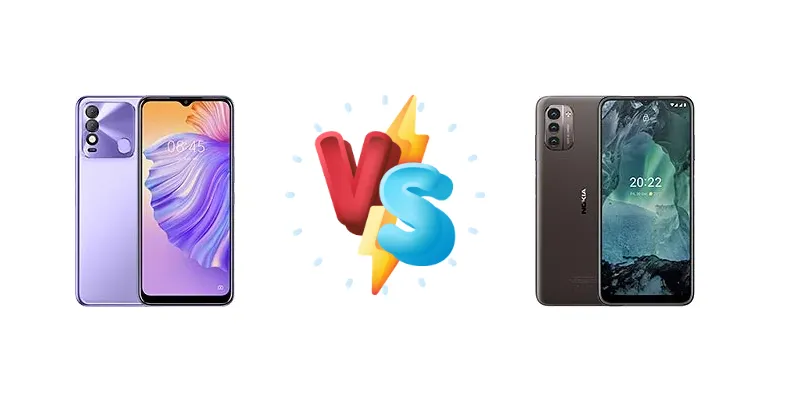
The sub-$150 smartphone market is fiercely competitive, demanding compromises. Both the Tecno Spark 8 and Nokia G21 aim to deliver essential features at an accessible price point. However, they take different approaches: the Spark 8 prioritizes a lower entry cost, while the G21 focuses on extended battery life and faster charging. This comparison will dissect their key specifications to determine which device best suits your needs.
🏆 Quick Verdict
For the average user prioritizing longevity and convenience, the Nokia G21 emerges as the better choice. Its 18W PD3.0 charging and comparable battery endurance, coupled with a more modern CPU architecture, outweigh the Spark 8’s slightly lower initial price. However, the Spark 8 remains a viable option for those on the absolute tightest budget.
| Network |
|---|
| 2G bands | GSM 850 / 900 / 1800 / 1900 | GSM 850 / 900 / 1800 / 1900 |
| 3G bands | HSDPA 850 / 900 / 2100 | HSDPA 850 / 900 / 2100 - International |
| 4G bands | LTE | 1, 3, 5, 7, 8, 20, 28, 38, 40, 41 - International |
| Speed | HSPA 42.2/5.76 Mbps, LTE Cat4 150/50 Mbps | HSPA 42.2/5.76 Mbps, LTE Cat4 150/50 Mbps |
| Technology | GSM / HSPA / LTE | GSM / HSPA / LTE |
| | - | 1, 2, 3, 4, 5, 7, 8, 12, 17, 28, 40, 66 - LATAM |
| Launch |
|---|
| Announced | 2021, September 02 | 2022, February 14 |
| Status | Available. Released 2021, September 02 | Available. Released 2022, February 15 |
| Body |
|---|
| Build | Glass front, plastic frame, plastic back | Glass front, plastic frame, plastic back |
| Dimensions | 164.8 x 76.1 x 9.2 mm (6.49 x 3.00 x 0.36 in) | 164.6 x 75.9 x 8.5 mm (6.48 x 2.99 x 0.33 in) |
| SIM | Nano-SIM + Nano-SIM | · Nano-SIM· Nano-SIM + Nano-SIM |
| Weight | 200 g (7.05 oz) | 190 g (6.70 oz) |
| Display |
|---|
| Resolution | 720 x 1600 pixels, 20:9 ratio (~269 ppi density) | 720 x 1600 pixels, 20:9 ratio (~270 ppi density) |
| Size | 6.52 inches, 102.6 cm2 (~81.8% screen-to-body ratio) | 6.5 inches, 102.0 cm2 (~81.6% screen-to-body ratio) |
| Type | IPS LCD, 480 nits (typ) | IPS LCD, 90Hz, 400 nits (typ) |
| Platform |
|---|
| CPU | Octa-core 2.0 GHz Cortex-A53 | Octa-core (2x1.6 GHz Cortex-A75 & 6x1.6 GHz Cortex-A55) |
| Chipset | Mediatek MT6762 Helio P22 (12 nm) | Unisoc T606 (12 nm) |
| GPU | PowerVR GE8320 | Mali-G57 MP1 |
| OS | Android 11 (Go edition), HIOS 7.6 | Android 11, upgradable to Android 13 |
| Memory |
|---|
| Card slot | microSDXC | microSDXC (dedicated slot) |
| Internal | 32GB 3GB RAM, 64GB 2GB RAM, 64GB 4GB RAM | 64GB 3GB RAM, 64GB 4GB RAM, 128GB 4GB RAM, 128GB 6GB RAM |
| | eMMC 5.1 | eMMC 5.1 |
| Main Camera |
|---|
| Dual | 16 MP, f/1.8, 27mm (wide), AF
Secondary unknown camera | - |
| Features | Quad-LED flash | LED flash, HDR, panorama |
| Single | 8 MP, f/2.0, 26mm (wide) | 8 MP, f/2.0, (wide) |
| Triple | - | 50 MP, f/1.8, 28mm (wide), 1/2.76", 0.64µm, PDAF
2 MP (macro)
Auxiliary lens |
| Video | 1080p@30fps | 1080p@30fps |
| Selfie camera |
|---|
| Features | Dual-LED flash | - |
| Single | 8 MP, f/2.0, 26mm (wide) | 8 MP, f/2.0, (wide) |
| Video | 1080p@30fps | 1080p@30fps |
| Sound |
|---|
| 3.5mm jack | Yes | Yes |
| 35mm jack | Yes | Yes |
| Loudspeaker | Yes | Yes |
| Comms |
|---|
| Bluetooth | Yes | 5.0, A2DP, LE |
| NFC | No | Yes (market/region dependent) |
| Positioning | GPS | GPS, GLONASS, GALILEO |
| Radio | FM radio | FM radio, RDS |
| USB | microUSB 2.0, OTG | USB Type-C 2.0, OTG |
| WLAN | Yes | Wi-Fi 802.11 a/b/g/n/ac, dual-band, Wi-Fi Direct |
| Features |
|---|
| Sensors | Fingerprint (rear-mounted), accelerometer, proximity | Fingerprint (side-mounted), accelerometer, proximity |
| Battery |
|---|
| Charging | 10W wired | 18W wired, PD3.0 |
| Type | 5000 mAh | Li-Po 5050 mAh |
| Misc |
|---|
| Colors | Turquoise Cyan, Atlantic Blue, Iris Purple | Nordic Blue, Dusk |
| Models | KG6, KG6k, MZ-TECNO KG6k | TA-1418, TA-1477, TA-1415, TA-1405, TA-1404, TA-1412 |
| Price | About 90 EUR | About 90 EUR |
| SAR | - | 1.00 W/kg (head) 1.10 W/kg (body) |
| SAR EU | - | 0.34 W/kg (head) 1.05 W/kg (body) |
| Tests |
|---|
| Battery life | - |
Endurance rating 126h
|
| Camera | - |
Photo / Video |
| Display | - |
Contrast ratio: 1631:1 (nominal) |
| Loudspeaker | - |
-30.7 LUFS (Below average)
|
| Performance | - |
AnTuTu: 171299 (v9)
GeekBench: 1193 (v5.1)
GFXBench: 8.9fps (ES 3.1 onscreen) |
Tecno Spark 8
- Lowest possible price point
- Acceptable battery life for basic use
- Functional for essential smartphone tasks
- Outdated Helio P22 chipset
- Slow 10W charging
- Likely struggles with multitasking
Nokia G21
- More powerful Unisoc T606 chipset
- Faster 18W PD3.0 charging
- Comparable battery endurance
- Slightly higher price than the Spark 8
- Camera performance likely limited by sensor
- Still not a high-performance device
Display Comparison
Both the Tecno Spark 8 and Nokia G21 share a contrast ratio of 1631:1, suggesting similar panel characteristics in terms of black levels. However, the Nokia G21 boasts a measured peak brightness of 500 nits, a significant advantage over what is likely a lower brightness output on the Spark 8. While neither display is expected to be color-accurate for professional work, the G21’s higher brightness will improve outdoor visibility. Bezels are likely comparable given the price bracket, and neither phone is expected to feature high refresh rate panels.
Camera Comparison
Both phones feature 'Photo / Video' capabilities, but detailed camera specifications are lacking. Given the price point, image quality will be heavily reliant on software processing. It’s safe to assume both phones will struggle in low-light conditions. Without sensor size or aperture information, it’s difficult to make a definitive judgment. However, the Nokia G21’s more powerful processor may allow for more sophisticated image processing algorithms, potentially resulting in slightly better photos. The presence of a 2MP macro camera on either device is largely a marketing gimmick and should not be a deciding factor.
Performance
The Nokia G21’s Unisoc T606 chipset represents a generational leap over the Tecno Spark 8’s MediaTek Helio P22. The T606 utilizes a combination of Cortex-A75 and Cortex-A55 cores, offering significantly improved single-core and multi-core performance compared to the Spark 8’s all-Cortex-A53 configuration. While both are 12nm chips, the architectural improvements in the T606 translate to a smoother user experience, especially when multitasking or running demanding applications. The Spark 8 will likely struggle with heavier tasks, exhibiting noticeable lag. Neither phone is a gaming powerhouse, but the G21 will handle less demanding titles more comfortably.
Battery Life
Both the Tecno Spark 8 and Nokia G21 achieve an endurance rating of 126 hours, indicating comparable battery life under similar usage conditions. However, the Nokia G21’s 18W wired charging with PD3.0 support is a substantial advantage over the Spark 8’s slow 10W charging. This means the G21 can be topped up much faster, minimizing downtime. While both phones will likely last a full day on a single charge for moderate users, the G21’s faster charging provides greater convenience and reduces range anxiety.
Buying Guide
Buy the Tecno Spark 8 if you need a functional smartphone for basic tasks – calls, texts, and light social media – and are constrained by the absolute lowest possible price. You’ll be making compromises on performance and charging speed. Buy the Nokia G21 if you prefer a phone that can last a full day on a single charge, charges significantly faster, and offers a slightly more responsive user experience, even if it means spending a little more upfront.
Frequently Asked Questions
❓ Is the Unisoc T606 in the Nokia G21 capable of running popular apps like WhatsApp and Facebook smoothly?
Yes, the Unisoc T606 is more than capable of handling everyday apps like WhatsApp and Facebook without significant lag. Its Cortex-A75 cores provide a noticeable performance boost over the older Helio P22 in the Tecno Spark 8, ensuring a smoother user experience for common tasks.
❓ How long does it realistically take to fully charge the Nokia G21 from 0% to 100%?
With its 18W PD3.0 charging, the Nokia G21 should fully charge from 0% to 100% in approximately 2.5 to 3 hours, depending on the charger used. This is significantly faster than the Tecno Spark 8, which could take upwards of 5-6 hours with its 10W charging.
❓ Will the Tecno Spark 8 struggle with video playback, particularly on platforms like YouTube?
The Tecno Spark 8’s Helio P22 chipset may exhibit some stuttering or lag when playing high-resolution videos on YouTube. While it can handle standard definition content, smoother playback of 720p or 1080p videos is not guaranteed. The Nokia G21, with its more powerful processor, will provide a more consistent video playback experience.