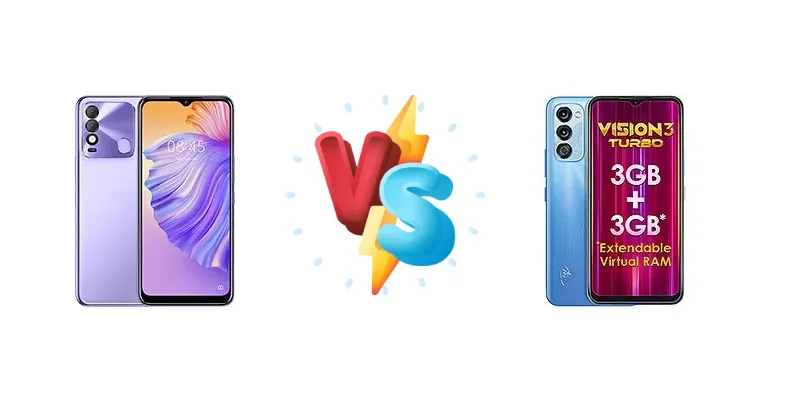
The sub-$150 smartphone market is fiercely competitive. Both the Tecno Spark 8 and the itel Vision 3 Turbo aim to deliver essential smartphone functionality at an incredibly affordable price. However, they take different approaches to achieving this, with the Spark 8 relying on a more established, albeit older, Mediatek chipset, while the Vision 3 Turbo opts for a Unisoc solution and faster charging. This comparison will dissect the key differences to determine which device offers the best value.
🏆 Quick Verdict
For the average user prioritizing faster charging and potentially smoother multitasking, the itel Vision 3 Turbo emerges as the better choice. While the Tecno Spark 8 benefits from the slightly more mature Mediatek Helio P22 platform, the Vision 3 Turbo’s 18W charging and newer Cortex-A55 cores offer a more compelling overall experience.
| Network |
|---|
| 2G bands | GSM 850 / 900 / 1800 / 1900 | GSM 850 / 900 / 1800 / 1900 |
| 3G bands | HSDPA 850 / 900 / 2100 | HSDPA 850 / 900 / 2100 |
| 4G bands | LTE | LTE |
| Speed | HSPA 42.2/5.76 Mbps, LTE Cat4 150/50 Mbps | HSPA, LTE |
| Technology | GSM / HSPA / LTE | GSM / HSPA / LTE |
| Launch |
|---|
| Announced | 2021, September 02 | 2022 |
| Status | Available. Released 2021, September 02 | Available. Released 2022 |
| Body |
|---|
| Build | Glass front, plastic frame, plastic back | - |
| Dimensions | 164.8 x 76.1 x 9.2 mm (6.49 x 3.00 x 0.36 in) | - |
| SIM | Nano-SIM + Nano-SIM | Dual SIM |
| Weight | 200 g (7.05 oz) | - |
| Display |
|---|
| Resolution | 720 x 1600 pixels, 20:9 ratio (~269 ppi density) | 720 x 1600 pixels, 20:9 ratio (~266 ppi density) |
| Size | 6.52 inches, 102.6 cm2 (~81.8% screen-to-body ratio) | 6.6 inches, 105.2 cm2 |
| Type | IPS LCD, 480 nits (typ) | IPS LCD |
| Platform |
|---|
| CPU | Octa-core 2.0 GHz Cortex-A53 | Octa-core (4x1.6 GHz Cortex-A55 & 4x1.2 GHz Cortex-A55) |
| Chipset | Mediatek MT6762 Helio P22 (12 nm) | Unisoc SC9863A (28 nm) |
| GPU | PowerVR GE8320 | IMG8322 |
| OS | Android 11 (Go edition), HIOS 7.6 | Android 11 (Go edition) |
| Memory |
|---|
| Card slot | microSDXC | microSDXC |
| Internal | 32GB 3GB RAM, 64GB 2GB RAM, 64GB 4GB RAM | 64GB 3GB RAM |
| | eMMC 5.1 | - |
| Main Camera |
|---|
| Dual | 16 MP, f/1.8, 27mm (wide), AF
Secondary unknown camera | - |
| Features | Quad-LED flash | LED flash |
| Single | 8 MP, f/2.0, 26mm (wide) | 8 MP (wide)
Auxiliary lens |
| Video | 1080p@30fps | 1080p@30fps |
| Selfie camera |
|---|
| Features | Dual-LED flash | - |
| Single | 8 MP, f/2.0, 26mm (wide) | 5 MP |
| Video | 1080p@30fps | Yes |
| Sound |
|---|
| 3.5mm jack | Yes | - |
| 35mm jack | Yes | Yes |
| Loudspeaker | Yes | Yes |
| Comms |
|---|
| Bluetooth | Yes | Yes |
| NFC | No | No |
| Positioning | GPS | GPS |
| Radio | FM radio | Unspecified |
| USB | microUSB 2.0, OTG | microUSB |
| WLAN | Yes | Yes |
| Features |
|---|
| Sensors | Fingerprint (rear-mounted), accelerometer, proximity | Fingerprint (rear-mounted), accelerometer |
| Battery |
|---|
| Charging | 10W wired | 18W wired |
| Type | 5000 mAh | 5000 mAh |
| Misc |
|---|
| Colors | Turquoise Cyan, Atlantic Blue, Iris Purple | Blue |
| Models | KG6, KG6k, MZ-TECNO KG6k | - |
| Price | About 90 EUR | - |
Tecno Spark 8
- Proven Mediatek Helio P22 chipset
- Established software ecosystem (potentially)
- Generally reliable performance for basic tasks
- Slower 10W charging
- Older Cortex-A53 CPU architecture
- Less efficient 12nm process compared to modern chips
itel Vision 3 Turbo
- Faster 18W wired charging
- More modern Cortex-A55 CPU cores
- Potentially smoother multitasking experience
- Less efficient 28nm Unisoc SC9863A process
- Unisoc chipset may have limited software support
- Potential for thermal throttling under heavy load
Display Comparison
Neither Tecno nor itel provide detailed display specifications beyond the basic panel size. However, given the price point, both likely utilize LCD panels. The key difference lies in the underlying processing power impacting UI smoothness. While display quality is likely similar, the itel Vision 3 Turbo’s newer CPU cores *may* contribute to slightly smoother scrolling and animations, though this is heavily dependent on software optimization.
Camera Comparison
Both devices likely feature basic camera setups geared towards casual photography. Without detailed sensor information, it’s difficult to make a definitive judgment. However, the focus should be on the main sensor’s capabilities, as auxiliary lenses (often 2MP macro lenses) typically offer limited real-world benefit. Given the price bracket, image processing will likely be similar, relying heavily on software algorithms to enhance image quality. Expect acceptable results in good lighting conditions, but struggles in low-light scenarios.
Performance
The core battleground is the chipset. The Tecno Spark 8’s Mediatek Helio P22 (12nm) features an octa-core CPU with Cortex-A53 cores clocked at 2.0 GHz. This is a mature architecture, but the 12nm process offers reasonable efficiency. The itel Vision 3 Turbo, however, utilizes the Unisoc SC9863A (28nm). While also an octa-core CPU, it employs a mixed cluster of four Cortex-A55 cores at 1.6 GHz and four at 1.2 GHz. The Cortex-A55 is a more modern architecture than the A53, offering improved performance per clock cycle. However, the 28nm process is significantly less efficient, potentially leading to higher power consumption and thermal throttling under sustained load. The itel's newer cores *should* provide a better multitasking experience, but the older process node is a significant drawback.
Battery Life
The itel Vision 3 Turbo’s 18W wired charging is a clear advantage over the Tecno Spark 8’s 10W charging. While neither phone boasts a massive battery capacity (specifics are unavailable), the faster charging speed significantly reduces downtime. A full charge on the Vision 3 Turbo will be considerably quicker, making it more convenient for users who need to quickly replenish their battery. The less efficient Unisoc chip *may* offset some of this advantage, but the charging speed difference remains substantial.
Buying Guide
Buy the Tecno Spark 8 if you prioritize a proven chipset architecture and are less concerned with rapid charging. It's a solid option for users who primarily need a phone for basic communication and light app usage. Buy the itel Vision 3 Turbo if you value faster charging speeds and a more modern CPU core design, even if it comes with a less efficient manufacturing process. This phone is ideal for users who frequently find themselves needing to top up their battery quickly and engage in moderate multitasking.
Frequently Asked Questions
❓ Will the Unisoc SC9863A in the itel Vision 3 Turbo struggle with demanding apps like PUBG Mobile?
The Unisoc SC9863A is an entry-level chipset. While it can handle less demanding games, PUBG Mobile may require significantly reduced graphics settings and frame rates for a playable experience. Expect occasional stuttering and frame drops, especially during intense action sequences. The Tecno Spark 8's Helio P22 might offer a slightly more stable, though still limited, gaming experience.
❓ How much faster is the 18W charging on the itel Vision 3 Turbo compared to the Tecno Spark 8's 10W charging in real-world use?
The 18W charging on the itel Vision 3 Turbo can realistically reduce charging times by 40-60% compared to the Tecno Spark 8's 10W charging. A full charge from 0% to 100% on the Vision 3 Turbo could take around 2-3 hours, while the Spark 8 might require 4-5 hours. This difference is particularly noticeable for quick top-ups.
❓ Is the 28nm process of the Unisoc SC9863A a major concern for battery life on the itel Vision 3 Turbo?
Yes, the 28nm process is less efficient than the 12nm process used in the Tecno Spark 8's Helio P22. This means the itel Vision 3 Turbo will likely consume more power for the same tasks, potentially resulting in shorter battery life. However, the faster charging can mitigate this concern for many users.