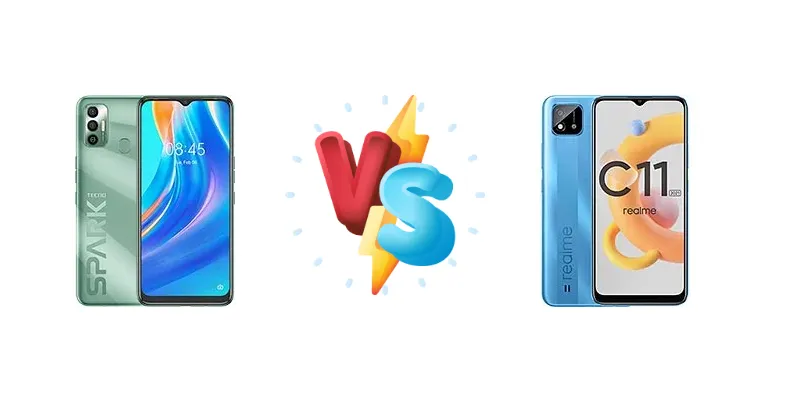
The Tecno Spark 7 and Realme C11 (2021) represent the fiercely competitive sub-$150 smartphone market. Both aim to deliver essential smartphone functionality at an accessible price point, but they take different approaches to achieving this. The key differentiator lies in their chipsets, impacting performance, efficiency, and overall user experience. This comparison dissects these differences to determine which device offers the best value.
🏆 Quick Verdict
For the average user prioritizing sustained performance and efficiency, the Tecno Spark 7 is the better choice. Its Mediatek Helio A25, built on a 12nm process, offers a noticeable advantage over the Realme C11 (2021)'s 28nm Unisoc SC9863A, translating to smoother multitasking and less thermal throttling during extended use.
| Network |
|---|
| 2G bands | GSM 850 / 900 / 1800 / 1900 | GSM 850 / 900 / 1800 / 1900 |
| 3G bands | HSDPA 850 / 900 / 2100 | HSDPA 850 / 900 / 1900 / 2100 |
| 4G bands | LTE | 1, 3, 5, 8, 38, 40, 41 |
| Speed | HSPA 42.2/5.76 Mbps, LTE Cat4 150/50 Mbps | HSPA, LTE |
| Technology | GSM / HSPA / LTE | GSM / HSPA / LTE |
| Launch |
|---|
| Announced | 2021, April 09 | 2021, June 28 |
| Status | Available. Released 2021, April 16 | Available. Released 2021, June 28 |
| Body |
|---|
| Build | - | Glass front, plastic frame, plastic back |
| Dimensions | 164.8 x 76.1 x 9.5 mm (6.49 x 3.00 x 0.37 in) | 165.2 x 76.4 x 8.9 mm (6.50 x 3.01 x 0.35 in) |
| SIM | Nano-SIM + Nano-SIM | Nano-SIM + Nano-SIM |
| Weight | - | 190 g (6.70 oz) |
| | - | Splash resistant design |
| Display |
|---|
| Resolution | 720 x 1600 pixels, 20:9 ratio (~270 ppi density) | 720 x 1600 pixels, 20:9 ratio (~269 ppi density) |
| Size | 6.5 inches, 102.0 cm2 (~81.3% screen-to-body ratio) | 6.52 inches, 102.6 cm2 (~81.3% screen-to-body ratio) |
| Type | IPS LCD | IPS LCD, 400 nits (typ) |
| Platform |
|---|
| CPU | Octa-core (4x1.8 GHz Cortex-A53 & 4x1.5 GHz Cortex-A53) | Octa-core (4x1.6 GHz Cortex-A55 & 4x1.2 GHz Cortex-A55) |
| Chipset | Mediatek MT6762D Helio A25 (12 nm) | Unisoc SC9863A (28 nm) |
| GPU | PowerVR GE8320 | IMG8322 |
| OS | Android 11, HIOS 7.5 | Android 11, Realme Go UI |
| Memory |
|---|
| Card slot | microSDXC (dedicated slot) | microSDXC (dedicated slot) |
| Internal | 32GB 2GB RAM, 64GB 3GB RAM, 64GB 4GB RAM | 32GB 2GB RAM, 64GB 4GB RAM |
| | eMMC 5.1 | eMMC 5.1 |
| Main Camera |
|---|
| Dual | 16 MP, AF
Secondary unknown camera | - |
| Features | Quad-LED flash | LED flash, HDR, panorama |
| Single | 8 MP | 8 MP, f/2.0, (wide), AF |
| Video | 1080p@30fps | 1080p@30fps |
| Selfie camera |
|---|
| Features | Dual-LED flash | HDR, panorama |
| Single | 8 MP | 5 MP, f/2.2, (wide) |
| Video | 1080p@30fps | 1080p@30fps |
| Sound |
|---|
| 3.5mm jack | Yes | Yes |
| 35mm jack | Yes | Yes |
| Loudspeaker | Yes | Yes |
| Comms |
|---|
| Bluetooth | Yes | 4.2, A2DP |
| NFC | No | No |
| Positioning | GPS | GPS, GLONASS, GALILEO, BDS |
| Radio | FM radio | Unspecified |
| USB | microUSB 2.0, OTG | microUSB 2.0, OTG |
| WLAN | Wi-Fi 802.11 b/g/n | Wi-Fi 802.11 b/g/n |
| Features |
|---|
| Sensors | Fingerprint (rear-mounted), accelerometer, proximity | Accelerometer, gyro, proximity, compass |
| Battery |
|---|
| Charging | - | 10W wired
Reverse wired |
| Type | Market-dependent versions:· 6000 mAh (Global)· 5000 mAh (Africa only) | 5000 mAh |
| Misc |
|---|
| Colors | Morpheus Blue, Spruce Green, Magnet Black | Cool Blue, Cool Grey |
| Models | KF6, KF6j, KF6i, KF6k, PR651h, PR651, PR651E, KF6m, KF6h, KF6n | RMX3231 |
| Price | About 90 EUR | About 80 EUR |
Tecno Spark 7
- More efficient processor (Helio A25)
- Potentially better sustained performance
- Likely better thermal management
- Lacks reverse wired charging
- Limited camera details available
Realme C11 (2021)
- Reverse wired charging capability
- Potentially lower price point
- More modern Cortex-A55 cores
- Less efficient processor (Unisoc SC9863A)
- Likely more thermal throttling
- Larger manufacturing process (28nm)
Display Comparison
Neither device boasts a standout display. Both likely feature basic IPS LCD panels with 720p+ resolution, typical for this price bracket. However, details like peak brightness and color accuracy are unavailable. The Realme C11 (2021) doesn't specify any display protection, while Tecno often includes basic scratch resistance. The lack of higher refresh rates or advanced panel technologies like LTPO is expected at this price point.
Camera Comparison
Both phones likely feature modest camera setups. Details are scarce, but both will likely include a primary sensor and multiple auxiliary lenses (often 2MP macro/depth sensors of limited utility). Without specific sensor size or aperture information, it’s difficult to declare a clear winner. Image processing will play a significant role, and brand-specific tuning will likely be the deciding factor. Expect acceptable results in good lighting conditions, but struggles in low-light scenarios on both devices.
Performance
The core difference lies in the chipsets. The Tecno Spark 7’s Mediatek Helio A25 (12nm) utilizes a more modern architecture (Cortex-A53) and a smaller manufacturing process compared to the Realme C11 (2021)’s Unisoc SC9863A (28nm). The 12nm process inherently leads to better power efficiency and reduced heat generation. While both are octa-core CPUs, the Helio A25’s clock speeds (1.8GHz & 1.5GHz) are slightly higher than the SC9863A’s (1.6GHz & 1.2GHz), suggesting a performance edge. The Unisoc chip's larger node size will likely result in more noticeable throttling under sustained load, impacting gaming and multitasking. The Realme C11's CPU uses Cortex-A55 cores, which are more efficient than the A53, but the larger process node negates much of that benefit.
Battery Life
Battery capacity is not specified for either device, but both likely fall in the 5000mAh range, common for budget smartphones. The Realme C11 (2021) offers 10W wired charging and, crucially, reverse wired charging – allowing it to act as a power bank for other devices. The Tecno Spark 7 lacks reverse charging. However, the Helio A25’s superior efficiency may translate to longer real-world battery life despite potentially having a similar capacity battery, as it draws less power during typical usage.
Buying Guide
Buy the Tecno Spark 7 if you need a phone capable of handling moderate multitasking, light gaming, and everyday tasks with reasonable responsiveness. Its more efficient processor will also contribute to better battery life during prolonged use. Buy the Realme C11 (2021) if your primary needs are extremely basic – calls, texts, and occasional social media – and you prioritize the convenience of reverse wired charging, a feature absent on the Spark 7.
Frequently Asked Questions
❓ Will the Unisoc SC9863A in the Realme C11 (2021) struggle with popular apps like Facebook or WhatsApp?
While the Unisoc SC9863A can handle basic apps like Facebook and WhatsApp, its 28nm process and lower clock speeds may result in noticeable lag when multitasking or using these apps for extended periods. The Tecno Spark 7’s Helio A25 is better equipped to handle these scenarios smoothly.
❓ Does the Tecno Spark 7 support any form of fast charging?
No, the Tecno Spark 7 does not specify any fast charging capabilities. It likely utilizes standard 5W or 10W charging. While slower than fast charging, it’s typical for phones in this price range. The Realme C11 (2021) also only supports 10W charging.
❓ Is the 2MP macro camera on either phone worth using?
Generally, 2MP macro cameras on budget smartphones offer limited practical benefit. Image quality is often poor, lacking detail and sharpness. They are primarily included for marketing purposes and are unlikely to significantly enhance your photography experience.
❓ Can the Realme C11 (2021) charge my wireless earbuds?
Yes, the Realme C11 (2021)'s reverse wired charging feature allows you to charge other devices, including wireless earbuds (using a USB cable), power banks, or even another smartphone, albeit at a slow 10W rate.