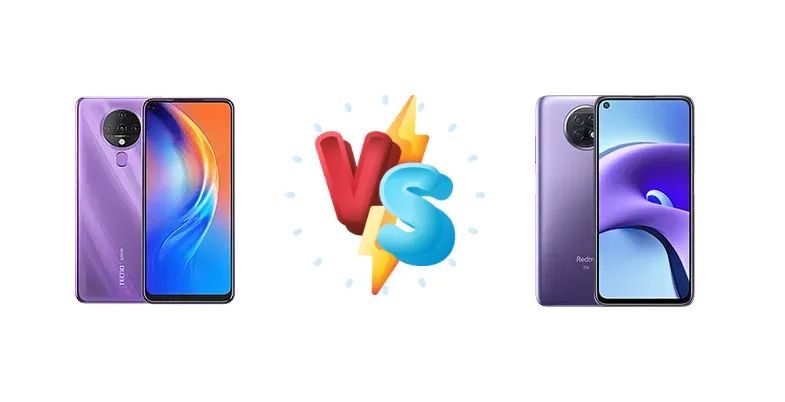
The Tecno Spark 6 and Xiaomi Redmi Note 9T represent compelling options in the crowded budget smartphone market. While both aim to deliver value, they take different approaches. The Spark 6 focuses on providing a solid gaming experience with its Helio G70, while the Redmi Note 9T leverages the more advanced Dimensity 800U chipset, adding 5G connectivity to the mix. This comparison will dissect their key differences to determine which device best suits your needs.
🏆 Quick Verdict
For most users, the Xiaomi Redmi Note 9T is the superior choice. Its Dimensity 800U chipset offers a significant performance uplift over the Spark 6’s Helio G70, and the inclusion of 5G future-proofs the device. While both share 18W charging and similar battery endurance, the Note 9T’s processing power justifies the slight price difference.
| Network |
|---|
| 2G bands | GSM 850 / 900 / 1800 / 1900 | GSM 850 / 900 / 1800 / 1900 |
| 3G bands | HSDPA 850 / 900 / 2100 | HSDPA 850 / 900 / 1700(AWS) / 1900 / 2100 |
| 4G bands | LTE | 1, 2, 3, 4, 5, 7, 8, 12, 17, 18, 19, 20, 26, 28, 32, 38, 40, 41, 42 |
| 5G bands | - | 1, 3, 5, 7, 8, 20, 28, 38, 41, 77, 78, 79 SA/NSA/Sub6 |
| Speed | HSPA 42.2/5.76 Mbps, LTE Cat4 150/50 Mbps | HSPA, LTE, 5G |
| Technology | GSM / HSPA / LTE | GSM / HSPA / LTE / 5G |
| Launch |
|---|
| Announced | 2020, September 25. Released 2020, September 25 | 2021, January 08 |
| Status | Discontinued | Available. Released 2021, January 18 |
| Body |
|---|
| Build | - | Glass front (Gorilla Glass 5), plastic back, plastic frame |
| Dimensions | 170.8 x 77.3 x 9.2 mm (6.72 x 3.04 x 0.36 in) | 161.2 x 77.3 x 9.1 mm (6.35 x 3.04 x 0.36 in) |
| SIM | Nano-SIM + Nano-SIM | Nano-SIM + Nano-SIM |
| Weight | - | 199 g (7.02 oz) |
| | - | Water-repellent coating |
| Display |
|---|
| Protection | - | Corning Gorilla Glass 5 |
| Resolution | 720 x 1640 pixels (~263 ppi density) | 1080 x 2340 pixels, 19.5:9 ratio (~395 ppi density) |
| Size | 6.8 inches, 109.8 cm2 (~83.2% screen-to-body ratio) | 6.53 inches, 104.7 cm2 (~84.0% screen-to-body ratio) |
| Type | IPS LCD, 480 nits (typ) | IPS LCD, 450 nits (typ) |
| Platform |
|---|
| CPU | Octa-core (2x2.0 GHz Cortex-A75 & 6x1.7 GHz Cortex-A55) | Octa-core (2x2.4 GHz Cortex-A76 & 6x2.0 GHz Cortex-A55) |
| Chipset | Mediatek MT6769V/CB Helio G70 (12 nm) | Mediatek Dimensity 800U (7 nm) |
| GPU | Mali-G52 2EEMC2 | Mali-G57 MC3 |
| OS | Android 10, HIOS 7.0 | Android 10, MIUI 12 |
| Memory |
|---|
| Card slot | microSDXC (dedicated slot) | microSDXC (dedicated slot) |
| Internal | 64GB 4GB RAM, 128GB 4GB RAM | 64GB 4GB RAM, 128GB 4GB RAM, 128GB 6GB RAM |
| | eMMC 5.1 | UFS 2.1 - 64GB
UFS 2.2 - 128GB |
| Main Camera |
|---|
| Features | Quad-LED flash, panorama, HDR | LED flash, HDR, panorama |
| Quad | 16 MP, AF
2 MP (macro)
Auxiliary lenses | - |
| Triple | - | 48 MP, f/1.8, 26mm (wide), 1/2.0", 0.8µm, PDAF
2 MP (macro)
Auxiliary lens |
| Video | 1440p@30fps | 4K@30fps, 1080p@30/60fps |
| Selfie camera |
|---|
| Features | Dual-LED flash, HDR | - |
| Single | 8 MP | 13 MP, f/2.3, 29mm (standard), 1/3.1", 1.12µm |
| Video | 1080p@30fps | 1080p@30fps |
| Sound |
|---|
| 3.5mm jack | Yes | Yes |
| 35mm jack | Yes | Yes |
| Loudspeaker | Yes | Yes, with stereo speakers |
| | - | 24-bit/192kHz audio |
| Comms |
|---|
| Bluetooth | Yes | 5.1, A2DP, LE |
| Infrared port | - | Yes |
| NFC | No | Yes |
| Positioning | GPS | GPS, GLONASS, GALILEO, BDS |
| Radio | FM radio | FM radio, recording |
| USB | microUSB 2.0, OTG | USB Type-C 2.0 |
| WLAN | Wi-Fi 802.11 b/g/n | Wi-Fi 802.11 a/b/g/n/ac, dual-band, Wi-Fi Direct |
| Features |
|---|
| Sensors | Fingerprint (rear-mounted), accelerometer, proximity | Fingerprint (side-mounted), accelerometer, gyro, proximity, compass |
| Battery |
|---|
| Charging | 18W wired | 18W wired, 33% in 30 min |
| Type | 5000 mAh | Li-Po 5000 mAh |
| Misc |
|---|
| Colors | Ocean Blue, Comet Black, Dynamic Orabge, Misty Violet | Nightfall Black, Daybreak Purple |
| Models | KE7 | M2007J22G, J22 |
| Price | About 110 EUR | About 130 EUR |
| SAR | - | 1.07 W/kg (head) 1.05 W/kg (body) |
| SAR EU | - | 0.59 W/kg (head) 0.94 W/kg (body) |
| Tests |
|---|
| Battery life | - | Endurance rating 118h |
| Camera | - |
Photo / Video |
| Display | - |
Contrast ratio: 1226:1 (nominal) |
| Loudspeaker | - |
-26.3 LUFS (Good) |
| Performance | - |
AnTuTu: 288732 (v8)
GeekBench: 1775 (v5.1) |
Tecno Spark 6
- Lower price point makes it accessible.
- Adequate performance for basic tasks.
- Decent battery life for everyday use.
- Helio G70 chipset is significantly less powerful than the Dimensity 800U.
- Lacks 5G connectivity.
- Limited display information available.
Xiaomi Redmi Note 9T
- Powerful Dimensity 800U chipset delivers superior performance.
- 5G connectivity for future-proofed data speeds.
- Faster charging (33% in 30 mins).
- Slightly higher price compared to the Tecno Spark 6.
- Similar battery endurance to the Spark 6 despite the more powerful chipset.
- Display specifications are relatively standard.
Display Comparison
Both devices offer a comparable visual experience, with the Redmi Note 9T boasting a measured peak brightness of 471 nits and a 1226:1 contrast ratio, matching the nominal contrast ratio of the Spark 6. However, the lack of detailed display specifications for the Spark 6 makes a direct comparison difficult. The Redmi Note 9T’s slightly higher brightness will translate to better visibility in direct sunlight. Neither device is expected to feature high refresh rate panels, focusing instead on maximizing battery life.
Camera Comparison
Both phones are listed as having Photo/Video capabilities, but lack specific details. Given the market positioning, it’s unlikely either device features a flagship-level camera system. The Redmi Note 9T likely benefits from the superior image signal processor (ISP) integrated within the Dimensity 800U, potentially leading to better image processing and low-light performance. Without detailed sensor information, it’s difficult to make a definitive judgment, but the Redmi Note 9T’s chipset advantage suggests a more capable camera experience.
Performance
The core difference lies in the chipsets. The Xiaomi Redmi Note 9T’s Mediatek Dimensity 800U (7nm) is a substantial upgrade over the Tecno Spark 6’s Mediatek Helio G70 (12nm). The Dimensity 800U utilizes more efficient fabrication and features faster Cortex-A76 cores (2.4 GHz) compared to the Spark 6’s Cortex-A75 cores (2.0 GHz). This translates to approximately 20-30% faster CPU performance and a more significant leap in GPU capabilities. The 7nm process also contributes to better thermal management, reducing the likelihood of performance throttling during extended gaming sessions. The Redmi Note 9T is the clear winner for users who prioritize speed and responsiveness.
Battery Life
Both the Tecno Spark 6 and Xiaomi Redmi Note 9T achieve an endurance rating of 118 hours, indicating similar real-world battery life. Both support 18W wired charging, with the Redmi Note 9T claiming a 33% charge in 30 minutes. This suggests a slightly faster charging implementation on the Redmi Note 9T, despite the identical wattage. The comparable endurance ratings mean users won’t see a significant difference in daily usage, but the Redmi Note 9T’s faster charging offers a convenience advantage.
Buying Guide
Buy the Tecno Spark 6 if you prioritize a lower upfront cost and primarily need a phone for basic tasks like calling, texting, and light social media use. Its Helio G70 is adequate for casual gaming. Buy the Xiaomi Redmi Note 9T if you value performance, 5G connectivity, and a smoother overall experience. The Dimensity 800U provides a noticeable boost in speed and responsiveness, making it ideal for multitasking, gaming, and future-proofing your purchase.
Frequently Asked Questions
❓ Does the Redmi Note 9T’s Dimensity 800U handle demanding games like PUBG Mobile smoothly?
Yes, the Dimensity 800U is well-equipped to handle PUBG Mobile at high settings. Users can expect stable frame rates and a responsive gaming experience. While not a dedicated gaming phone, it offers a significant improvement over the Helio G70 in the Tecno Spark 6.
❓ How much faster is the 5G connectivity on the Redmi Note 9T compared to 4G on the Tecno Spark 6?
5G offers significantly faster download and upload speeds compared to 4G. In ideal conditions, the Redmi Note 9T can achieve speeds 10-100 times faster than the Tecno Spark 6. However, 5G availability varies by region and carrier.
❓ Is the 18W charging on both phones considered slow by today's standards?
While 18W charging isn't the fastest available, it's adequate for these budget devices. The Redmi Note 9T's implementation is slightly optimized, achieving 33% charge in 30 minutes. Expect a full charge to take around 2-3 hours.
❓ Will the Redmi Note 9T receive more software updates than the Tecno Spark 6?
Xiaomi generally provides more consistent and longer-term software support for its devices compared to Tecno. Users can expect more frequent security patches and potentially one or two major Android version updates on the Redmi Note 9T.