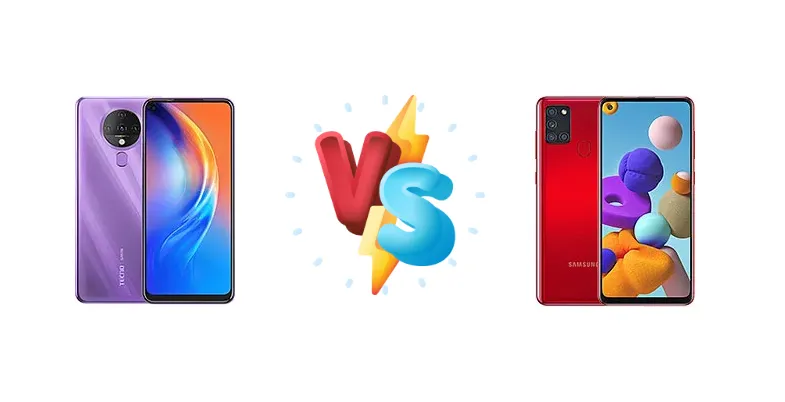
The Tecno Spark 6 and Samsung Galaxy A21s represent compelling options in the ultra-budget smartphone segment. Both aim to deliver essential features at a low price point, but they take different approaches to achieving this. The Spark 6 prioritizes gaming performance with its Helio G70 chipset, while the A21s focuses on a balanced experience with the Exynos 850 and a slightly more refined display.
🏆 Quick Verdict
For the average user prioritizing a smooth, all-around experience, the Samsung Galaxy A21s is the better choice. While the Tecno Spark 6 boasts a more powerful CPU core configuration, the Exynos 850’s 8nm process and optimized software deliver consistent performance and comparable battery life.
| Network |
|---|
| 2G bands | GSM 850 / 900 / 1800 / 1900 | GSM 850 / 900 / 1800 / 1900 |
| 3G bands | HSDPA 850 / 900 / 2100 | HSDPA 850 / 900 / 1900 / 2100 |
| 4G bands | LTE | 1, 2, 3, 5, 7, 8, 20, 28, 38, 40, 41 |
| Speed | HSPA 42.2/5.76 Mbps, LTE Cat4 150/50 Mbps | HSPA, LTE |
| Technology | GSM / HSPA / LTE | GSM / HSPA / LTE |
| Launch |
|---|
| Announced | 2020, September 25. Released 2020, September 25 | 2020, May 15. Released 2020, June 02 |
| Status | Discontinued | Discontinued |
| Body |
|---|
| Build | - | Glass front, plastic frame, plastic back |
| Dimensions | 170.8 x 77.3 x 9.2 mm (6.72 x 3.04 x 0.36 in) | 163.7 x 75.3 x 8.9 mm (6.44 x 2.96 x 0.35 in) |
| SIM | Nano-SIM + Nano-SIM | · Nano-SIM· Nano-SIM + Nano-SIM |
| Weight | - | 192 g (6.77 oz) |
| Display |
|---|
| Resolution | 720 x 1640 pixels (~263 ppi density) | 720 x 1600 pixels, 20:9 ratio (~270 ppi density) |
| Size | 6.8 inches, 109.8 cm2 (~83.2% screen-to-body ratio) | 6.5 inches, 102.0 cm2 (~82.8% screen-to-body ratio) |
| Type | IPS LCD, 480 nits (typ) | PLS LCD |
| Platform |
|---|
| CPU | Octa-core (2x2.0 GHz Cortex-A75 & 6x1.7 GHz Cortex-A55) | Octa-core (4x2.0 GHz Cortex-A55 & 4x2.0 GHz Cortex-A55) |
| Chipset | Mediatek MT6769V/CB Helio G70 (12 nm) | Exynos 850 (8 nm) |
| GPU | Mali-G52 2EEMC2 | Mali-G52 |
| OS | Android 10, HIOS 7.0 | Android 10, upgradable to Android 12, One UI 4.1 |
| Memory |
|---|
| Card slot | microSDXC (dedicated slot) | microSDXC (dedicated slot) |
| Internal | 64GB 4GB RAM, 128GB 4GB RAM | 32GB 2GB RAM, 32GB 3GB RAM, 32GB 4GB RAM, 64GB 3GB RAM, 64GB 4GB RAM, 64GB 6GB RAM, 128GB 2GB RAM, 128GB 3GB RAM, 128GB 4/6GB RAM |
| | eMMC 5.1 | eMMC 5.1 |
| Main Camera |
|---|
| Features | Quad-LED flash, panorama, HDR | LED flash, panorama, HDR |
| Quad | 16 MP, AF
2 MP (macro)
Auxiliary lenses | 48 MP, f/2.0, 26mm (wide), 1/2.0", 0.8µm, PDAF
8 MP, f/2.2, 123˚ (ultrawide), 1/4.0", 1.12µm
2 MP (macro)
Auxiliary lens |
| Video | 1440p@30fps | 1080p@30fps |
| Selfie camera |
|---|
| Features | Dual-LED flash, HDR | - |
| Single | 8 MP | 13 MP, f/2.2, (wide), 1/3.1", 1.12µm |
| Video | 1080p@30fps | 1080p@30fps |
| Sound |
|---|
| 3.5mm jack | Yes | Yes |
| 35mm jack | Yes | Yes |
| Loudspeaker | Yes | Yes |
| Comms |
|---|
| Bluetooth | Yes | 5.0, A2DP, LE |
| NFC | No | Yes (market/region dependent) |
| Positioning | GPS | GPS, GLONASS, GALILEO, BDS |
| Radio | FM radio | FM radio, RDS, recording |
| USB | microUSB 2.0, OTG | USB Type-C 2.0 |
| WLAN | Wi-Fi 802.11 b/g/n | Wi-Fi 802.11 a/b/g/n/ac, dual-band, Wi-Fi Direct |
| Features |
|---|
| Sensors | Fingerprint (rear-mounted), accelerometer, proximity | Fingerprint (rear-mounted), accelerometer, gyro, proximity, compass |
| Battery |
|---|
| Charging | 18W wired | 15W wired |
| Type | 5000 mAh | Li-Po 5000 mAh |
| Misc |
|---|
| Colors | Ocean Blue, Comet Black, Dynamic Orabge, Misty Violet | Black, White, Blue, Red |
| Models | KE7 | SM-A217F, SM-A217F/DS, SM-A217F/DSN, SM-A217M, SM-A217M/DS, SM-A217N |
| Price | About 110 EUR | About 220 EUR |
| SAR EU | - | 0.42 W/kg (head) 1.54 W/kg (body) |
| Tests |
|---|
| Battery life | - | Endurance rating 119h |
| Camera | - |
Photo / Video |
| Display | - |
Contrast ratio: 1287:1 (nominal) |
| Loudspeaker | - |
-30.0 LUFS (Average) |
| Performance | - |
AnTuTu: 107157 (v8)
GeekBench: 1100 (v5.1)
GFXBench: 11fps (ES 3.1 onscreen) |
Tecno Spark 6
- Potentially higher peak gaming performance due to Cortex-A75 cores
- Faster 18W wired charging
- Aggressive pricing may offer better value
- Less efficient 12nm process may lead to throttling
- Limited brand recognition and software support
- Display specifications are unknown
Samsung Galaxy A21s
- More efficient 8nm Exynos 850 processor
- Brighter display (490 nits)
- Samsung’s brand reputation and software support
- Slower 15W wired charging
- CPU core architecture is less powerful than the Spark 6
- May be slightly more expensive
Display Comparison
The Samsung Galaxy A21s features a display with a measured peak brightness of 490 nits and a 1287:1 contrast ratio. While the Tecno Spark 6’s display specifications aren’t provided, the A21s’ higher brightness makes it more usable outdoors. Both share the same contrast ratio, suggesting similar panel technology, but the A21s’ measured data provides a concrete advantage in visibility. The lack of high refresh rate support on either device is typical for this price bracket.
Camera Comparison
Both devices offer 'Photo / Video' capabilities, but detailed camera specifications are absent. Given the price point, image quality will likely be similar, relying heavily on software processing. The absence of information regarding sensor size or aperture makes a direct comparison difficult. It’s safe to assume both phones will struggle in low-light conditions, and the often-included 2MP macro lenses on both are unlikely to deliver significant detail. The Samsung’s brand recognition for camera software may provide a slight edge in image processing.
Performance
The core difference lies in the chipsets. The Tecno Spark 6 utilizes the Mediatek Helio G70 (12nm), featuring a dual-core Cortex-A75 setup alongside six Cortex-A55 cores, peaking at 2.0 GHz. The Samsung Galaxy A21s employs the Exynos 850 (8nm) with eight Cortex-A55 cores, also clocked at 2.0 GHz. Despite the Spark 6’s faster core architecture, the Exynos 850’s smaller 8nm process node offers superior power efficiency and thermal management. This translates to more sustained performance under load and less throttling during extended gaming sessions. The A21s’ efficiency is a key advantage.
Battery Life
Both the Tecno Spark 6 (18W charging) and Samsung Galaxy A21s (15W charging) achieve an endurance rating of 119 hours. This suggests comparable battery life despite the Spark 6’s faster charging capability. The Exynos 850’s efficiency likely offsets the slightly slower charging speed, resulting in similar real-world usage times. While the Spark 6 can charge faster, the A21s’ optimized power consumption ensures it won’t be constantly plugged in.
Buying Guide
Buy the Tecno Spark 6 if you frequently play mobile games and need the extra processing power for demanding titles, even if it means potentially shorter battery life. Buy the Samsung Galaxy A21s if you value a more balanced experience with a slightly brighter display, a more efficient processor, and the Samsung brand reputation for software updates and reliability.
Frequently Asked Questions
❓ Does the Exynos 850 in the Galaxy A21s overheat during prolonged gaming?
The Exynos 850’s 8nm process is designed for efficiency, minimizing heat generation. While it won’t match flagship performance, it’s unlikely to overheat during typical gaming sessions. The A21s will likely experience less throttling than the Tecno Spark 6 under sustained load.
❓ Is the 18W charging on the Tecno Spark 6 significantly faster in real-world use?
While 18W is faster than the A21s’ 15W, the difference in charging speed won’t be dramatic. The Exynos 850’s efficiency means the A21s doesn’t need to be charged as frequently, mitigating the slower charging speed. Expect a roughly 30-minute difference for a full charge.
❓ How does the software experience differ between the Tecno Spark 6 and Samsung Galaxy A21s?
Samsung’s One UI is generally considered more polished and feature-rich than Tecno’s HiOS. Samsung also has a better track record for software updates and security patches, providing longer-term support for the A21s.
❓ Will either phone struggle with popular apps like Facebook, WhatsApp, and YouTube?
Neither phone should struggle with everyday apps like Facebook, WhatsApp, and YouTube. Both the Helio G70 and Exynos 850 are capable of handling these tasks smoothly. However, multitasking with many apps open simultaneously may slow down the Tecno Spark 6 slightly.