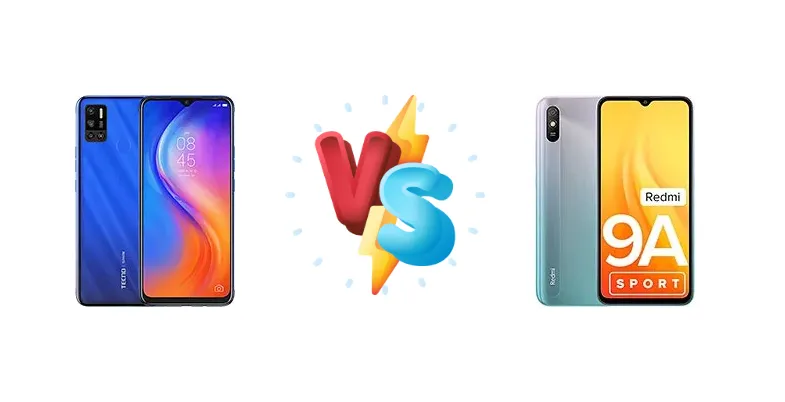
The Tecno Spark 6 Air and Xiaomi Redmi 9A Sport represent the fiercely competitive sub-$150 smartphone market. Both aim to deliver essential smartphone functionality at an accessible price, but they take different approaches to achieving this. The Redmi 9A Sport prioritizes a more modern chipset for improved performance, while the Spark 6 Air focuses on a balance of features and affordability. This comparison will dissect their key differences to help you choose the right device.
🏆 Quick Verdict
For most users, the Xiaomi Redmi 9A Sport is the better choice. Its Helio G25 chipset, featuring an octa-core CPU, provides a noticeable performance uplift over the Tecno Spark 6 Air’s Helio A22, making it more responsive for everyday tasks and light gaming. While the Spark 6 Air offers faster 18W charging, the Redmi 9A Sport’s performance advantage outweighs this benefit for the average user.
| Network |
|---|
| 2G bands | GSM 850 / 900 / 1800 / 1900 | GSM 850 / 900 / 1800 / 1900 |
| 3G bands | HSDPA 850 / 900 / 2100 | HSDPA 850 / 900 / 2100 |
| 4G bands | LTE | 1, 3, 5, 8, 40, 41 |
| Speed | HSPA 42.2/5.76 Mbps, LTE Cat4 150/50 Mbps | HSPA, LTE |
| Technology | GSM / HSPA / LTE | GSM / HSPA / LTE |
| Launch |
|---|
| Announced | 2020, July 30. Released 2020, August 06 | 2021, September 28 |
| Status | Discontinued | Available. Released 2021, September 28 |
| Body |
|---|
| Dimensions | 174.7 x 79.4 x 9.3 mm (6.88 x 3.13 x 0.37 in) | 164.9 x 77.1 x 9 mm (6.49 x 3.04 x 0.35 in) |
| SIM | Nano-SIM + Nano-SIM | Nano-SIM + Nano-SIM |
| Weight | - | 194 g (6.84 oz) |
| | - | Water-repellent coating |
| Display |
|---|
| Resolution | 720 x 1640 pixels (~256 ppi density) | 720 x 1600 pixels, 20:9 ratio (~269 ppi density) |
| Size | 7.0 inches, 116.4 cm2 (~83.9% screen-to-body ratio) | 6.53 inches, 102.9 cm2 (~81.0% screen-to-body ratio) |
| Type | IPS LCD, 480 nits (typ) | IPS LCD, 400 nits (typ) |
| Platform |
|---|
| CPU | Quad-core 1.8 GHz Cortex-A53 | Octa-core (4x2.0 GHz Cortex-A53 & 4x1.5 GHz Cortex-A53) |
| Chipset | Mediatek MT6761 Helio A22 (12 nm) | Mediatek MT6762G Helio G25 (12 nm) |
| GPU | PowerVR GE8320 | PowerVR GE8320 |
| OS | Android 10 (Go edition), HiOS 6.2 | Android 10, MIUI 12 |
| Memory |
|---|
| Card slot | microSDXC (dedicated slot) | microSDXC (dedicated slot) |
| Internal | 32GB 2GB RAM, 32GB 3GB RAM, 64GB 3GB RAM | 32GB 2GB RAM, 32GB 3GB RAM |
| | eMMC 5.1 | eMMC 5.1 |
| Main Camera |
|---|
| Features | Quad-LED flash, HDR | LED flash, HDR |
| Single | - | 13 MP, f/2.2, 28mm (wide), 1.0µm, PDAF |
| Triple | 13 MP, f/1.8, AF
Auxiliary lenses | - |
| Video | 1080p@30fps | 1080p@30/60fps |
| Selfie camera |
|---|
| Features | Dual-LED flash | HDR |
| Single | 8 MP | 5 MP, f/2.2, (wide), 1.12µm |
| Video | - | 1080p@30fps |
| Sound |
|---|
| 3.5mm jack | Yes | Yes |
| 35mm jack | Yes | Yes |
| Loudspeaker | Yes | Yes |
| Comms |
|---|
| Bluetooth | 5.0, A2DP, LE | 5.0, A2DP, LE |
| NFC | No | No |
| Positioning | GPS | GPS, GLONASS, BDS |
| Radio | FM radio | FM radio |
| USB | microUSB 2.0, OTG | microUSB 2.0, OTG |
| WLAN | Wi-Fi 802.11 b/g/n | Wi-Fi 802.11 a/b/g/n, Wi-Fi Direct |
| Features |
|---|
| Sensors | Fingerprint (rear-mounted), accelerometer, proximity | Accelerometer, proximity |
| Battery |
|---|
| Charging | 18W wired | 10W wired |
| Type | 6000 mAh | Li-Po 5000 mAh |
| Misc |
|---|
| Colors | Comet Black, Ocean Blue, Cloud White | Carbon Black, Coral Green, Metallic Blue |
| Models | KE6, KE6j, KF6 | - |
| Price | About 90 EUR | About 100 EUR |
Tecno Spark 6 Air
- Faster 18W wired charging
- Potentially better battery life due to less demanding chipset
- Competitive price point
- Significantly weaker processor performance
- Less responsive user experience
- Limited multitasking capabilities
Xiaomi Redmi 9A Sport
- More powerful Helio G25 octa-core processor
- Smoother multitasking and app performance
- Better gaming capabilities (for light games)
- Slower 10W wired charging
- Potentially shorter battery life under heavy load
- May be slightly more expensive
Display Comparison
Neither device boasts a standout display. Both likely utilize LCD panels, typical for this price bracket. The focus here isn't on visual fidelity, but on basic usability. While specific display specs (resolution, brightness) are unavailable, the Redmi 9A Sport’s slightly larger screen real estate may be preferable for media consumption. Bezels are expected to be substantial on both devices, reflecting their budget positioning.
Camera Comparison
Camera performance on both devices will be modest. Without detailed sensor information, it’s safe to assume both rely on basic image sensors. The Redmi 9A Sport may benefit from MediaTek’s image signal processor (ISP) enhancements within the Helio G25, potentially leading to slightly better image quality in favorable lighting conditions. However, don't expect flagship-level results; both phones are geared towards functional, rather than exceptional, photography. The presence of a 2MP macro lens on either device is largely a marketing tactic, offering limited practical benefit.
Performance
The core difference lies in the chipsets. The Xiaomi Redmi 9A Sport’s MediaTek Helio G25 is a clear upgrade over the Tecno Spark 6 Air’s Helio A22. The G25’s octa-core configuration (4x2.0 GHz Cortex-A53 & 4x1.5 GHz Cortex-A53) provides significantly more processing power than the A22’s quad-core 1.8 GHz Cortex-A53. This translates to faster app loading times, smoother multitasking, and a more responsive overall experience. While neither chipset is a gaming powerhouse, the G25 will handle less demanding titles with greater ease. The Redmi 9A Sport will likely exhibit less lag when switching between apps.
Battery Life
The Tecno Spark 6 Air’s 18W wired charging is its key advantage in this category. While battery capacity is unknown for both, 18W charging will significantly reduce charging times compared to the Redmi 9A Sport’s 10W charging. However, the Redmi 9A Sport’s more efficient Helio G25 chipset may partially offset this difference by consuming less power during typical usage. The faster charging of the Spark 6 Air is most beneficial for users who frequently need to quickly replenish their battery throughout the day.
Buying Guide
Buy the Tecno Spark 6 Air if you prioritize faster charging and are primarily focused on basic smartphone functions like calls, messaging, and light social media use. Its 18W charging is a boon for those who frequently need to top up their battery. Buy the Xiaomi Redmi 9A Sport if you value smoother multitasking, a more responsive user experience, and the ability to handle slightly more demanding apps and games. The octa-core Helio G25 chipset offers a significant performance advantage for a minimal price increase.
Frequently Asked Questions
❓ Will the Redmi 9A Sport struggle with popular apps like WhatsApp and Facebook?
No, the Redmi 9A Sport’s Helio G25 chipset is more than capable of handling everyday apps like WhatsApp, Facebook, and web browsing without significant lag. While it won’t offer a flagship-level experience, it provides a smooth and responsive user experience for these common tasks.
❓ Is the 18W charging on the Tecno Spark 6 Air a game-changer?
While 18W charging is faster than the Redmi 9A Sport’s 10W charging, it’s not a revolutionary difference. It will reduce charging times, but the overall battery life will still be a limiting factor. It’s most beneficial for users who frequently need to top up their battery throughout the day.
❓ Can the Redmi 9A Sport handle any mobile games?
The Redmi 9A Sport can handle less demanding mobile games like PUBG Mobile (on low settings), Free Fire, and Asphalt 9. However, don’t expect a high-framerate, graphically intensive gaming experience. The Helio G25 is an entry-level gaming chipset, so compromises will be necessary.
❓ Which phone is better for someone who primarily uses their phone for calls and texts?
For basic use cases like calls and texts, both phones are perfectly adequate. However, the Tecno Spark 6 Air’s faster charging might be slightly more convenient if you frequently forget to charge your phone overnight.