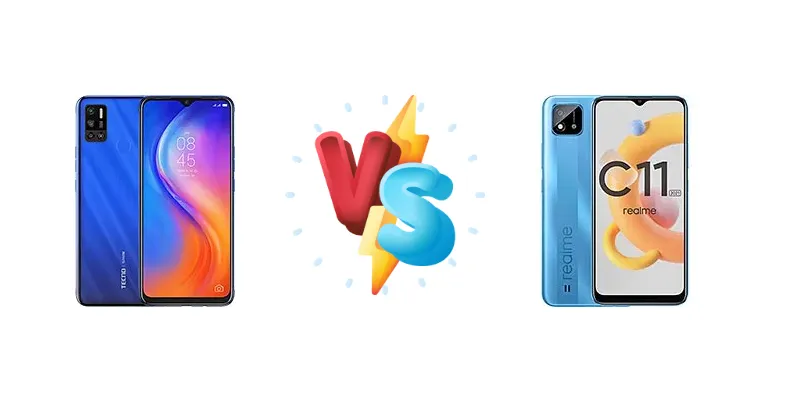
The Tecno Spark 6 Air and Realme C11 (2021) represent the ultra-budget end of the smartphone spectrum. Both aim to deliver essential smartphone functionality at the lowest possible price point, but they take different approaches to achieving this. The Spark 6 Air prioritizes faster charging, while the C11 (2021) opts for an octa-core processor, despite a less efficient manufacturing process. This comparison will dissect these choices to determine which device offers the best value.
🏆 Quick Verdict
For the average user prioritizing responsiveness in everyday tasks, the Realme C11 (2021) is the better choice. Its octa-core Unisoc SC9863A, while built on a larger 28nm process, provides a noticeable performance advantage over the Tecno Spark 6 Air’s quad-core Helio A22. However, the Spark 6 Air’s 18W charging is a significant benefit for those who value quick top-ups.
| Network |
|---|
| 2G bands | GSM 850 / 900 / 1800 / 1900 | GSM 850 / 900 / 1800 / 1900 |
| 3G bands | HSDPA 850 / 900 / 2100 | HSDPA 850 / 900 / 1900 / 2100 |
| 4G bands | LTE | 1, 3, 5, 8, 38, 40, 41 |
| Speed | HSPA 42.2/5.76 Mbps, LTE Cat4 150/50 Mbps | HSPA, LTE |
| Technology | GSM / HSPA / LTE | GSM / HSPA / LTE |
| Launch |
|---|
| Announced | 2020, July 30. Released 2020, August 06 | 2021, June 28 |
| Status | Discontinued | Available. Released 2021, June 28 |
| Body |
|---|
| Build | - | Glass front, plastic frame, plastic back |
| Dimensions | 174.7 x 79.4 x 9.3 mm (6.88 x 3.13 x 0.37 in) | 165.2 x 76.4 x 8.9 mm (6.50 x 3.01 x 0.35 in) |
| SIM | Nano-SIM + Nano-SIM | Nano-SIM + Nano-SIM |
| Weight | - | 190 g (6.70 oz) |
| | - | Splash resistant design |
| Display |
|---|
| Resolution | 720 x 1640 pixels (~256 ppi density) | 720 x 1600 pixels, 20:9 ratio (~269 ppi density) |
| Size | 7.0 inches, 116.4 cm2 (~83.9% screen-to-body ratio) | 6.52 inches, 102.6 cm2 (~81.3% screen-to-body ratio) |
| Type | IPS LCD, 480 nits (typ) | IPS LCD, 400 nits (typ) |
| Platform |
|---|
| CPU | Quad-core 1.8 GHz Cortex-A53 | Octa-core (4x1.6 GHz Cortex-A55 & 4x1.2 GHz Cortex-A55) |
| Chipset | Mediatek MT6761 Helio A22 (12 nm) | Unisoc SC9863A (28 nm) |
| GPU | PowerVR GE8320 | IMG8322 |
| OS | Android 10 (Go edition), HiOS 6.2 | Android 11, Realme Go UI |
| Memory |
|---|
| Card slot | microSDXC (dedicated slot) | microSDXC (dedicated slot) |
| Internal | 32GB 2GB RAM, 32GB 3GB RAM, 64GB 3GB RAM | 32GB 2GB RAM, 64GB 4GB RAM |
| | eMMC 5.1 | eMMC 5.1 |
| Main Camera |
|---|
| Features | Quad-LED flash, HDR | LED flash, HDR, panorama |
| Single | - | 8 MP, f/2.0, (wide), AF |
| Triple | 13 MP, f/1.8, AF
Auxiliary lenses | - |
| Video | 1080p@30fps | 1080p@30fps |
| Selfie camera |
|---|
| Features | Dual-LED flash | HDR, panorama |
| Single | 8 MP | 5 MP, f/2.2, (wide) |
| Video | - | 1080p@30fps |
| Sound |
|---|
| 3.5mm jack | Yes | Yes |
| 35mm jack | Yes | Yes |
| Loudspeaker | Yes | Yes |
| Comms |
|---|
| Bluetooth | 5.0, A2DP, LE | 4.2, A2DP |
| NFC | No | No |
| Positioning | GPS | GPS, GLONASS, GALILEO, BDS |
| Radio | FM radio | Unspecified |
| USB | microUSB 2.0, OTG | microUSB 2.0, OTG |
| WLAN | Wi-Fi 802.11 b/g/n | Wi-Fi 802.11 b/g/n |
| Features |
|---|
| Sensors | Fingerprint (rear-mounted), accelerometer, proximity | Accelerometer, gyro, proximity, compass |
| Battery |
|---|
| Charging | 18W wired | 10W wired
Reverse wired |
| Type | 6000 mAh | 5000 mAh |
| Misc |
|---|
| Colors | Comet Black, Ocean Blue, Cloud White | Cool Blue, Cool Grey |
| Models | KE6, KE6j, KF6 | RMX3231 |
| Price | About 90 EUR | About 80 EUR |
Tecno Spark 6 Air
- Faster 18W charging for quicker top-ups
- Potentially lower price point (depending on region)
- Simple and straightforward user experience
- Slower processor performance compared to the Realme C11 (2021)
- Older CPU architecture (Cortex-A53)
Realme C11 (2021)
- Octa-core processor for smoother multitasking
- More modern CPU architecture (Cortex-A55)
- Reverse wired charging capability
- Slower 10W charging
- Less efficient 28nm manufacturing process
Display Comparison
Neither device boasts a standout display. Both are expected to feature basic LCD panels, typical of this price bracket. The lack of specified display characteristics like brightness (nits) or color gamut coverage suggests neither is optimized for outdoor visibility or color accuracy. The focus here is purely on functionality, not visual fidelity. Bezels are likely to be substantial on both devices, maximizing screen real estate within a compact form factor.
Camera Comparison
Camera performance is unlikely to be a differentiating factor. Both devices likely feature basic camera setups focused on capturing acceptable images in good lighting conditions. Without specific sensor size or aperture information, it’s difficult to make a definitive judgment. The inclusion of a 2MP macro camera on either device is largely a marketing tactic, as the image quality from such sensors is typically underwhelming. Image processing will likely be minimal, relying heavily on software algorithms to enhance photos.
Performance
The core difference lies in the chipset. The Realme C11 (2021) utilizes the Unisoc SC9863A, an octa-core processor comprised of four 1.6 GHz Cortex-A55 cores and four 1.2 GHz Cortex-A55 cores. This configuration, despite being fabricated on a less efficient 28nm process, offers superior multi-core performance compared to the Tecno Spark 6 Air’s MediaTek Helio A22. The Helio A22 is a quad-core processor with Cortex-A53 cores clocked at 1.8 GHz. While the A22’s higher clock speed might seem advantageous, the A53 architecture is older and less efficient than the A55 found in the Unisoc chip. The C11’s octa-core setup will translate to smoother performance when multitasking and running more demanding applications. The 28nm process of the Unisoc chip will likely result in higher power consumption under load, but the performance gains are likely worth the trade-off for most users.
Battery Life
The Realme C11 (2021) supports 10W wired charging, while the Tecno Spark 6 Air steps up to 18W wired charging. This is a significant advantage for the Spark 6 Air, allowing for considerably faster charging times. While battery capacity isn’t specified, the faster charging speed will reduce downtime. The C11 (2021) also offers reverse wired charging, a feature absent on the Spark 6 Air, allowing it to act as a power bank for other devices, albeit at a slow rate. The trade-off is that the Unisoc chip’s less efficient process may lead to slightly faster battery drain during intensive use.
Buying Guide
Buy the Tecno Spark 6 Air if you frequently find yourself needing to quickly recharge your phone and can tolerate slightly slower app loading times. This phone is ideal for users who prioritize convenience over raw processing power. Buy the Realme C11 (2021) if you prefer a smoother multitasking experience and are willing to accept slower charging speeds. This is the better option for users who engage in light gaming or frequently switch between applications.
Frequently Asked Questions
❓ Will the Realme C11 (2021) struggle with popular apps like WhatsApp and Facebook?
No, the Unisoc SC9863A’s octa-core configuration is more than capable of handling everyday apps like WhatsApp, Facebook, and web browsing. While it won’t offer a flagship-level experience, it will provide a smooth and responsive user experience for these common tasks.
❓ How long will it take to fully charge the Tecno Spark 6 Air from 0%?
With 18W charging, the Tecno Spark 6 Air should fully charge in approximately 2-3 hours, depending on battery capacity (which isn't officially specified). This is significantly faster than the Realme C11 (2021)'s 10W charging, which would likely take 3.5-4.5 hours.
❓ Can the Realme C11 (2021) be used to charge my wireless earbuds?
Yes, the Realme C11 (2021) supports reverse wired charging. You can connect a USB cable to the phone and then connect your earbuds to charge them, although the charging speed will be slow due to the 10W output.