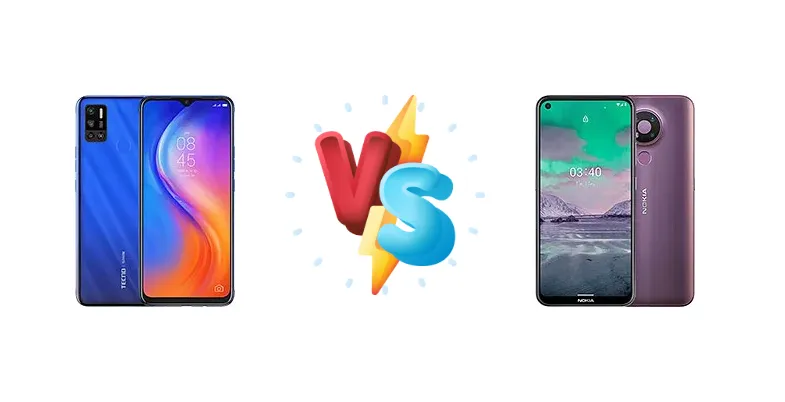
The Tecno Spark 6 Air and Nokia 3.4 represent two distinct approaches to the ultra-budget smartphone market. The Spark 6 Air prioritizes fast charging, while the Nokia 3.4 leverages Qualcomm’s Snapdragon platform for a potentially smoother user experience. This comparison dissects their key differences to determine which device delivers the best value.
🏆 Quick Verdict
For most users, the Nokia 3.4 is the superior choice. Its Qualcomm Snapdragon 460 chipset, built on an 11nm process, provides a noticeable performance advantage over the Tecno Spark 6 Air’s MediaTek Helio A22. While the Spark 6 Air boasts 18W charging, the Nokia 3.4’s more efficient processor and overall refinement make it a better daily driver.
| Network |
|---|
| 2G bands | GSM 850 / 900 / 1800 / 1900 | GSM 850 / 900 / 1800 / 1900 |
| 3G bands | HSDPA 850 / 900 / 2100 | HSDPA 850 / 900 / 1700(AWS) / 1900 / 2100 |
| 4G bands | LTE | 1, 2, 3, 4, 5, 7, 8, 12, 17, 13, 28, 66 |
| Speed | HSPA 42.2/5.76 Mbps, LTE Cat4 150/50 Mbps | HSPA, LTE |
| Technology | GSM / HSPA / LTE | GSM / HSPA / LTE |
| Launch |
|---|
| Announced | 2020, July 30. Released 2020, August 06 | 2020, September 22. Released 2020, October 26 |
| Status | Discontinued | Discontinued |
| Body |
|---|
| Dimensions | 174.7 x 79.4 x 9.3 mm (6.88 x 3.13 x 0.37 in) | 161 x 76 x 8.7 mm (6.34 x 2.99 x 0.34 in) |
| SIM | Nano-SIM + Nano-SIM | · Nano-SIM· Nano-SIM + Nano-SIM |
| Weight | - | 180 g (6.35 oz) |
| Display |
|---|
| Resolution | 720 x 1640 pixels (~256 ppi density) | 720 x 1560 pixels, 19.5:9 ratio (~269 ppi density) |
| Size | 7.0 inches, 116.4 cm2 (~83.9% screen-to-body ratio) | 6.39 inches, 100.2 cm2 (~81.9% screen-to-body ratio) |
| Type | IPS LCD, 480 nits (typ) | IPS LCD, 400 nits (typ) |
| Platform |
|---|
| CPU | Quad-core 1.8 GHz Cortex-A53 | Octa-core (4x1.8 GHz Cortex-A73 & 4x1.8 GHz Cortex-A53) |
| Chipset | Mediatek MT6761 Helio A22 (12 nm) | Qualcomm SM4250 Snapdragon 460 (11 nm) |
| GPU | PowerVR GE8320 | Adreno 610 |
| OS | Android 10 (Go edition), HiOS 6.2 | Android 10, upgradable to Android 11 |
| Memory |
|---|
| Card slot | microSDXC (dedicated slot) | microSDXC (dedicated slot) |
| Internal | 32GB 2GB RAM, 32GB 3GB RAM, 64GB 3GB RAM | 32GB 3GB RAM, 64GB 3GB RAM, 64GB 4GB RAM |
| | eMMC 5.1 | eMMC 5.1 |
| Main Camera |
|---|
| Features | Quad-LED flash, HDR | LED flash, HDR, panorama |
| Triple | 13 MP, f/1.8, AF
Auxiliary lenses | 13 MP, (wide), PDAF
5 MP, (ultrawide)
Auxiliary lens |
| Video | 1080p@30fps | 1080p@30fps |
| Selfie camera |
|---|
| Features | Dual-LED flash | - |
| Single | 8 MP | 8 MP, (wide) |
| Video | - | 1080p@30fps |
| Sound |
|---|
| 3.5mm jack | Yes | Yes |
| 35mm jack | Yes | Yes |
| Loudspeaker | Yes | Yes |
| Comms |
|---|
| Bluetooth | 5.0, A2DP, LE | 4.2, A2DP, aptX |
| NFC | No | Yes (market/region dependent) |
| Positioning | GPS | GPS, GLONASS, GALILEO, BDS |
| Radio | FM radio | FM radio |
| USB | microUSB 2.0, OTG | USB Type-C 2.0 |
| WLAN | Wi-Fi 802.11 b/g/n | Wi-Fi 802.11 b/g/n |
| Features |
|---|
| Sensors | Fingerprint (rear-mounted), accelerometer, proximity | Fingerprint (rear-mounted), accelerometer, gyro, proximity |
| Battery |
|---|
| Charging | 18W wired | 10W wired |
| Type | 6000 mAh | Li-Po 4000 mAh |
| Misc |
|---|
| Colors | Comet Black, Ocean Blue, Cloud White | Fjord, Dusk, Charcoal |
| Models | KE6, KE6j, KF6 | TA-1288, TA-1285, TA-1283 |
| Price | About 90 EUR | About 100 EUR |
| SAR | - | 0.83 W/kg (head) 1.05 W/kg (body) |
| SAR EU | - | 0.36 W/kg (head) 1.56 W/kg (body) |
Tecno Spark 6 Air
- Faster 18W wired charging
- Potentially lower price point
- Larger battery capacity (likely, given charging speed)
- Less powerful MediaTek Helio A22 chipset
- Inferior CPU architecture for multitasking
- Potentially less efficient power consumption
Nokia 3.4
- More powerful Qualcomm Snapdragon 460 chipset
- Octa-core CPU for smoother performance
- More efficient 11nm process node
- Slower 10W wired charging
- Potentially higher price point
- May require more frequent charging
Display Comparison
Neither device boasts a standout display. Both likely utilize LCD panels, common in this price bracket. The lack of specified resolution or refresh rates suggests both are targeting basic visual clarity. The focus here isn't on visual fidelity, but on functionality. Bezels are likely comparable, given the similar target price points.
Camera Comparison
Both phones likely feature basic camera setups geared towards casual photography. Without detailed sensor information, it’s difficult to make a definitive judgment. However, the Nokia 3.4’s image signal processor (ISP) within the Snapdragon 460 likely offers superior image processing capabilities, potentially resulting in better dynamic range and noise reduction compared to the Helio A22’s ISP. The presence of a more powerful processor allows for more complex computational photography features, even if the sensor resolution is similar.
Performance
The core difference lies in the chipsets. The Nokia 3.4’s Qualcomm Snapdragon 460 (11nm) is a significant upgrade over the Tecno Spark 6 Air’s MediaTek Helio A22 (12nm). The Snapdragon 460’s octa-core configuration – featuring four Cortex-A73 cores alongside four A53 cores – provides a substantial boost in multi-tasking and application launch speeds compared to the Spark 6 Air’s quad-core A53 setup. The 11nm process node further enhances efficiency, potentially leading to better thermal management and sustained performance. This translates to a more fluid experience when switching between apps and a more responsive UI on the Nokia 3.4.
Battery Life
The Tecno Spark 6 Air’s 18W charging is its key battery advantage. While battery capacity isn’t specified, 18W charging will significantly reduce charging times compared to the Nokia 3.4’s 10W charging. However, the Snapdragon 460’s greater power efficiency could offset the charging speed difference in real-world usage. Users who prioritize minimizing downtime will favor the Spark 6 Air, while those who value overall efficiency and longer battery life between charges might prefer the Nokia 3.4.
Buying Guide
Buy the Tecno Spark 6 Air if your primary need is extremely fast charging and you frequently find yourself needing to top up your battery quickly, even if it means sacrificing some performance. Buy the Nokia 3.4 if you prioritize a smoother, more responsive user experience, better app performance, and a more reliable software experience, even if charging takes a bit longer.
Frequently Asked Questions
❓ Will the Nokia 3.4 struggle with demanding games like PUBG Mobile?
While the Snapdragon 460 isn't a gaming powerhouse, it's capable of running PUBG Mobile at lower settings. Expect playable frame rates with reduced graphics quality. The Tecno Spark 6 Air’s Helio A22 will likely offer a less smooth experience, even at the lowest settings.
❓ How much faster is the charging on the Tecno Spark 6 Air compared to the Nokia 3.4?
The Tecno Spark 6 Air’s 18W charging will likely charge the phone from 0-100% in around 2-3 hours, depending on battery capacity. The Nokia 3.4’s 10W charging could take 4-5 hours for a full charge. This difference is significant for users who need a quick top-up.
❓ Does the Nokia 3.4 receive regular software updates?
Nokia is known for its commitment to software updates, even on its budget devices. The Nokia 3.4 is part of Android One, guaranteeing at least two years of OS upgrades and three years of security patches, offering a more secure and up-to-date experience than many competitors in this price range.