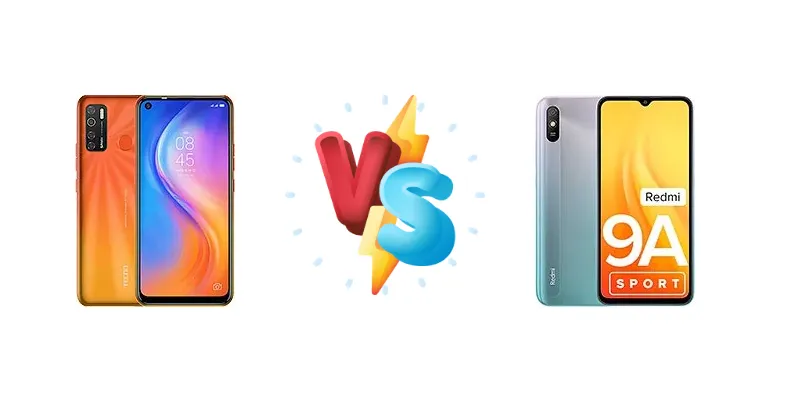
The Tecno Spark 5 and Xiaomi Redmi 9A Sport represent the fiercely competitive sub-$150 smartphone market. Both devices aim to deliver essential smartphone functionality at an accessible price point, but they differ in their underlying hardware. This comparison focuses on the core performance differences stemming from their respective Mediatek Helio A22 and Helio G25 chipsets, and how those differences translate to real-world usage.
🏆 Quick Verdict
For the average user prioritizing slightly smoother multitasking and potentially better gaming performance, the Xiaomi Redmi 9A Sport is the better choice. Its Helio G25 chipset, with its octa-core configuration featuring both high and low-frequency Cortex-A53 cores, offers a noticeable advantage over the Tecno Spark 5’s Helio A22. However, the difference isn't massive, and the Spark 5 remains a viable option for basic tasks.
| Network |
|---|
| 2G bands | GSM 850 / 900 / 1800 / 1900 | GSM 850 / 900 / 1800 / 1900 |
| 3G bands | HSDPA 850 / 900 / 2100 | HSDPA 850 / 900 / 2100 |
| 4G bands | LTE | 1, 3, 5, 8, 40, 41 |
| Speed | HSPA 42.2/5.76 Mbps, LTE Cat4 150/50 Mbps | HSPA, LTE |
| Technology | GSM / HSPA / LTE | GSM / HSPA / LTE |
| Launch |
|---|
| Announced | 2020, May 04. Released 2020, May 26 | 2021, September 28 |
| Status | Discontinued | Available. Released 2021, September 28 |
| Body |
|---|
| Dimensions | 164.7 x 76.3 x 8.8 mm (6.48 x 3.00 x 0.35 in) | 164.9 x 77.1 x 9 mm (6.49 x 3.04 x 0.35 in) |
| SIM | Nano-SIM + Nano-SIM | Nano-SIM + Nano-SIM |
| Weight | - | 194 g (6.84 oz) |
| | - | Water-repellent coating |
| Display |
|---|
| Resolution | 720 x 1600 pixels, 20:9 ratio (~266 ppi density) | 720 x 1600 pixels, 20:9 ratio (~269 ppi density) |
| Size | 6.6 inches, 105.2 cm2 (~83.7% screen-to-body ratio) | 6.53 inches, 102.9 cm2 (~81.0% screen-to-body ratio) |
| Type | IPS LCD | IPS LCD, 400 nits (typ) |
| Platform |
|---|
| CPU | Octa-core 2.0 GHz Cortex-A53 | Octa-core (4x2.0 GHz Cortex-A53 & 4x1.5 GHz Cortex-A53) |
| Chipset | Mediatek MT6761 Helio A22 (12 nm) | Mediatek MT6762G Helio G25 (12 nm) |
| GPU | PowerVR GE8320 | PowerVR GE8320 |
| OS | Android 10, HIOS 6.1 | Android 10, MIUI 12 |
| Memory |
|---|
| Card slot | microSDXC (dedicated slot) | microSDXC (dedicated slot) |
| Internal | 32GB 2GB RAM | 32GB 2GB RAM, 32GB 3GB RAM |
| | eMMC 5.1 | eMMC 5.1 |
| Main Camera |
|---|
| Features | Quad-LED flash, panorama, HDR | LED flash, HDR |
| Quad | 13 MP, f/1.8, PDAF
2 MP (macro)
Auxiliary lenses | - |
| Single | - | 13 MP, f/2.2, 28mm (wide), 1.0µm, PDAF |
| Video | 1080p@30fps | 1080p@30/60fps |
| Selfie camera |
|---|
| Features | Dual-LED flash, HDR | HDR |
| Single | 8 MP, f/2.0, (wide) | 5 MP, f/2.2, (wide), 1.12µm |
| Video | 1080p@30fps | 1080p@30fps |
| Sound |
|---|
| 3.5mm jack | Yes | Yes |
| 35mm jack | Yes | Yes |
| Loudspeaker | Yes | Yes |
| Comms |
|---|
| Bluetooth | Yes | 5.0, A2DP, LE |
| NFC | No | No |
| Positioning | GPS | GPS, GLONASS, BDS |
| Radio | FM radio | FM radio |
| USB | microUSB 2.0, OTG | microUSB 2.0, OTG |
| WLAN | Wi-Fi 802.11 b/g/n | Wi-Fi 802.11 a/b/g/n, Wi-Fi Direct |
| Features |
|---|
| Sensors | Fingerprint (rear-mounted), accelerometer, proximity | Accelerometer, proximity |
| Battery |
|---|
| Charging | - | 10W wired |
| Type | 5000 mAh | Li-Po 5000 mAh |
| Misc |
|---|
| Colors | Ice Jadeite, Spark Orange, Vacation Blue, Misty Grey | Carbon Black, Coral Green, Metallic Blue |
| Models | KE5, KD7S | - |
| Price | About 150 EUR | About 100 EUR |
Tecno Spark 5
- Potentially longer battery life due to the Helio A22's efficiency.
- Simple and straightforward user experience.
- Affordable price point.
- Less powerful processor compared to the Helio G25.
- May struggle with demanding apps and multitasking.
Xiaomi Redmi 9A Sport
- More powerful Helio G25 chipset for smoother performance.
- big.LITTLE architecture for improved efficiency.
- Better suited for light gaming and multitasking.
- Potentially shorter battery life compared to the Tecno Spark 5.
- 10W charging is relatively slow.
Display Comparison
Neither device is expected to boast a particularly impressive display. Both likely utilize LCD panels, and detailed specs like brightness and color accuracy are unavailable. The focus here is on performance, not visual fidelity. Bezels are likely comparable, reflecting the budget nature of both phones. The absence of high refresh rates or advanced panel technologies like LTPO is standard for this price bracket.
Camera Comparison
Given the price point, camera performance is unlikely to be a key differentiator. Both devices likely feature a primary camera alongside basic auxiliary lenses (potentially a depth sensor or macro lens). Without specific sensor size or aperture information, it’s difficult to make a definitive judgment. Image processing will likely be heavily reliant on software algorithms, and image quality will be adequate for casual snapshots but not competitive with higher-end smartphones. The 2MP macro cameras often found in this segment are generally of limited utility.
Performance
The core difference lies in the chipsets. The Tecno Spark 5’s Mediatek Helio A22 is an octa-core processor utilizing eight Cortex-A53 cores clocked at 2.0 GHz. The Xiaomi Redmi 9A Sport, however, features the Helio G25. While also an octa-core processor, the G25 employs a big.LITTLE architecture with four Cortex-A53 cores at 2.0 GHz and four power-efficient Cortex-A53 cores at 1.5 GHz. This configuration allows the G25 to dynamically allocate tasks, improving efficiency and responsiveness. The G25’s slightly more advanced architecture provides a tangible, though not dramatic, performance boost in multitasking and app loading times. The Redmi 9A Sport’s 10W charging is a standard offering for this segment, and will likely result in longer charging times compared to devices with faster charging capabilities.
Battery Life
Battery capacity is not specified for either device, but both likely feature batteries in the 4000-5000 mAh range, typical for this class. The Redmi 9A Sport’s 10W charging, while slow by modern standards, is consistent with the budget positioning. The Helio A22 in the Tecno Spark 5 is generally more power-efficient due to its simpler architecture, potentially leading to slightly longer battery life under similar usage conditions. However, the G25’s efficiency gains from its big.LITTLE architecture may partially offset this difference.
Buying Guide
Buy the Tecno Spark 5 if you need a functional smartphone for essential tasks like calling, texting, and light social media browsing, and prioritize maximizing battery life over raw performance. Buy the Xiaomi Redmi 9A Sport if you prefer a device capable of handling slightly more demanding apps, occasional gaming, and benefit from a more balanced CPU configuration, even if it means slightly faster battery drain.
Frequently Asked Questions
❓ Will the Redmi 9A Sport handle popular games like PUBG Mobile?
The Redmi 9A Sport’s Helio G25 can run PUBG Mobile, but likely at lower graphics settings and frame rates to maintain a playable experience. Expect to adjust settings to prioritize smoothness over visual fidelity. The Helio A22 in the Tecno Spark 5 would struggle significantly with PUBG Mobile.
❓ Is the difference in performance between the Helio A22 and Helio G25 noticeable for everyday tasks?
For basic tasks like browsing, calling, and texting, the difference is minimal. However, when opening multiple apps, switching between them, or using more demanding applications, the Redmi 9A Sport’s Helio G25 will feel noticeably snappier and more responsive due to its big.LITTLE architecture.
❓ How long will it take to fully charge the Redmi 9A Sport with its 10W charger?
With its 10W charging, the Redmi 9A Sport will likely take between 3 to 4 hours to fully charge from 0% to 100%, depending on battery capacity and usage during charging. This is a standard charging time for budget smartphones.