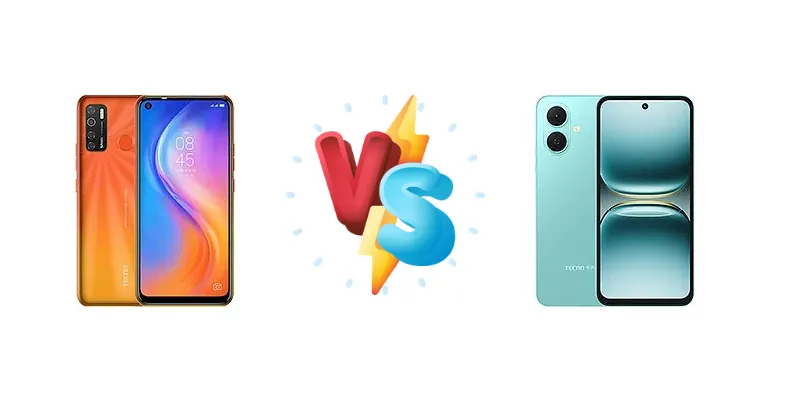
Tecno's Spark series consistently targets the ultra-budget smartphone market. The Spark 5 and Spark Go 2 represent two distinct approaches within this segment. The Spark 5, an older model, offers a familiar Mediatek chipset, while the Spark Go 2 introduces Unisoc's T7250, aiming for improved efficiency and performance. This comparison dissects the key differences to determine which device delivers the best value for money.
🏆 Quick Verdict
For most users, the Tecno Spark Go 2 is the better choice. Its Unisoc T7250 chipset, featuring Cortex-A75 cores, provides a noticeable performance uplift over the Spark 5’s Helio A22, especially in multitasking and app loading. The 15W charging is also a significant advantage, offsetting the potentially smaller battery capacity.
| Network |
|---|
| 2G bands | GSM 850 / 900 / 1800 / 1900 | GSM 850 / 900 / 1800 / 1900 |
| 3G bands | HSDPA 850 / 900 / 2100 | HSDPA 900 / 2100 |
| 4G bands | LTE | LTE |
| Speed | HSPA 42.2/5.76 Mbps, LTE Cat4 150/50 Mbps | HSPA, LTE |
| Technology | GSM / HSPA / LTE | GSM / HSPA / LTE |
| Launch |
|---|
| Announced | 2020, May 04. Released 2020, May 26 | 2025, June 24 |
| Status | Discontinued | Available. Released 2025, June |
| Body |
|---|
| Build | - | Glass front, plastic back, plastic frame |
| Dimensions | 164.7 x 76.3 x 8.8 mm (6.48 x 3.00 x 0.35 in) | 165.6 x 77 x 8.3 mm (6.52 x 3.03 x 0.33 in) |
| SIM | Nano-SIM + Nano-SIM | Nano-SIM + Nano-SIM |
| Weight | - | - |
| Display |
|---|
| Resolution | 720 x 1600 pixels, 20:9 ratio (~266 ppi density) | 720 x 1600 pixels, 20:9 ratio (~263 ppi density) |
| Size | 6.6 inches, 105.2 cm2 (~83.7% screen-to-body ratio) | 6.67 inches, 107.4 cm2 (~84.2% screen-to-body ratio) |
| Type | IPS LCD | IPS LCD, 120Hz |
| Platform |
|---|
| CPU | Octa-core 2.0 GHz Cortex-A53 | Octa-core (2x1.8 GHz Cortex-A75 & 6x1.6 GHz Cortex-A55) |
| Chipset | Mediatek MT6761 Helio A22 (12 nm) | Unisoc T7250 (12 nm) |
| GPU | PowerVR GE8320 | Mali-G57 MP1 |
| OS | Android 10, HIOS 6.1 | Android 15, HIOS 15 |
| Memory |
|---|
| Card slot | microSDXC (dedicated slot) | microSDXC |
| Internal | 32GB 2GB RAM | 64GB 3GB RAM, 64GB 4GB RAM, 128GB 3GB RAM, 128GB 4GB RAM, 256GB 4GB RAM |
| | eMMC 5.1 | - |
| Main Camera |
|---|
| Features | Quad-LED flash, panorama, HDR | Dual-LED flash, HDR |
| Quad | 13 MP, f/1.8, PDAF
2 MP (macro)
Auxiliary lenses | - |
| Single | - | 13 MP, f/1.8, 27mm (wide), PDAF |
| Video | 1080p@30fps | 1080p@30fps |
| Selfie camera |
|---|
| Features | Dual-LED flash, HDR | Dual-LED flash |
| Single | 8 MP, f/2.0, (wide) | 8 MP |
| Video | 1080p@30fps | Yes |
| Sound |
|---|
| 3.5mm jack | Yes | - |
| 35mm jack | Yes | Yes |
| Loudspeaker | Yes | Yes, with dual speakers |
| Comms |
|---|
| Bluetooth | Yes | Yes |
| Infrared port | - | Yes |
| NFC | No | No |
| Positioning | GPS | GPS |
| Radio | FM radio | FM radio |
| USB | microUSB 2.0, OTG | USB Type-C, OTG |
| WLAN | Wi-Fi 802.11 b/g/n | Yes |
| Features |
|---|
| Sensors | Fingerprint (rear-mounted), accelerometer, proximity | Fingerprint (side-mounted); unspecified sensors |
| Battery |
|---|
| Charging | - | 15W wired |
| Type | 5000 mAh | 5000 mAh |
| Misc |
|---|
| Colors | Ice Jadeite, Spark Orange, Vacation Blue, Misty Grey | Ink Black, Titanium Grey, Veil White, Turquoise Green |
| Models | KE5, KD7S | KM4 |
| Price | About 150 EUR | About 80 EUR |
Tecno Spark 5
- Potentially lower price point (depending on current deals)
- Familiar Mediatek platform
- May have slightly larger battery capacity (speculative)
- Significantly weaker CPU performance
- Slower charging speeds
- Less responsive user experience
Tecno Spark Go 2
- Faster and more efficient Unisoc T7250 chipset
- 15W fast charging
- Improved multitasking capabilities
- May be slightly more expensive
- Unisoc chipset may have less software optimization
- Potentially smaller battery capacity (speculative)
Display Comparison
Neither device boasts a standout display. Both utilize 12nm chipsets, suggesting similar power constraints impacting display capabilities. While specific display specs (resolution, brightness) are missing, the focus here is on processing power to drive the UI. The absence of high refresh rates or advanced panel technologies like LTPO is expected in this price bracket. Bezels are likely comparable, prioritizing cost reduction over premium aesthetics.
Camera Comparison
Without detailed camera specifications, a direct comparison is difficult. However, it’s reasonable to assume both devices feature entry-level camera setups. The market segment suggests a focus on megapixel count over sensor size or optical image stabilization (OIS). Any 2MP macro or depth sensors on either device are likely to offer limited practical benefit. Image processing will be a key differentiator, and Unisoc’s ISP within the T7250 *may* offer slight improvements over the Helio A22’s ISP, but this is speculative without testing.
Performance
The core difference lies in the chipsets. The Tecno Spark 5’s Mediatek Helio A22 utilizes eight Cortex-A53 cores clocked at 2.0 GHz. This is a relatively basic architecture, suitable for light tasks. Conversely, the Spark Go 2’s Unisoc T7250 employs a more sophisticated configuration: two Cortex-A75 cores at 1.8 GHz and six Cortex-A55 cores at 1.6 GHz. The A75 cores offer significantly higher single-core performance, translating to snappier app launches and smoother multitasking. While both are 12nm, the architectural advantage of the T7250 is substantial. The Spark Go 2 will demonstrably outperform the Spark 5 in CPU-intensive tasks.
Battery Life
Battery capacity details are missing for both devices. However, the Spark Go 2’s inclusion of 15W wired charging is a significant advantage. The Spark 5 likely supports slower charging speeds. Even if the Spark 5 has a slightly larger battery, the faster charging of the Go 2 will result in less downtime and a more convenient user experience. 15W charging on the Go 2 will likely achieve a 0-100% charge in under 3 hours, while the Spark 5 could take considerably longer.
Buying Guide
Buy the Tecno Spark 5 if you prioritize a proven, if slower, platform and are on an extremely tight budget, accepting compromises in performance. Buy the Tecno Spark Go 2 if you value a more responsive user experience, faster charging, and are willing to spend a little more for a more modern chipset architecture. The Go 2 is ideal for users who frequently switch between apps or enjoy light gaming.
Frequently Asked Questions
❓ Will the Tecno Spark Go 2 handle popular apps like WhatsApp and Facebook smoothly?
Yes, the Unisoc T7250 chipset in the Spark Go 2 is more than capable of running apps like WhatsApp and Facebook smoothly. The Cortex-A75 cores provide a performance boost that will result in faster app loading times and a more responsive experience compared to the Spark 5.
❓ Is the 15W charging on the Spark Go 2 a significant improvement over the Spark 5?
Absolutely. While the exact charging speed of the Spark 5 is unknown, it's likely to be significantly slower. 15W charging on the Spark Go 2 will reduce charging times considerably, allowing you to get back to using your phone much faster. This is particularly beneficial for users who rely heavily on their smartphones throughout the day.
❓ Can the Tecno Spark Go 2 handle light gaming?
The Spark Go 2 is suitable for light gaming. While it won't handle demanding titles at high settings, the Unisoc T7250 can comfortably run less graphically intensive games. The Spark 5 will struggle more with even basic games due to its weaker processor.
❓ Does the Unisoc T7250 chipset have good software support and updates?
Software support for Unisoc chipsets can be less extensive than for Mediatek or Qualcomm. However, Tecno has been improving its software update cadence. Check online forums and reviews for user reports on the Spark Go 2's software update experience in your region.