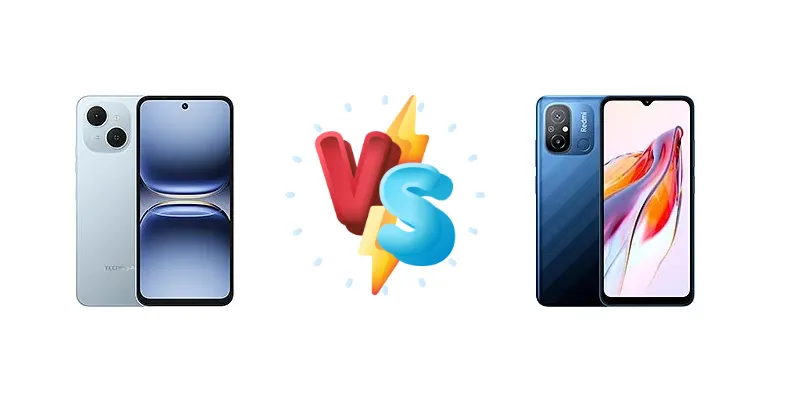
The Tecno Spark 40C and Xiaomi Redmi 12C represent the fiercely competitive sub-$150 smartphone market. Both aim to deliver essential features at an accessible price, but subtle differences in their core hardware – specifically the chipset and charging capabilities – can significantly impact the user experience. This comparison dissects these differences to determine which device offers the best value.
🏆 Quick Verdict
For most users, the Tecno Spark 40C emerges as the slightly better choice. While both phones share a similar CPU configuration, the Helio G81’s slightly optimized architecture and the significantly faster 18W charging provide a tangible advantage in daily use and convenience, justifying a potential small price premium.
| Network |
|---|
| 2G bands | GSM 850 / 900 / 1800 / 1900 | GSM 850 / 900 / 1800 / 1900 |
| 3G bands | HSDPA 900 / 2100 | HSDPA 850 / 900 / 2100 |
| 4G bands | LTE | 1, 3, 5, 7, 8, 20, 28, 38, 40, 41 - International |
| Speed | HSPA, LTE | HSPA, LTE |
| Technology | GSM / HSPA / LTE | GSM / CDMA / HSPA / EVDO / LTE |
| | - | CDMA2000 1xEV-DO |
| Launch |
|---|
| Announced | 2025, July 19 | 2022, December 31 |
| Status | Available. Released 2025, August | Available. Released 2023, January 01 |
| Body |
|---|
| Build | Glass front, plastic back, plastic frame | - |
| Dimensions | 165.6 x 77 x 8.4 mm (6.52 x 3.03 x 0.33 in) | 168.8 x 76.4 x 8.8 mm (6.65 x 3.01 x 0.35 in) |
| SIM | Nano-SIM + Nano-SIM | Nano-SIM + Nano-SIM |
| Weight | - | 192 g (6.77 oz) |
| Display |
|---|
| Resolution | 720 x 1600 pixels, 20:9 ratio (~263 ppi density) | 720 x 1650 pixels (~268 ppi density) |
| Size | 6.67 inches, 107.4 cm2 (~84.2% screen-to-body ratio) | 6.71 inches, 106.5 cm2 (~82.6% screen-to-body ratio) |
| Type | IPS LCD, 120Hz | IPS LCD, 500 nits (typ) |
| Platform |
|---|
| CPU | Octa-core (2x2.0 GHz Cortex-A75 & 6x1.8 GHz Cortex-A55) | Octa-core (2x2.0 GHz Cortex-A75 & 6x1.8 GHz Cortex-A55) |
| Chipset | Mediatek Helio G81 (12 nm) | Mediatek MT6769Z Helio G85 (12 nm) |
| GPU | Mali-G52 MC2 | Mali-G52 MC2 |
| OS | Android 15, HIOS 15.1 | Android 12, MIUI 13 |
| Memory |
|---|
| Card slot | Unspecified | microSDXC (dedicated slot) |
| Internal | 128GB 4GB RAM, 128GB 8GB RAM, 256GB 8GB RAM | 32GB 2GB RAM, 32GB 3GB RAM, 32GB 4GB RAM, 64GB 3GB RAM, 64GB 4GB RAM, 128GB 3GB RAM, 128GB 4GB RAM, 128GB 6GB RAM |
| | - | eMMC 5.1 |
| Main Camera |
|---|
| Dual | - | 50 MP, (wide), PDAF
0.08 MP (depth) |
| Features | Dual-LED flash, HDR | LED flash, HDR |
| Single | 13 MP, f/1.8, 27mm (wide), PDAF | 50 MP, f/1.8, (wide), 1/2.76", PDAF
Auxiliary lens |
| Video | 1080p@30fps | 1080p@30fps |
| Selfie camera |
|---|
| Single | 8 MP | 5 MP, f/2.2, (wide) |
| Video | Yes | 1080p@30fps |
| Sound |
|---|
| 3.5mm jack | - | Yes |
| 35mm jack | Yes | Yes |
| Loudspeaker | Yes, with dual speakers | Yes |
| Comms |
|---|
| Bluetooth | Yes | 5.1, A2DP, LE |
| Infrared port | Yes | - |
| NFC | No | Yes (market/region dependent) |
| Positioning | GPS | GPS, GLONASS, BDS, GALILEO |
| Radio | FM radio | FM radio |
| USB | USB Type-C, OTG | microUSB 2.0 |
| WLAN | Yes | Wi-Fi 802.11 a/b/g/n/ac, dual-band, Wi-Fi Direct |
| Features |
|---|
| Sensors | Fingerprint (side-mounted); unspecified sensors | Fingerprint (rear-mounted), accelerometer |
| | - | Virtual proximity sensing |
| Battery |
|---|
| Charging | 18W wired | 10W wired |
| Type | 6000 mAh | Li-Po 5000 mAh |
| Misc |
|---|
| Colors | Veil White, Ripple Blue, Titanium Grey, Ink Black | Graphite Gray, Ocean Blue, Mint Green, Lavender Purple |
| Models | KM4k | 22120RN86G, 22120RN86I, 22126RN91Y, 2212ARNC4L |
| Price | About 90 EUR | £ 132.99 / € 107.41 |
| SAR | - | 1.08 W/kg (head) 0.64 W/kg (body) |
| SAR EU | - | 0.98 W/kg (head) 0.99 W/kg (body) |
Tecno Spark 40C
- Faster 18W charging for quicker top-ups.
- Slightly optimized Helio G81 chipset.
- Potentially smoother multitasking experience.
- May be slightly more expensive than the Redmi 12C.
- Camera specifications are largely unknown.
Xiaomi Redmi 12C
- Generally lower price point.
- Acceptable performance for basic tasks.
- Likely similar battery life to the Tecno Spark 40C.
- Significantly slower 10W charging.
- Helio G85 offers minimal performance gain over G81.
- Potential for less responsive performance under load.
Display Comparison
Neither Tecno nor Xiaomi provide detailed display specifications beyond resolution. Given the price bracket, both likely utilize IPS LCD panels. The absence of information regarding peak brightness, color gamut coverage, or PWM dimming rates suggests a focus on cost reduction. Bezels are expected to be relatively substantial on both devices. Without further data, it’s safe to assume display quality is comparable and not a major differentiating factor.
Camera Comparison
Camera details are sparse. Both phones likely feature a primary camera and depth sensor, with the Redmi 12C often including a 2MP macro lens (which offers limited practical benefit). Without knowing sensor sizes or apertures, it’s difficult to assess image quality. Image processing algorithms will play a significant role, and Xiaomi’s typically leans towards more saturated colors, while Tecno’s tends to be more natural. The absence of Optical Image Stabilization (OIS) on either device means low-light performance will be limited.
Performance
Both the Tecno Spark 40C and Xiaomi Redmi 12C are powered by octa-core CPUs featuring the same core configuration: 2x2.0 GHz Cortex-A75 and 6x1.8 GHz Cortex-A55. However, the chipset differs – the Tecno uses the Mediatek Helio G81, while the Xiaomi employs the Helio G85. While both are 12nm chips, the G81 is a slightly older, but refined design. The G85 boasts a marginally higher GPU clock speed, but in real-world usage, the difference will be minimal for typical tasks. Both phones will handle everyday apps and light gaming adequately, but neither is designed for graphically intensive titles. RAM configurations are crucial here; faster LPDDR4X RAM would benefit both, but the specific RAM speed isn't specified.
Battery Life
Battery capacity is not specified for either device, but both likely fall in the 5000mAh range, typical for this price segment. The critical difference lies in charging speed. The Tecno Spark 40C supports 18W wired charging, while the Redmi 12C is limited to 10W. This translates to a significantly faster 0-100% charge time for the Tecno, potentially shaving off 30-60 minutes. For users who value convenience and quick top-ups, the 18W charging is a substantial advantage.
Buying Guide
Buy the Tecno Spark 40C if you prioritize faster charging and potentially smoother multitasking, even if only marginally. This phone is ideal for users who frequently find themselves needing to top up their battery quickly throughout the day. Buy the Xiaomi Redmi 12C if you are looking for the absolute lowest price point and are willing to accept slower charging speeds and potentially slightly less responsive performance during demanding tasks. It’s a solid option for basic smartphone needs.
Frequently Asked Questions
❓ Will the Helio G81 in the Tecno Spark 40C struggle with popular games like PUBG Mobile?
While the Helio G81 can run PUBG Mobile, expect to play at lower graphics settings (Balanced or Low) to maintain a stable frame rate. It's not a gaming-focused chipset, so demanding titles will require compromises. The Redmi 12C with the G85 will offer a similar gaming experience.
❓ How long will it take to fully charge the Tecno Spark 40C with the included charger?
With the 18W charger, the Tecno Spark 40C should fully charge from 0% to 100% in approximately 2-2.5 hours, depending on usage during charging. This is significantly faster than the Redmi 12C's estimated 3-4 hours with its 10W charger.
❓ Is the camera on either phone good enough for casual social media photos?
Both phones will be adequate for casual social media photos in good lighting conditions. However, don't expect exceptional detail or dynamic range. Low-light performance will be limited due to the lack of OIS and potentially smaller sensors. The image processing style will differ between the two brands.
❓ Does the Xiaomi Redmi 12C support fast charging with a different charger?
While the Redmi 12C ships with a 10W charger, it *may* support slightly faster charging with a compatible PD (Power Delivery) charger, but the increase will be limited by the phone's internal charging circuitry. It will not benefit from the full 18W capabilities of the Tecno Spark 40C.