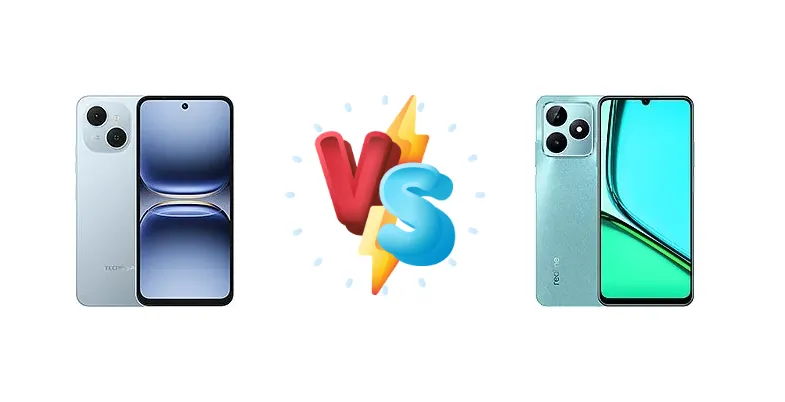
The sub-$150 smartphone market is fiercely competitive. The Tecno Spark 40C and Realme C51s both aim to deliver essential features at an accessible price point, but they take different approaches. The Spark 40C prioritizes a proven chipset, while the C51s focuses on significantly faster charging. This comparison dissects their key differences to determine which phone offers the best value.
🏆 Quick Verdict
For the average user prioritizing sustained performance and a slightly more established chipset, the Tecno Spark 40C is the better choice. While the Realme C51s boasts impressive 33W charging, the Unisoc Tiger T612 doesn't quite match the Helio G81's overall processing power, impacting multitasking and gaming experiences.
| Network |
|---|
| 2G bands | GSM 850 / 900 / 1800 / 1900 | GSM 850 / 900 / 1800 / 1900 |
| 3G bands | HSDPA 900 / 2100 | HSDPA 900 / 2100 |
| 4G bands | LTE | 1, 3, 5, 8, 38, 40 |
| Speed | HSPA, LTE | HSPA, LTE |
| Technology | GSM / HSPA / LTE | GSM / HSPA / LTE |
| Launch |
|---|
| Announced | 2025, July 19 | 2024, March 15 |
| Status | Available. Released 2025, August | Available. Released 2024, March 15 |
| Body |
|---|
| Build | Glass front, plastic back, plastic frame | Glass front, plastic frame, plastic back |
| Dimensions | 165.6 x 77 x 8.4 mm (6.52 x 3.03 x 0.33 in) | 167.2 x 76.7 x 7.5 mm (6.58 x 3.02 x 0.30 in) |
| SIM | Nano-SIM + Nano-SIM | Nano-SIM + Nano-SIM |
| Weight | - | 182 g (6.42 oz) |
| Display |
|---|
| Resolution | 720 x 1600 pixels, 20:9 ratio (~263 ppi density) | 720 x 1600 pixels, 20:9 ratio (~260 ppi density) |
| Size | 6.67 inches, 107.4 cm2 (~84.2% screen-to-body ratio) | 6.74 inches, 109.7 cm2 (~85.5% screen-to-body ratio) |
| Type | IPS LCD, 120Hz | IPS LCD, 90Hz, 560 nits (peak) |
| Platform |
|---|
| CPU | Octa-core (2x2.0 GHz Cortex-A75 & 6x1.8 GHz Cortex-A55) | Octa-core (2x1.8 GHz Cortex-A75 & 6x1.8 GHz Cortex-A55) |
| Chipset | Mediatek Helio G81 (12 nm) | Unisoc Tiger T612 (12 nm) |
| GPU | Mali-G52 MC2 | Mali-G57 |
| OS | Android 15, HIOS 15.1 | Android 13, Realme UI |
| Memory |
|---|
| Card slot | Unspecified | microSDXC (dedicated slot) |
| Internal | 128GB 4GB RAM, 128GB 8GB RAM, 256GB 8GB RAM | 128GB 6GB RAM |
| Main Camera |
|---|
| Features | Dual-LED flash, HDR | LED flash, HDR, panorama |
| Single | 13 MP, f/1.8, 27mm (wide), PDAF | 50 MP, f/1.8, 27mm (wide), 1/2.76", 0.64µm, PDAF
Auxiliary lens |
| Video | 1080p@30fps | 1080p@30fps |
| Selfie camera |
|---|
| Features | - | HDR |
| Single | 8 MP | 5 MP, f/2.2, 28mm (wide), 1/5.0", 1.12µm |
| Video | Yes | 720p@30fps |
| Sound |
|---|
| 35mm jack | Yes | Yes |
| Loudspeaker | Yes, with dual speakers | Yes |
| Comms |
|---|
| Bluetooth | Yes | 5.0, A2DP, LE |
| Infrared port | Yes | - |
| NFC | No | Yes, 360˚ (market/region dependent) |
| Positioning | GPS | GPS, GLONASS, GALILEO |
| Radio | FM radio | Unspecified |
| USB | USB Type-C, OTG | USB Type-C |
| WLAN | Yes | Wi-Fi 802.11 a/b/g/n/ac, dual-band |
| Features |
|---|
| Sensors | Fingerprint (side-mounted); unspecified sensors | Fingerprint (side-mounted), accelerometer, gyro, proximity, compass |
| Battery |
|---|
| Charging | 18W wired | 33W wired, 0-50% in 28 min |
| Type | 6000 mAh | 5000 mAh |
| Misc |
|---|
| Colors | Veil White, Ripple Blue, Titanium Grey, Ink Black | Shiny Green, Mighty Black |
| Models | KM4k | RMX3765 |
| Price | About 90 EUR | About 100 EUR |
Tecno Spark 40C
- More powerful processor (Helio G81)
- Potentially better gaming performance
- Likely more efficient power consumption
- Slower charging speed (18W)
- May have less refined software experience
Realme C51s
- Significantly faster charging (33W)
- Quick 0-50% charge in 28 minutes
- Potentially optimized Unisoc ISP
- Less powerful processor (Tiger T612)
- May struggle with demanding games
- Unisoc chipset has less widespread software support
Display Comparison
Neither device's display specifications are provided, so a direct comparison is limited. However, given their price bracket, both likely utilize LCD panels with 720p+ resolution. Realme historically focuses on display quality within this segment, potentially offering slightly better color accuracy or brightness. The absence of information regarding refresh rates suggests both are likely capped at 60Hz, standard for this price point.
Camera Comparison
Without detailed camera specifications, a comprehensive comparison is impossible. Both phones likely feature a primary camera alongside depth or macro sensors. Given the market segment, image quality will be heavily reliant on software processing. The absence of OIS on either device suggests low-light performance will be limited. The Realme C51s may leverage Unisoc's ISP for improved image processing, but the Tecno Spark 40C's sensor size (if larger) would be a significant advantage.
Performance
The core difference lies in the chipsets. The Tecno Spark 40C features the Mediatek Helio G81, built on a 12nm process, with an octa-core configuration of 2x2.0 GHz Cortex-A75 and 6x1.8 GHz Cortex-A55 cores. The Realme C51s utilizes the Unisoc Tiger T612, also on a 12nm process, but with a slightly slower 2x1.8 GHz Cortex-A75 and 6x1.8 GHz Cortex-A55 configuration. While both CPUs share the same core architecture, the higher clock speed of the A75 cores in the Helio G81 translates to a noticeable performance advantage in CPU-intensive tasks and gaming. The G81's GPU is also generally more capable, offering a smoother gaming experience. The Realme C51s may benefit from Unisoc's optimizations, but the raw specifications favor the Tecno.
Battery Life
The Realme C51s takes a clear lead in charging speed with its 33W wired charging, capable of reaching 0-50% in just 28 minutes. The Tecno Spark 40C is limited to 18W wired charging, resulting in a significantly longer charging time. While battery capacity isn't specified, the faster charging of the C51s is a major convenience factor for users who frequently need to top up their phone. However, the Helio G81 in the Spark 40C is generally more power-efficient, potentially offsetting the slower charging with longer battery life during typical usage.
Buying Guide
Buy the Tecno Spark 40C if you need a phone capable of handling moderate gaming and multitasking without significant slowdowns, and you aren't overly concerned with the fastest possible charging. Buy the Realme C51s if you prioritize minimizing downtime with its 33W fast charging and primarily use your phone for basic tasks like calls, messaging, and social media, where raw processing power is less critical.
Frequently Asked Questions
❓ Will the Unisoc Tiger T612 in the Realme C51s struggle with graphically intensive games like PUBG Mobile?
The Unisoc Tiger T612 is a capable chipset for everyday tasks, but it may struggle to maintain consistent frame rates in demanding games like PUBG Mobile, especially at higher settings. You'll likely need to lower the graphics settings to achieve a playable experience. The Tecno Spark 40C's Helio G81 offers a more comfortable gaming experience.
❓ How much faster is the 33W charging on the Realme C51s compared to the 18W charging on the Tecno Spark 40C in real-world use?
The 33W charging on the Realme C51s will significantly reduce charging times. While a full 0-100% time isn't specified, the 0-50% in 28 minutes claim indicates a substantial advantage. The Tecno Spark 40C's 18W charging will likely take over 2 hours for a full charge, making the C51s ideal for users who need a quick power boost.
❓ Does the Tecno Spark 40C's Helio G81 chipset generate more heat during prolonged gaming sessions?
The Helio G81 can generate more heat than the Tiger T612 under sustained load, but thermal management depends heavily on the phone's cooling system. While the G81 is more powerful, it's possible the Realme C51s' less demanding chipset will run cooler. However, the Spark 40C's performance advantage is likely worth the potential for slightly warmer temperatures.