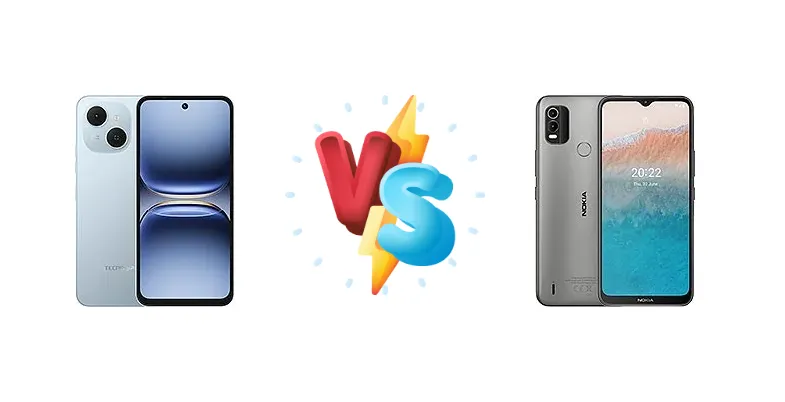
The Tecno Spark 40C and Nokia C21 Plus represent two distinct approaches to the ultra-budget smartphone market. The Tecno prioritizes performance with a more powerful chipset, while the Nokia focuses on a clean software experience and potentially longer software support. This comparison dives deep into the hardware and software differences to determine which phone offers the best value.
🏆 Quick Verdict
For most users, the Tecno Spark 40C emerges as the stronger choice. Its Mediatek Helio G81 chipset delivers significantly better performance than the Nokia C21 Plus’ Unisoc SC9863A, making it more suitable for gaming and demanding apps. While the Nokia offers a cleaner software experience, the performance gap is too substantial to ignore.
| Network |
|---|
| 2G bands | GSM 850 / 900 / 1800 / 1900 | GSM 850 / 900 / 1800 / 1900 |
| 3G bands | HSDPA 900 / 2100 | HSDPA 850 / 900 / 2100 |
| 4G bands | LTE | LTE |
| Speed | HSPA, LTE | HSPA 42.2/5.76 Mbps, LTE Cat4 150/50 Mbps |
| Technology | GSM / HSPA / LTE | GSM / HSPA / LTE |
| | - | HSDPA 850 / 900 / 1700(AWS) / 1900 / 2100 |
| Launch |
|---|
| Announced | 2025, July 19 | 2022, February 28 |
| Status | Available. Released 2025, August | Available. Released 2022, April 29 |
| Body |
|---|
| Build | Glass front, plastic back, plastic frame | Glass front, aluminum frame, plastic back |
| Dimensions | 165.6 x 77 x 8.4 mm (6.52 x 3.03 x 0.33 in) | 164.8 x 75.9 x 8.6 mm (6.49 x 2.99 x 0.34 in) |
| SIM | Nano-SIM + Nano-SIM | · Nano-SIM· Nano-SIM + Nano-SIM |
| Weight | - | 178 g or 191 g (6.28 oz) |
| | - | Splash protection |
| Display |
|---|
| Protection | - | Scratch-resistant glass |
| Resolution | 720 x 1600 pixels, 20:9 ratio (~263 ppi density) | 720 x 1600 pixels, 20:9 ratio (~269 ppi density) |
| Size | 6.67 inches, 107.4 cm2 (~84.2% screen-to-body ratio) | 6.52 inches, 102.6 cm2 (~82.1% screen-to-body ratio) |
| Type | IPS LCD, 120Hz | IPS LCD |
| Platform |
|---|
| CPU | Octa-core (2x2.0 GHz Cortex-A75 & 6x1.8 GHz Cortex-A55) | Octa-core (4x1.6 GHz Cortex-A55 & 4x1.2 GHz Cortex-A55) |
| Chipset | Mediatek Helio G81 (12 nm) | Unisoc SC9863A (28 nm) |
| GPU | Mali-G52 MC2 | IMG8322 |
| OS | Android 15, HIOS 15.1 | Android 11 (Go edition) |
| Memory |
|---|
| Card slot | Unspecified | microSDXC (dedicated slot) |
| Internal | 128GB 4GB RAM, 128GB 8GB RAM, 256GB 8GB RAM | 32GB 2GB RAM, 32GB 3GB RAM, 64GB 2GB RAM, 64GB 3GB RAM, 64GB 4GB RAM |
| | - | eMMC 5.1 |
| Main Camera |
|---|
| Dual | - | 13 MP, (wide), AF
Auxiliary lens |
| Features | Dual-LED flash, HDR | LED flash, HDR, panorama |
| Single | 13 MP, f/1.8, 27mm (wide), PDAF | 5 MP |
| Video | 1080p@30fps | 1080p@30fps |
| Selfie camera |
|---|
| Features | - | LED flash |
| Single | 8 MP | 5 MP |
| Video | Yes | 720p |
| Sound |
|---|
| 3.5mm jack | - | Yes |
| 35mm jack | Yes | Yes |
| Loudspeaker | Yes, with dual speakers | Yes |
| Comms |
|---|
| Bluetooth | Yes | 4.2, A2DP |
| Infrared port | Yes | - |
| NFC | No | No |
| Positioning | GPS | GPS |
| Radio | FM radio | FM radio |
| USB | USB Type-C, OTG | microUSB 2.0 |
| WLAN | Yes | Wi-Fi 802.11 b/g/n |
| Features |
|---|
| Sensors | Fingerprint (side-mounted); unspecified sensors | Fingerprint (rear-mounted), accelerometer, proximity |
| Battery |
|---|
| Charging | 18W wired | 10W wired |
| Type | 6000 mAh | Li-Ion 4000/5050 mAh |
| Misc |
|---|
| Colors | Veil White, Ripple Blue, Titanium Grey, Ink Black | Dark Cyan, Warm Gray |
| Models | KM4k | TA-1433, TA-1431, TA-1426, TA-1424 |
| Price | About 90 EUR | About 120 EUR |
| SAR | - | 0.57 W/kg (head) 0.65 W/kg (body) |
| SAR EU | - | 0.40 W/kg (head) 0.99 W/kg (body) |
Tecno Spark 40C
- Significantly faster processor for gaming and apps
- Faster 18W charging
- Potentially better low-light camera performance
- Software experience may be less clean than Nokia
- May receive fewer software updates
Nokia C21 Plus
- Clean Android Go Edition software
- Potentially longer software support from Nokia
- Compact and lightweight design
- Significantly slower processor
- Slow 10W charging
- Limited gaming capabilities
Display Comparison
Neither device boasts a standout display. Both likely feature LCD panels, typical for this price bracket. However, details like resolution and peak brightness are missing. The Nokia C21 Plus’ smaller screen size (6.5 inches vs. the Tecno’s 6.6 inches) may offer slightly higher pixel density, but the difference will be minimal. The absence of high refresh rates on both devices means scrolling and animations won’t be as fluid as on more expensive phones.
Camera Comparison
Camera performance is likely to be similar, with both phones targeting basic photography needs. Details on sensor sizes and apertures are unavailable, but given the price point, expectations should be tempered. The focus should be on adequate performance in good lighting conditions. The presence of a dedicated night mode on the Tecno Spark 40C *might* offer a slight advantage in low-light scenarios, but image processing quality will be a key differentiator. The inclusion of a 2MP macro lens on both devices is largely a marketing gimmick and unlikely to deliver significant improvements in image quality.
Performance
The performance disparity is the most significant difference. The Tecno Spark 40C’s Mediatek Helio G81, built on a 12nm process, features a more modern CPU architecture – specifically, two Cortex-A75 cores alongside six Cortex-A55 cores – compared to the Nokia C21 Plus’ Unisoc SC9863A. The Unisoc chip utilizes four Cortex-A55 cores at 1.6GHz and another four at 1.2GHz, and is fabricated on a much older 28nm process. This translates to a substantial performance advantage for the Tecno in CPU-intensive tasks and gaming. The Helio G81’s GPU will also provide a smoother gaming experience. The 28nm process of the Unisoc chip will also result in higher power consumption for similar tasks.
Battery Life
While battery capacity isn’t specified, both phones likely house batteries in the 4000-5000mAh range. However, the Tecno Spark 40C’s 18W wired charging is a clear advantage over the Nokia C21 Plus’ 10W charging. This means the Tecno will recharge significantly faster, reducing downtime. The more efficient Helio G81 chipset may also contribute to slightly better battery life under heavy use, despite potentially having a similar capacity battery.
Buying Guide
Buy the Tecno Spark 40C if you need a phone capable of handling more than basic tasks, enjoy mobile gaming, or value faster app loading times. Its 18W charging also provides a quicker top-up. Buy the Nokia C21 Plus if you prioritize a streamlined Android Go experience, potentially longer software updates (a Nokia strength), and are primarily focused on essential communication features like calls and messaging.
Frequently Asked Questions
❓ Is the Mediatek Helio G81 in the Tecno Spark 40C capable of running demanding games like PUBG Mobile?
Yes, the Helio G81 is a capable gaming chipset for its price range. While you may need to lower graphics settings for optimal performance in PUBG Mobile, it will provide a playable experience, unlike the Unisoc SC9863A in the Nokia C21 Plus, which would struggle significantly.
❓ Does the Nokia C21 Plus’ Android Go Edition offer a smoother experience than a standard Android installation on the Tecno Spark 40C?
Android Go Edition is designed for devices with limited resources. It uses less storage space and RAM, potentially making the Nokia C21 Plus *feel* smoother despite its weaker processor. However, the Tecno Spark 40C’s more powerful chipset will ultimately provide a faster and more responsive experience overall, even with a standard Android installation.
❓ How long will it take to fully charge each phone from 0%?
With 18W charging, the Tecno Spark 40C should fully charge in approximately 2-3 hours, assuming a 4000-5000mAh battery. The Nokia C21 Plus, with its 10W charging, will likely take 4-5 hours to reach 100%.