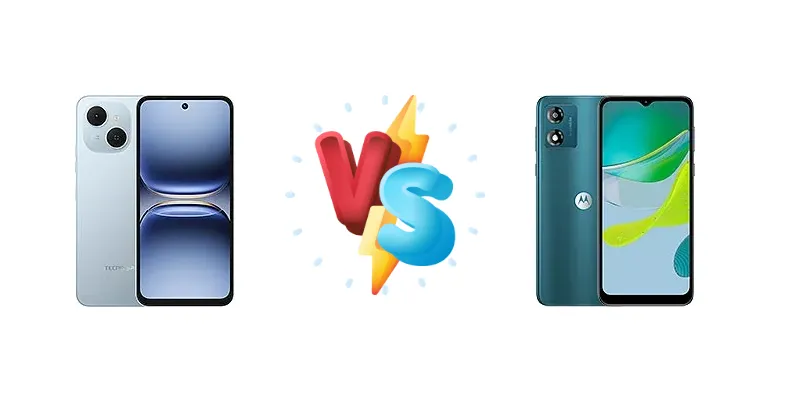
The Tecno Spark 40C and Motorola Moto E13 represent the fiercely competitive sub-$150 smartphone market. Both aim to deliver essential smartphone functionality at an accessible price, but they take different approaches to achieving this. The Spark 40C prioritizes processing power with a MediaTek Helio G81, while the Moto E13 opts for the Unisoc T606, focusing on efficiency. This comparison will dissect their key differences to determine which device offers the best value.
🏆 Quick Verdict
For users prioritizing performance and faster charging, the Tecno Spark 40C is the clear winner. Its Helio G81 chipset offers a noticeable performance advantage over the Moto E13’s Unisoc T606, and the 18W charging significantly reduces downtime. However, the Moto E13 remains a viable option for those seeking a basic, reliable smartphone with a clean software experience.
| Network |
|---|
| 2G bands | GSM 850 / 900 / 1800 / 1900 | GSM 850 / 900 / 1800 / 1900 |
| 3G bands | HSDPA 900 / 2100 | HSDPA 850 / 900 / 2100 |
| 4G bands | LTE | 1, 3, 5, 7, 8, 28, 38, 40, 41 |
| Speed | HSPA, LTE | HSPA, LTE |
| Technology | GSM / HSPA / LTE | GSM / HSPA / LTE |
| | - | 1, 3, 5, 7, 8, 20, 28, 38, 40, 41 |
| Launch |
|---|
| Announced | 2025, July 19 | 2023, January 24 |
| Status | Available. Released 2025, August | Available. Released 2023, February 13 |
| Body |
|---|
| Build | Glass front, plastic back, plastic frame | Glass front, plastic frame, plastic back |
| Dimensions | 165.6 x 77 x 8.4 mm (6.52 x 3.03 x 0.33 in) | 164.2 x 75 x 8.5 mm (6.46 x 2.95 x 0.33 in) |
| SIM | Nano-SIM + Nano-SIM | Nano-SIM + Nano-SIM |
| Weight | - | 179.5 g (6.35 oz) |
| | - | Water-resistant design |
| Display |
|---|
| Resolution | 720 x 1600 pixels, 20:9 ratio (~263 ppi density) | 720 x 1600 pixels, 20:9 ratio (~270 ppi density) |
| Size | 6.67 inches, 107.4 cm2 (~84.2% screen-to-body ratio) | 6.5 inches, 102.0 cm2 (~82.8% screen-to-body ratio) |
| Type | IPS LCD, 120Hz | IPS LCD |
| Platform |
|---|
| CPU | Octa-core (2x2.0 GHz Cortex-A75 & 6x1.8 GHz Cortex-A55) | Octa-core (2x1.6 GHz Cortex-A75 & 6x1.6 GHz Cortex-A55) |
| Chipset | Mediatek Helio G81 (12 nm) | Unisoc T606 (12 nm) |
| GPU | Mali-G52 MC2 | Mali-G57 MP1 |
| OS | Android 15, HIOS 15.1 | Android 13 (Go edition) |
| Memory |
|---|
| Card slot | Unspecified | microSDXC (dedicated slot) |
| Internal | 128GB 4GB RAM, 128GB 8GB RAM, 256GB 8GB RAM | 32GB 2GB RAM, 64GB 2GB RAM, 64GB 4GB RAM, 128GB 8GB RAM |
| | - | eMMC 5.1 |
| Main Camera |
|---|
| Features | Dual-LED flash, HDR | LED flash, HDR, panorama |
| Single | 13 MP, f/1.8, 27mm (wide), PDAF | 13 MP, f/2.2, (wide), 1.12µm, PDAF |
| Video | 1080p@30fps | 1080p@30fps |
| Selfie camera |
|---|
| Single | 8 MP | 5 MP, f/2.4, (wide), 1/5.0", 1.12µm |
| Video | Yes | 1080p@30fps |
| Sound |
|---|
| 3.5mm jack | - | Yes |
| 35mm jack | Yes | Yes |
| Loudspeaker | Yes, with dual speakers | Yes |
| Comms |
|---|
| Bluetooth | Yes | 5.0, A2DP, LE |
| Infrared port | Yes | - |
| NFC | No | No |
| Positioning | GPS | GPS, GLONASS, GALILEO |
| Radio | FM radio | FM radio, recording |
| USB | USB Type-C, OTG | USB Type-C 2.0, OTG |
| WLAN | Yes | Wi-Fi 802.11 a/b/g/n/ac, dual-band |
| Features |
|---|
| Sensors | Fingerprint (side-mounted); unspecified sensors | Accelerometer, proximity |
| Battery |
|---|
| Charging | 18W wired | 10W wired |
| Type | 6000 mAh | Li-Po 5000 mAh |
| Misc |
|---|
| Colors | Veil White, Ripple Blue, Titanium Grey, Ink Black | Cosmic Black, Creamy White, Aurora Green |
| Models | KM4k | - |
| Price | About 90 EUR | $ 119.99 / € 104.99 |
Tecno Spark 40C
- Faster processor (Helio G81)
- Faster charging (18W)
- Potentially better multitasking performance
- May generate more heat under load
- Software experience may be more cluttered
Motorola Moto E13
- Clean Android experience
- Potentially better battery life during light use
- Generally more affordable
- Slower processor (Unisoc T606)
- Slower charging (10W)
- Less responsive user interface
Display Comparison
Neither device boasts a standout display. Both utilize 12nm chipsets, suggesting similar power constraints impacting display capabilities. While specific display specs (resolution, panel type) are missing, the focus here is on performance. The absence of high refresh rates or advanced features like LTPO on either device is typical for this price bracket. Bezels are likely to be substantial on both, prioritizing cost reduction over premium aesthetics.
Camera Comparison
Without detailed camera specifications, a direct comparison is limited. Both phones likely feature a primary camera and potentially a secondary depth or macro sensor. Given the price point, image quality will be heavily reliant on software processing. The absence of Optical Image Stabilization (OIS) on either device suggests that low-light performance will be a challenge. The focus should be on the main sensor resolution and aperture, which are currently unknown. The 2MP macro cameras often found in this segment are generally of limited practical use.
Performance
The core difference lies in the chipsets. The Tecno Spark 40C’s MediaTek Helio G81, with its 2x2.0 GHz Cortex-A75 cores and 6x1.8 GHz Cortex-A55 cores, offers a performance edge over the Motorola Moto E13’s Unisoc T606 (2x1.6 GHz Cortex-A75 & 6x1.6 GHz Cortex-A55). The higher clock speeds of the G81’s prime cores translate to snappier app launches and smoother multitasking. While both are octa-core designs, the G81’s architecture provides a tangible advantage in CPU-intensive tasks. The Unisoc T606 prioritizes efficiency, potentially leading to slightly better battery life under light loads, but at the cost of overall responsiveness. RAM configurations are crucial, but absent from the provided data; however, the G81 will extract more performance from any given RAM amount.
Battery Life
The Tecno Spark 40C’s 18W wired charging is a significant advantage over the Motorola Moto E13’s 10W charging. This translates to substantially faster charging times, reducing downtime. While battery capacity isn’t specified, the faster charging speed allows the Spark 40C to recover more quickly from heavy usage. The Unisoc T606’s efficiency might offer slightly longer battery life during basic tasks, but the convenience of faster charging on the Tecno Spark 40C is a compelling benefit.
Buying Guide
Buy the Tecno Spark 40C if you need a phone capable of handling moderate gaming, multitasking, and benefit from quicker charging times. This is ideal for students or users who consume a lot of media on the go. Buy the Motorola Moto E13 if you prefer a simpler, more streamlined Android experience with a focus on essential functions like calls, messaging, and light social media use, and prioritize battery life over raw performance.
Frequently Asked Questions
❓ Will the Tecno Spark 40C struggle with demanding games like PUBG Mobile?
While the Helio G81 can handle PUBG Mobile, you'll likely need to lower graphics settings to achieve a consistently smooth frame rate. The phone may experience some thermal throttling during extended gaming sessions, impacting performance over time. The Moto E13 would struggle even more with demanding titles.
❓ Is the software on the Motorola Moto E13 truly 'clean'?
Motorola's Android implementation is known for being close to stock Android, with minimal bloatware and a streamlined user interface. This contrasts with Tecno's HiOS, which often includes pre-installed apps and customizations. However, 'clean' is subjective; Motorola still includes its own suite of apps, though they are generally less intrusive.
❓ How much faster is the 18W charging on the Tecno Spark 40C compared to the 10W charging on the Moto E13?
The 18W charging on the Tecno Spark 40C will likely reduce charging time by approximately 40-50% compared to the Moto E13’s 10W charging. This means a full charge could take around 2-3 hours on the Moto E13, while the Tecno Spark 40C could achieve a full charge in approximately 1.5-2 hours.