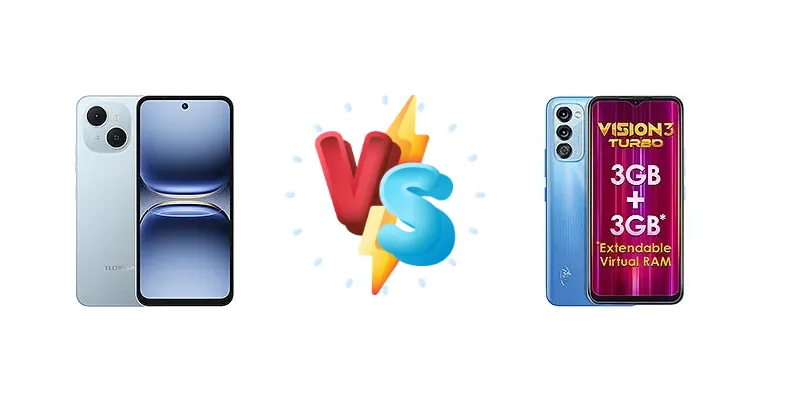
The Tecno Spark 40C and itel Vision 3 Turbo represent the fiercely competitive sub-$150 smartphone market. Both aim to deliver essential features at an accessible price, but they take drastically different approaches to core components, particularly the chipset. This comparison dissects those differences to determine which device offers the best value for your money.
🏆 Quick Verdict
For most users, the Tecno Spark 40C emerges as the stronger choice. Its Mediatek Helio G81 chipset, built on a more efficient 12nm process, provides a significant performance advantage over the itel Vision 3 Turbo’s Unisoc SC9863A, translating to smoother multitasking and better gaming capabilities. While both offer 18W charging, the G81’s efficiency helps offset the likely smaller battery capacity.
| Network |
|---|
| 2G bands | GSM 850 / 900 / 1800 / 1900 | GSM 850 / 900 / 1800 / 1900 |
| 3G bands | HSDPA 900 / 2100 | HSDPA 850 / 900 / 2100 |
| 4G bands | LTE | LTE |
| Speed | HSPA, LTE | HSPA, LTE |
| Technology | GSM / HSPA / LTE | GSM / HSPA / LTE |
| Launch |
|---|
| Announced | 2025, July 19 | 2022 |
| Status | Available. Released 2025, August | Available. Released 2022 |
| Body |
|---|
| Build | Glass front, plastic back, plastic frame | - |
| Dimensions | 165.6 x 77 x 8.4 mm (6.52 x 3.03 x 0.33 in) | - |
| SIM | Nano-SIM + Nano-SIM | Dual SIM |
| Weight | - | - |
| Display |
|---|
| Resolution | 720 x 1600 pixels, 20:9 ratio (~263 ppi density) | 720 x 1600 pixels, 20:9 ratio (~266 ppi density) |
| Size | 6.67 inches, 107.4 cm2 (~84.2% screen-to-body ratio) | 6.6 inches, 105.2 cm2 |
| Type | IPS LCD, 120Hz | IPS LCD |
| Platform |
|---|
| CPU | Octa-core (2x2.0 GHz Cortex-A75 & 6x1.8 GHz Cortex-A55) | Octa-core (4x1.6 GHz Cortex-A55 & 4x1.2 GHz Cortex-A55) |
| Chipset | Mediatek Helio G81 (12 nm) | Unisoc SC9863A (28 nm) |
| GPU | Mali-G52 MC2 | IMG8322 |
| OS | Android 15, HIOS 15.1 | Android 11 (Go edition) |
| Memory |
|---|
| Card slot | Unspecified | microSDXC |
| Internal | 128GB 4GB RAM, 128GB 8GB RAM, 256GB 8GB RAM | 64GB 3GB RAM |
| Main Camera |
|---|
| Features | Dual-LED flash, HDR | LED flash |
| Single | 13 MP, f/1.8, 27mm (wide), PDAF | 8 MP (wide)
Auxiliary lens |
| Video | 1080p@30fps | 1080p@30fps |
| Selfie camera |
|---|
| Single | 8 MP | 5 MP |
| Video | Yes | Yes |
| Sound |
|---|
| 35mm jack | Yes | Yes |
| Loudspeaker | Yes, with dual speakers | Yes |
| Comms |
|---|
| Bluetooth | Yes | Yes |
| Infrared port | Yes | - |
| NFC | No | No |
| Positioning | GPS | GPS |
| Radio | FM radio | Unspecified |
| USB | USB Type-C, OTG | microUSB |
| WLAN | Yes | Yes |
| Features |
|---|
| Sensors | Fingerprint (side-mounted); unspecified sensors | Fingerprint (rear-mounted), accelerometer |
| Battery |
|---|
| Charging | 18W wired | 18W wired |
| Type | 6000 mAh | 5000 mAh |
| Misc |
|---|
| Colors | Veil White, Ripple Blue, Titanium Grey, Ink Black | Blue |
| Models | KM4k | - |
| Price | About 90 EUR | - |
Tecno Spark 40C
- Superior chipset performance with the Helio G81
- More efficient 12nm fabrication process
- Potentially better camera image processing
- May have a slightly higher price point
- Battery capacity not specified, could be smaller than itel
itel Vision 3 Turbo
- Likely the most affordable option
- 18W fast charging support
- Acceptable for basic smartphone tasks
- Significantly weaker chipset performance
- Less efficient 28nm process leads to higher power consumption
- Potentially lower quality camera output
Display Comparison
Neither device’s display specifications are detailed in the provided data, so analysis relies on market positioning. Given the price bracket, both likely feature LCD panels with 720p+ resolution. However, the Tecno brand generally incorporates slightly better color calibration and brightness levels in its displays. Expect both to have noticeable bezels, typical of this segment. Without PWM frequency data, it's impossible to assess flicker-related eye strain differences.
Camera Comparison
Without sensor details, a direct camera comparison is limited. Both devices likely feature a primary camera alongside auxiliary lenses (potentially 2MP macro/depth sensors). The Tecno brand often emphasizes camera software enhancements, potentially offering better image processing algorithms. However, the Unisoc chipset’s image signal processor (ISP) is likely less capable than the one found in the Helio G81, potentially resulting in lower dynamic range and less detail in photos. The aperture of the main lens will be a key differentiator, but that information is unavailable.
Performance
The core difference lies in the chipsets. The Tecno Spark 40C’s Mediatek Helio G81 (12nm) boasts an octa-core configuration with two Cortex-A75 cores clocked at 2.0 GHz, paired with six Cortex-A55 cores at 1.8 GHz. This architecture provides a substantial performance uplift compared to the itel Vision 3 Turbo’s Unisoc SC9863A (28nm). The Unisoc chip uses four Cortex-A55 cores at 1.6 GHz and another four at 1.2 GHz. The 28nm fabrication process of the Unisoc chip is significantly less efficient, meaning it will generate more heat and consume more power for the same level of performance. This impacts sustained performance and battery life. The G81’s A75 cores offer a noticeable advantage in single-core tasks and gaming.
Battery Life
Both phones support 18W wired charging, suggesting similar charging speeds. However, the Unisoc SC9863A’s less efficient 28nm process will likely result in faster battery drain under load. While the battery capacity isn’t specified, the Helio G81’s efficiency gives the Tecno Spark 40C a potential advantage in overall battery life, even with a similar capacity. Expect both to achieve a full charge in approximately 2-3 hours with a compatible charger.
Buying Guide
Buy the Tecno Spark 40C if you prioritize responsiveness and the ability to handle moderately demanding apps and games. It’s ideal for users who frequently switch between applications or enjoy casual gaming. Buy the itel Vision 3 Turbo if your primary needs are basic communication – calls, texts, and light social media – and you’re looking for the absolute lowest price point, accepting compromises in performance.
Frequently Asked Questions
❓ Will the Unisoc SC9863A struggle with popular apps like WhatsApp and Facebook?
While the Unisoc SC9863A can handle basic apps like WhatsApp and Facebook, expect slower loading times and occasional lag, especially when multitasking. The chipset’s limited processing power will become noticeable with even moderate usage.
❓ Is the 18W charging on the itel Vision 3 Turbo truly 'fast charging'?
18W charging is considered relatively slow by today’s standards. While it’s faster than standard 5W charging, it will still take approximately 2-3 hours to fully charge either device. The efficiency of the chipset will impact how quickly the battery actually charges.
❓ Can the Tecno Spark 40C handle light gaming like PUBG Mobile or Call of Duty Mobile?
The Tecno Spark 40C’s Helio G81 is capable of running PUBG Mobile and Call of Duty Mobile at low to medium settings with acceptable frame rates. However, expect some frame drops during intense action sequences. The itel Vision 3 Turbo would struggle significantly with these titles.
❓ Does the Tecno Spark 40C have any software features to optimize battery life?
Tecno’s HiOS software typically includes battery optimization features such as app power management and a battery saver mode. These features can help extend battery life, especially on the more efficient Helio G81 chipset.