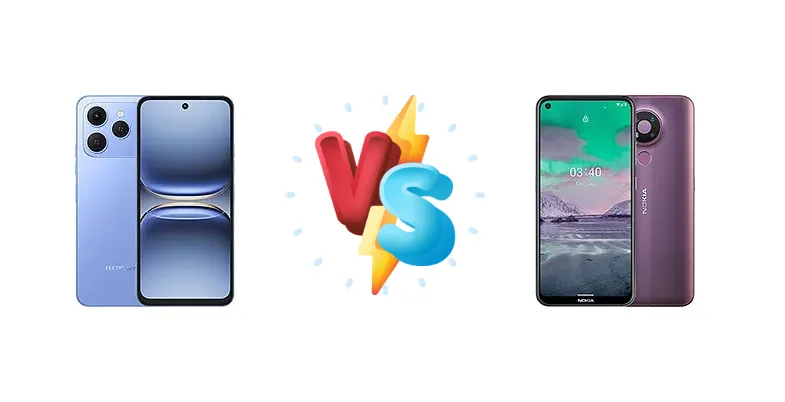
The Tecno Spark 40 and Nokia 3.4 represent distinct approaches to the budget smartphone market. The Spark 40 prioritizes performance with a more powerful chipset and rapid charging, while the Nokia 3.4 aims for a balance of efficiency and a clean software experience. This comparison dissects their key specifications to determine which device delivers the best value for your money.
🏆 Quick Verdict
For the average user prioritizing responsiveness and quick top-ups, the Tecno Spark 40 emerges as the winner. Its Mediatek Helio G81 chipset offers a noticeable performance edge over the Snapdragon 460 in the Nokia 3.4, and the 45W charging is a game-changer in this price segment. However, the Nokia 3.4 remains a viable option for those valuing software simplicity and potentially longer battery life during light use.
| Network |
|---|
| 2G bands | GSM 850 / 900 / 1800 / 1900 | GSM 850 / 900 / 1800 / 1900 |
| 3G bands | HSDPA 900 / 2100 | HSDPA 850 / 900 / 1700(AWS) / 1900 / 2100 |
| 4G bands | LTE | 1, 2, 3, 4, 5, 7, 8, 12, 17, 13, 28, 66 |
| Speed | HSPA, LTE | HSPA, LTE |
| Technology | GSM / HSPA / LTE | GSM / HSPA / LTE |
| Launch |
|---|
| Announced | 2025, July 02 | 2020, September 22. Released 2020, October 26 |
| Status | Available. Released 2025, July | Discontinued |
| Body |
|---|
| Dimensions | 165.6 x 77 x 7.7 mm (6.52 x 3.03 x 0.30 in) | 161 x 76 x 8.7 mm (6.34 x 2.99 x 0.34 in) |
| SIM | Nano-SIM + Nano-SIM | · Nano-SIM· Nano-SIM + Nano-SIM |
| Weight | - | 180 g (6.35 oz) |
| Display |
|---|
| Resolution | 720 x 1600 pixels, 20:9 ratio (~263 ppi density) | 720 x 1560 pixels, 19.5:9 ratio (~269 ppi density) |
| Size | 6.67 inches, 107.4 cm2 (~84.2% screen-to-body ratio) | 6.39 inches, 100.2 cm2 (~81.9% screen-to-body ratio) |
| Type | IPS LCD, 120Hz | IPS LCD, 400 nits (typ) |
| Platform |
|---|
| CPU | Octa-core (2x2.0 GHz Cortex-A75 & 6x1.8 GHz Cortex-A55) | Octa-core (4x1.8 GHz Cortex-A73 & 4x1.8 GHz Cortex-A53) |
| Chipset | Mediatek Helio G81 (12 nm)Mediatek Helio G91 (12 nm) - NFC model | Qualcomm SM4250 Snapdragon 460 (11 nm) |
| GPU | Mali-G52 MC2 | Adreno 610 |
| OS | Android 15, HIOS 15 | Android 10, upgradable to Android 11 |
| Memory |
|---|
| Card slot | microSDXC | microSDXC (dedicated slot) |
| Internal | 128GB 4GB RAM, 128GB 6GB RAM, 256GB 4GB RAM, 256GB 8GB RAM | 32GB 3GB RAM, 64GB 3GB RAM, 64GB 4GB RAM |
| | - | eMMC 5.1 |
| Main Camera |
|---|
| Features | Dual-LED flash | LED flash, HDR, panorama |
| Single | 50 MP, (wide), PDAF
Auxiliary lens | - |
| Triple | - | 13 MP, (wide), PDAF
5 MP, (ultrawide)
Auxiliary lens |
| Video | 1440p@30fps, 1080p@30fps | 1080p@30fps |
| Selfie camera |
|---|
| Features | Dual-LED flash | - |
| Single | 8 MP, (wide) | 8 MP, (wide) |
| Video | 1080p@30fps | 1080p@30fps |
| Sound |
|---|
| 3.5mm jack | - | Yes |
| 35mm jack | Yes | Yes |
| Loudspeaker | Yes, with stereo speakers | Yes |
| Comms |
|---|
| Bluetooth | Yes | 4.2, A2DP, aptX |
| Infrared port | Yes | - |
| NFC | Yes (market/region dependent) | Yes (market/region dependent) |
| Positioning | GPS | GPS, GLONASS, GALILEO, BDS |
| Radio | FM radio | FM radio |
| USB | USB Type-C | USB Type-C 2.0 |
| WLAN | Yes | Wi-Fi 802.11 b/g/n |
| Features |
|---|
| Sensors | Fingerprint (side-mounted); unspecified sensors | Fingerprint (rear-mounted), accelerometer, gyro, proximity |
| Battery |
|---|
| Charging | 45W wired, 55 min to 100% | 10W wired |
| Type | 5200 mAh | Li-Po 4000 mAh |
| Misc |
|---|
| Colors | Ink Black, Titanium Grey, Veil White, Mirage Blue | Fjord, Dusk, Charcoal |
| Models | KM5 | TA-1288, TA-1285, TA-1283 |
| Price | About 110 EUR | About 100 EUR |
| SAR | - | 0.83 W/kg (head) 1.05 W/kg (body) |
| SAR EU | - | 0.36 W/kg (head) 1.56 W/kg (body) |
Tecno Spark 40
- Significantly faster charging (45W)
- More powerful processor (Helio G81)
- Potentially better gaming performance
- Software may be heavily customized
- Potentially less efficient battery life
Nokia 3.4
- Clean Android experience
- Potentially better battery efficiency
- More understated design
- Slow charging (10W)
- Less powerful processor (Snapdragon 460)
- Slower app loading and multitasking
Display Comparison
Neither device boasts a standout display. Both likely feature LCD panels, common in this price bracket. The focus here isn't on visual fidelity, but on usability. While specific display specs are missing, the Tecno Spark 40's larger target audience suggests a potentially larger screen size, which could be beneficial for media consumption. However, without knowing the resolution and brightness levels, it's difficult to definitively declare a winner.
Camera Comparison
Camera performance is difficult to assess without detailed sensor information. Both phones likely feature a multi-camera setup, but the emphasis should be on the main sensor. Given the price point, image quality will be heavily reliant on software processing. The Nokia 3.4's image processing tends to be more natural, while Tecno often employs more aggressive sharpening and color boosting. Without knowing the megapixel counts and aperture values, it's impossible to declare a clear winner, but the G81's ISP capabilities *could* offer slightly better image processing potential.
Performance
The core difference lies in the chipsets. The Tecno Spark 40 utilizes the Mediatek Helio G81 (or G91 in NFC models), built on a 12nm process, featuring an octa-core configuration with two Cortex-A75 cores clocked at 2.0 GHz and six Cortex-A55 cores at 1.8 GHz. This contrasts with the Nokia 3.4’s Qualcomm Snapdragon 460 (11nm) with four Cortex-A73 cores at 1.8 GHz and four Cortex-A53 cores at 1.8 GHz. The Helio G81’s Cortex-A75 cores represent a significant architectural upgrade over the A73 cores in the Snapdragon 460, translating to faster single-core performance and improved responsiveness in applications. The 11nm process of the Snapdragon 460 *should* offer better efficiency, but the G81's performance advantage is likely more noticeable in everyday use. The G81 is also more commonly paired with a more capable GPU, further widening the performance gap for gaming.
Battery Life
The Tecno Spark 40’s 45W wired charging is a massive advantage. It promises a full charge in approximately 55 minutes, a significant improvement over the Nokia 3.4’s sluggish 10W charging. While the Nokia 3.4 might have a slightly larger battery capacity (spec not provided), the faster charging of the Spark 40 mitigates any potential battery life disadvantage. Users who frequently top up their phones will greatly benefit from the Spark 40’s charging speed.
Buying Guide
Buy the Tecno Spark 40 if you need a phone for moderate gaming, frequent multitasking, or simply want a device that feels snappy and charges incredibly quickly. Buy the Nokia 3.4 if you prioritize a clean Android experience, value battery life for basic tasks like calls and messaging, and prefer a more understated design. The Nokia 3.4 is also a better choice for users who dislike aggressive software customization.
Frequently Asked Questions
❓ Does the Mediatek Helio G81 in the Tecno Spark 40 get hot during extended gaming sessions?
The Helio G81 is known to generate more heat than the Snapdragon 460. While the Spark 40 likely has thermal management features, prolonged gaming at high settings *could* lead to some throttling. However, the performance uplift is significant enough that even with some throttling, the gaming experience will likely be superior to the Nokia 3.4.
❓ Is the software on the Tecno Spark 40 heavily modified from stock Android?
Tecno's HiOS is known for its extensive customization. Expect a different user interface compared to the near-stock Android experience on the Nokia 3.4. This includes pre-installed apps and altered system settings. While HiOS offers features some users may appreciate, others may prefer the simplicity of Nokia's Android One implementation.
❓ How much slower is the 10W charging on the Nokia 3.4 compared to the Tecno Spark 40's 45W?
The difference is substantial. A full charge on the Nokia 3.4 with its 10W charger will likely take over 3 hours, whereas the Tecno Spark 40 can achieve a full charge in around 55 minutes. This means you can quickly top up the Spark 40 during short breaks, something the Nokia 3.4 simply can't offer.