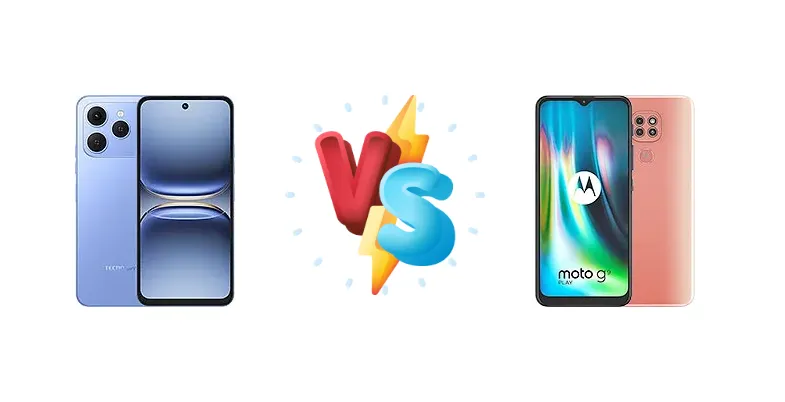
The Tecno Spark 40 and Motorola Moto G9 Play represent compelling options in the sub-$150 smartphone market. While both aim to deliver essential features at an accessible price, they diverge in their core hardware choices, particularly in chipset and charging technology. This comparison dissects these differences to determine which device offers the best value for your money.
🏆 Quick Verdict
For the average user prioritizing quick top-ups and slightly better performance, the Tecno Spark 40 is the stronger choice. Its 45W charging significantly outperforms the Moto G9 Play’s 20W, and the Helio G81 offers a modest performance advantage. However, the Moto G9 Play’s display brightness is a notable strength.
| Network |
|---|
| 2G bands | GSM 850 / 900 / 1800 / 1900 | GSM 850 / 900 / 1800 / 1900 |
| 3G bands | HSDPA 900 / 2100 | HSDPA 850 / 900 / 1900 / 2100 |
| 4G bands | LTE | 1, 2, 3, 5, 7, 8, 18, 19, 20, 26, 28, 38, 40, 41 |
| EDGE | - | Class 10 |
| GPRS | - | Class 10 |
| Speed | HSPA, LTE | HSPA 42.2/5.76 Mbps, LTE Cat4 150/50 Mbps |
| Technology | GSM / HSPA / LTE | GSM / HSPA / LTE |
| Launch |
|---|
| Announced | 2025, July 02 | 2020, August 24. Released 2020, August 28 |
| Status | Available. Released 2025, July | Discontinued |
| Body |
|---|
| Build | - | Glass front, plastic back, plastic frame |
| Dimensions | 165.6 x 77 x 7.7 mm (6.52 x 3.03 x 0.30 in) | 165.2 x 75.7 x 9.2 mm (6.50 x 2.98 x 0.36 in) |
| Keyboard | - | QWERTY |
| SIM | Nano-SIM + Nano-SIM | · Nano-SIM· Nano-SIM + Nano-SIM |
| Weight | - | 200 g (7.05 oz) |
| | - | Water-repellent coating |
| Display |
|---|
| Resolution | 720 x 1600 pixels, 20:9 ratio (~263 ppi density) | 720 x 1600 pixels, 20:9 ratio (~269 ppi density) |
| Size | 6.67 inches, 107.4 cm2 (~84.2% screen-to-body ratio) | 6.5 inches, 102.8 cm2 (~82.2% screen-to-body ratio) |
| Type | IPS LCD, 120Hz | IPS LCD |
| Platform |
|---|
| CPU | Octa-core (2x2.0 GHz Cortex-A75 & 6x1.8 GHz Cortex-A55) | Octa-core (4x2.0 GHz Kryo 260 Gold & 4x1.8 GHz Kryo 260 Silver) |
| Chipset | Mediatek Helio G81 (12 nm)Mediatek Helio G91 (12 nm) - NFC model | Qualcomm SM6115 Snapdragon 662 (11 nm) |
| GPU | Mali-G52 MC2 | Adreno 610 |
| OS | Android 15, HIOS 15 | Android 10, upgradable to Android 11 |
| Memory |
|---|
| Card slot | microSDXC | microSDXC (uses shared SIM slot) |
| Internal | 128GB 4GB RAM, 128GB 6GB RAM, 256GB 4GB RAM, 256GB 8GB RAM | 64GB 4GB RAM, 128GB 4GB RAM |
| Main Camera |
|---|
| Features | Dual-LED flash | LED flash, HDR, panorama |
| Single | 50 MP, (wide), PDAF
Auxiliary lens | 1.3 MP |
| Triple | - | 48 MP, f/1.7, (wide), 1/2.0", 0.8µm, PDAF
2 MP (macro)
Auxiliary lens |
| Video | 1440p@30fps, 1080p@30fps | 1080p@30/60fps |
| Selfie camera |
|---|
| Features | Dual-LED flash | HDR |
| Single | 8 MP, (wide) | 8 MP, f/2.2, 1.12µm |
| Video | 1080p@30fps | 1080p@30fps |
| Sound |
|---|
| 3.5mm jack | - | Yes |
| 35mm jack | Yes | Yes |
| Loudspeaker | Yes, with stereo speakers | Yes |
| Comms |
|---|
| Bluetooth | Yes | 5.0, A2DP, LE |
| Infrared port | Yes | Yes |
| NFC | Yes (market/region dependent) | Yes |
| Positioning | GPS | GPS, GLONASS, GALILEO |
| Radio | FM radio | FM radio |
| USB | USB Type-C | USB Type-C 2.0 |
| WLAN | Yes | Wi-Fi 802.11 a/b/g/n/ac, dual-band, Wi-Fi Direct |
| Features |
|---|
| Browser | - | WAP 2.0/xHTML, HTML (PocketIE) |
| Sensors | Fingerprint (side-mounted); unspecified sensors | Fingerprint (rear-mounted), accelerometer, gyro, proximity |
| Battery |
|---|
| Charging | 45W wired, 55 min to 100% | 20W wired |
| Type | 5200 mAh | Li-Po 5000 mAh |
| Misc |
|---|
| Colors | Ink Black, Titanium Grey, Veil White, Mirage Blue | Forest Green, Sapphire Blue, Spring Pink |
| Models | KM5 | XT2083, XT2083-1 |
| Price | About 110 EUR | About 430 EUR |
| Tests |
|---|
| Camera | - |
Photo / Video |
| Display | - |
Contrast ratio: 1944:1 |
| Loudspeaker | - |
-27.6 LUFS (Good)
|
| Performance | - |
AnTuTu: 170064 (v8)
GeekBench: 1402 (v5.1)
GFXBench: 13fps (ES 3.1 onscreen) |
Tecno Spark 40
- Faster 45W charging
- Potentially better single-core performance with Cortex-A75 cores
- Slightly more powerful GPU
- Display specifications are unknown
- Potential for higher power consumption due to 12nm process
Motorola Moto G9 Play
- Brighter display (465 nits)
- More power-efficient 11nm process
- Established brand reputation
- Slower 20W charging
- Less powerful CPU cores
- Potentially lower gaming performance
Display Comparison
The Motorola Moto G9 Play boasts a measured peak brightness of 465 nits and a 1944:1 contrast ratio, suggesting good visibility in bright conditions. The Tecno Spark 40’s display specifications are not provided, making a direct brightness comparison impossible. However, given the price point, it’s likely the Moto G9 Play holds an advantage in outdoor readability. Both share the same contrast ratio, indicating similar black levels and color depth. Without knowing the panel technology used in the Spark 40 (IPS vs. TFT), it’s difficult to assess color accuracy.
Camera Comparison
Both devices list 'Photo / Video' capabilities, offering minimal insight. Without specific sensor details, it’s challenging to assess camera quality. The absence of information regarding megapixel counts or aperture sizes suggests neither phone prioritizes camera performance as a key selling point. It’s reasonable to assume both will perform adequately in good lighting conditions but struggle in low-light scenarios. The presence of a 2MP macro lens on either device is likely a marketing feature with limited practical benefit.
Performance
The Tecno Spark 40 utilizes the Mediatek Helio G81 (12nm), featuring an octa-core CPU with two Cortex-A75 cores clocked at 2.0 GHz and six Cortex-A55 cores at 1.8 GHz. The Motorola Moto G9 Play is powered by the Qualcomm Snapdragon 662 (11nm), also an octa-core processor with four Kryo 260 Gold cores at 2.0 GHz and four Kryo 260 Silver cores at 1.8 GHz. The Snapdragon 662’s 11nm process *should* offer slightly better power efficiency, but the G81’s Cortex-A75 cores provide a potential edge in single-core performance, impacting app launch speeds and responsiveness. The G81 also has a slightly more powerful GPU, potentially leading to better gaming performance, though both are limited by their respective chipsets.
Battery Life
The Tecno Spark 40 features 45W wired charging, claiming a full charge in 55 minutes. The Motorola Moto G9 Play is limited to 20W wired charging, resulting in a significantly longer charging time. While battery capacity isn’t specified for either device, the faster charging of the Spark 40 is a substantial advantage for users who value convenience. The difference in charging speed will be noticeable in daily use, allowing for quicker top-ups throughout the day.
Buying Guide
Buy the Tecno Spark 40 if you need faster charging speeds and a phone that can handle moderate gaming without significant slowdown. It’s ideal for users who frequently find themselves needing to quickly replenish their battery. Buy the Motorola Moto G9 Play if you prioritize a brighter display for outdoor visibility and are less concerned with maximizing charging speed or demanding gaming performance. It’s a solid choice for everyday tasks and media consumption.
Frequently Asked Questions
❓ Does the Tecno Spark 40’s Helio G81 chip get hot during extended gaming sessions?
The Helio G81 is known to generate some heat under sustained load. While the 12nm process isn’t the most efficient, the Spark 40’s thermal design will determine how well it manages heat. Expect some throttling during prolonged gaming, but it should remain playable for moderate sessions. The Moto G9 Play’s Snapdragon 662, with its 11nm process, may exhibit slightly better thermal performance.
❓ Is the 20W charging on the Moto G9 Play slow compared to other phones in this price range?
Yes, 20W charging is relatively slow compared to the increasingly common 33W or 45W charging solutions found in other budget smartphones. The Moto G9 Play will take considerably longer to fully charge than the Tecno Spark 40, which supports 45W charging. This difference is significant for users who prioritize quick top-ups.
❓ Will the Motorola Moto G9 Play struggle with demanding apps or multitasking?
The Snapdragon 662 is a capable processor for everyday tasks like browsing, social media, and video streaming. However, it may exhibit some slowdown when running multiple demanding apps simultaneously or when switching between them frequently. It’s best suited for users with moderate multitasking needs.