
Tecno Spark 40 Pro+ vs Xiaomi Redmi Note 13 Pro+: A Deep Dive Comparison
| Phones Images | |||||
|---|---|---|---|---|---|
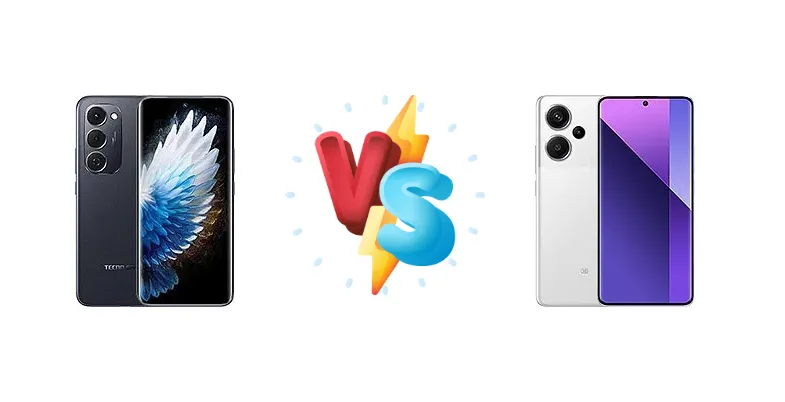
|
🏆 Quick Verdict
For the average user prioritizing all-day battery life and a smooth experience, the Tecno Spark 40 Pro+ emerges as the winner. Its impressive 10:48h active use score and versatile charging options outweigh the Redmi Note 13 Pro+'s faster processor and charging, especially considering the price difference.
| PHONES | ||
|---|---|---|
| Phone Names | Tecno Spark 40 Pro+ | Xiaomi Redmi Note 13 Pro+ |
| Network | ||
|---|---|---|
| 2G bands | GSM 850 / 900 / 1800 / 1900 | GSM 850 / 900 / 1800 / 1900 |
| 3G bands | HSDPA 850 / 900 / 1700(AWS) / 1900 / 2100 | HSDPA 800 / 850 / 900 / 1700(AWS) / 1900 / 2100 - International |
| 4G bands | 1, 2, 3, 4, 5, 7, 8, 12, 20, 28, 38, 40, 41, 66 | 1, 2, 3, 4, 5, 7, 8, 12, 13, 17, 18, 19, 20, 26, 28, 32, 38, 40, 41, 66 - International |
| 5G bands | - | 1, 3, 5, 7, 8, 20, 28, 38, 40, 41, 66, 77, 78 SA/NSA- International |
| Speed | HSPA, LTE | HSPA, LTE, 5G |
| Technology | GSM / HSPA / LTE | GSM / CDMA / HSPA / EVDO / LTE / 5G |
| Launch | ||
|---|---|---|
| Announced | 2025, July 02 | 2023, September 21 |
| Status | Available. Released 2025, July 07 | Available. Released 2023, September 21 |
| Body | ||
|---|---|---|
| Build | Glass front (Gorilla Glass 7i), plastic back, plastic frame | Glass front (Gorilla Glass Victus), glass back or silicone polymer back (eco leather) |
| Dimensions | 163.9 x 75.8 x 6.5 mm (6.45 x 2.98 x 0.26 in) | 161.4 x 74.2 x 8.9 mm (6.35 x 2.92 x 0.35 in) |
| SIM | Nano-SIM + Nano-SIM | · Nano-SIM + eSIM· Nano-SIM + Nano-SIM |
| Weight | 160.4 g (5.64 oz) | 199 g or 204.5 g (7.02 oz) |
| Display | ||
|---|---|---|
| Protection | Corning Gorilla Glass 7i | Corning Gorilla Glass Victus |
| Resolution | 1224 x 2720 pixels, 20:9 ratio (~440 ppi density) | 1220 x 2712 pixels, 20:9 ratio (~446 ppi density) |
| Size | 6.78 inches, 111.0 cm2 (~89.3% screen-to-body ratio) | 6.67 inches, 107.4 cm2 (~89.7% screen-to-body ratio) |
| Type | AMOLED, 1B colors, 144Hz, 1600 nits (HBM), 4500 nits (peak) | AMOLED, 68B colors, 120Hz, 1920Hz PWM, Dolby Vision, HDR10+, 1800 nits (peak) |
| Platform | ||
|---|---|---|
| CPU | Octa-core (2x2.2 GHz Cortex-A76 & 6x2.0 GHz Cortex-A55) | Octa-core (2x2.8 GHz Cortex-A715 & 6x2.0 GHz Cortex-A510) |
| Chipset | Mediatek Helio G200 (6 nm) | Mediatek Dimensity 7200 Ultra (4 nm) |
| GPU | Mali-G57 MC2 (1.1GHz) | Mali-G610 MC4 |
| OS | Android 15, up to 3 major Android upgrades, HIOS 15 | Android 13, up to 3 major Android upgrades, HyperOS |
| Memory | ||
|---|---|---|
| Card slot | No | No |
| Internal | 128GB 8GB RAM, 256GB 8GB RAM | 256GB 8GB RAM, 256GB 12GB RAM, 512GB 8GB RAM, 512GB 12GB RAM, 512GB 16GB RAM |
| Main Camera | ||
|---|---|---|
| Features | Dual-LED flash, HDR | Dual-LED dual-tone flash, HDR, panorama |
| Single | 50 MP, f/1.6, (wide), 1/2.8", 0.64µm, PDAF Auxiliary lens | - |
| Triple | - | 200 MP, f/1.7, 23mm (wide), 1/1.4", 0.56µm, multi-directional PDAF, OIS 8 MP, f/2.2, 16mm, 120˚ (ultrawide), 1/4.0", 1.12µm 2 MP (macro) |
| Video | 1440p@30fps, 1080p@30fps, gyro-EIS | 4K@24/30fps, 1080p@30/60/120fps, gyro-EIS |
| Selfie camera | ||
|---|---|---|
| Features | Dual-LED flash | HDR, panorama |
| Single | 13 MP, f/2.2, (wide), 1/3.1", 1.12µm | 16 MP, f/2.4, (wide) |
| Video | 1080p@30fps | 1080p@30/60fps |
| Sound | ||
|---|---|---|
| 35mm jack | No | No |
| Loudspeaker | Yes, with stereo speakers | Yes, with stereo speakers |
| Comms | ||
|---|---|---|
| Bluetooth | 5.3, A2DP, LE | 5.3, A2DP, LE |
| Infrared port | Yes | Yes |
| NFC | Yes (market/region dependent) | Yes (market/region dependent) |
| Positioning | GPS | GPS, GLONASS, BDS, GALILEO, QZSS |
| Radio | FM radio | No |
| USB | USB Type-C 2.0, OTG | USB Type-C 2.0, OTG |
| WLAN | Wi-Fi 802.11 a/b/g/n/ac, dual-band | Wi-Fi 802.11 a/b/g/n/ac/6, dual-band, Wi-Fi Direct |
| Features | ||
|---|---|---|
| Sensors | Fingerprint (under display, optical), accelerometer, gyro, proximity, compass | Fingerprint (under display, optical), accelerometer, gyro, proximity, compass |
| Battery | ||
|---|---|---|
| Charging | 45W wired, 100% in 55 min 30W wireless 5W reverse wireless 10W reverse wired Bypass charging | 120W wired, PD3.0, 100% in 19 min |
| Type | 5200 mAh | Li-Po 5000 mAh |
| Misc | ||
|---|---|---|
| Colors | Nebula Black, Aurora White, Moon Titanium, Tundra Green | Midnight Black (Fushion Black), Moonlight White (Fushion White), Aurora Purple, Fushion Purple, Camo Green |
| Models | KM7 | 23090RA98C, 23090RA98G, 23090RA98I |
| Price | About 180 EUR | $ 299.98 / £ 299.00 / € 208.98 / ₹ 24,999 |
| SAR | - | 1.09 W/kg (head) 0.85 W/kg (body) |
| SAR EU | - | 0.98 W/kg (head) 1.00 W/kg (body) |
Tecno Spark 40 Pro+
- Exceptional battery life (10:48h active use)
- Brighter display (1601 nits)
- Wireless and reverse wireless charging
- More affordable price point (likely)
- Less powerful processor
- Slower wired charging
Xiaomi Redmi Note 13 Pro+
- Significantly faster processor (Dimensity 7200 Ultra)
- Blazing-fast 120W wired charging (19 minutes)
- Potentially superior camera image processing
- More efficient 4nm chipset
- Shorter battery life (10:38h active use)
- No wireless charging
- Higher price (likely)
Display Comparison
The Tecno Spark 40 Pro+ boasts a brighter display, reaching a measured 1601 nits, compared to the Redmi Note 13 Pro+'s 1283 nits. This translates to better visibility under direct sunlight. While both likely utilize AMOLED panels (not specified in the data), the higher peak brightness of the Tecno gives it an edge. The absence of refresh rate data makes it difficult to assess motion clarity, but the brightness difference is a clear win for the Tecno in outdoor scenarios.
Camera Comparison
Without detailed camera specifications, a direct comparison is limited. However, the chipset difference suggests the Redmi Note 13 Pro+ likely benefits from a more advanced image signal processor (ISP), potentially leading to better image processing and low-light performance. The absence of sensor size data prevents a definitive judgment, but the Dimensity 7200 Ultra’s capabilities hint at a more sophisticated camera system. We can assume both phones will feature multiple lenses, but the Redmi’s processor gives it an advantage in computational photography.
Performance
The Xiaomi Redmi Note 13 Pro+ leverages the Mediatek Dimensity 7200 Ultra, fabricated on a more efficient 4nm process, and featuring Cortex-A715 cores clocked at 2.8 GHz. This represents a significant performance leap over the Tecno Spark 40 Pro+'s Mediatek Helio G200 (6nm) with its Cortex-A76 cores at 2.2 GHz. The Dimensity 7200 Ultra will deliver noticeably faster app loading times, smoother multitasking, and a superior gaming experience. However, the G200 is still capable for everyday tasks, and the 6nm process helps mitigate some of the performance gap. The Redmi Note 13 Pro+ is the clear winner for power users.
Battery Life
The Tecno Spark 40 Pro+ shines in battery endurance, achieving an impressive 10:48h of active use. While the Redmi Note 13 Pro+ isn’t far behind at 10:38h, the Tecno’s longer runtime is significant. The real differentiator is charging speed: the Redmi Note 13 Pro+’s 120W wired charging (fully charging in 19 minutes) is dramatically faster than the Tecno’s 45W (55 minutes). The Tecno also offers 30W wireless and 5W/10W reverse wireless charging, features absent on the Redmi. The Tecno prioritizes longevity and charging versatility, while the Redmi focuses on speed.
Buying Guide
Buy the Tecno Spark 40 Pro+ if you need a phone that will reliably last a full day (and then some) on a single charge, and if you value wireless charging and reverse charging capabilities. Buy the Xiaomi Redmi Note 13 Pro+ if you prioritize the fastest possible charging speeds, demand a more powerful processor for demanding tasks like video editing or gaming, and are willing to compromise on battery longevity.