
Tecno Spark 40 Pro+ vs Google Pixel 7a: A Deep Dive into Battery, Performance, and Value
| Phones Images | |||||
|---|---|---|---|---|---|
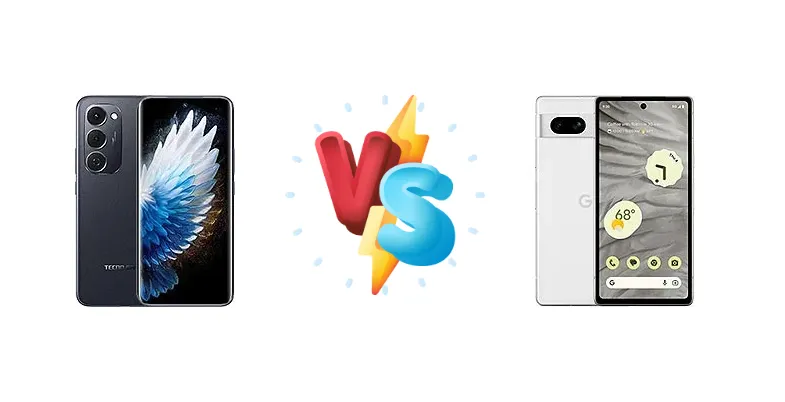
|
🏆 Quick Verdict
For the average user prioritizing all-day battery life and fast charging, the Tecno Spark 40 Pro+ is the clear winner. Its 10:48h active use score and 45W charging significantly outperform the Pixel 7a, despite the latter’s more powerful processor. However, the Pixel 7a remains a strong contender for camera enthusiasts and those deeply integrated into the Google ecosystem.
| PHONES | ||
|---|---|---|
| Phone Names | Tecno Spark 40 Pro+ | Google Pixel 7a |
| Network | ||
|---|---|---|
| 2G bands | GSM 850 / 900 / 1800 / 1900 | GSM 850 / 900 / 1800 / 1900 |
| 3G bands | HSDPA 850 / 900 / 1700(AWS) / 1900 / 2100 | HSDPA 800 / 850 / 900 / 1700(AWS) / 1900 / 2100 |
| 4G bands | 1, 2, 3, 4, 5, 7, 8, 12, 20, 28, 38, 40, 41, 66 | 1, 2, 3, 4, 5, 7, 8, 12, 13, 14, 17, 20, 25, 26, 28, 29, 30, 38, 40, 41, 48, 66, 71 - GWKK3, G0DZQ |
| 5G bands | - | 1, 2, 3, 5, 7, 8, 12, 14, 20, 25, 28, 30, 38, 41, 48, 66, 71, 77, 78 SA/NSA/Sub6 - GWKK3 |
| Speed | HSPA, LTE | HSPA, LTE, 5G |
| Technology | GSM / HSPA / LTE | GSM / HSPA / LTE / 5G |
| - | 1, 2, 3, 5, 7, 8, 12, 20, 25, 28, 38, 40, 41, 66, 75, 76, 77, 78, 79 SA/NSA/Sub6 - GHL1X, G82U8 | |
| Launch | ||
|---|---|---|
| Announced | 2025, July 02 | 2023, May 10 |
| Status | Available. Released 2025, July 07 | Available. Released 2023, May 10 |
| Body | ||
|---|---|---|
| Build | Glass front (Gorilla Glass 7i), plastic back, plastic frame | Glass front (Gorilla Glass 3), aluminum frame, plastic back |
| Dimensions | 163.9 x 75.8 x 6.5 mm (6.45 x 2.98 x 0.26 in) | 152 x 72.9 x 9 mm (5.98 x 2.87 x 0.35 in) |
| SIM | Nano-SIM + Nano-SIM | Nano-SIM + eSIM |
| Weight | 160.4 g (5.64 oz) | 193.5 g (6.84 oz) |
| - | IP67 dust/water resistant (up to 1m for 30 min) | |
| Display | ||
|---|---|---|
| Protection | Corning Gorilla Glass 7i | Corning Gorilla Glass 3 |
| Resolution | 1224 x 2720 pixels, 20:9 ratio (~440 ppi density) | 1080 x 2400 pixels, 20:9 ratio (~429 ppi density) |
| Size | 6.78 inches, 111.0 cm2 (~89.3% screen-to-body ratio) | 6.1 inches, 90.7 cm2 (~81.8% screen-to-body ratio) |
| Type | AMOLED, 1B colors, 144Hz, 1600 nits (HBM), 4500 nits (peak) | OLED, HDR, 90Hz |
| - | Always-on display | |
| Platform | ||
|---|---|---|
| CPU | Octa-core (2x2.2 GHz Cortex-A76 & 6x2.0 GHz Cortex-A55) | Octa-core (2x2.85 GHz Cortex-X1 & 2x2.35 GHz Cortex-A78 & 4x1.80 GHz Cortex-A55) |
| Chipset | Mediatek Helio G200 (6 nm) | Google Tensor G2 (5 nm) |
| GPU | Mali-G57 MC2 (1.1GHz) | Mali-G710 MP7 |
| OS | Android 15, up to 3 major Android upgrades, HIOS 15 | Android 13, upgradable to Android 15, up to 5 major Android upgrades |
| Memory | ||
|---|---|---|
| Card slot | No | No |
| Internal | 128GB 8GB RAM, 256GB 8GB RAM | 128GB 8GB RAM |
| - | UFS 3.1 | |
| Main Camera | ||
|---|---|---|
| Dual | - | 64 MP, f/1.9, 26mm (wide), 1/1.73", 0.8µm, dual pixel PDAF, OIS 13 MP, f/2.2, 120˚ (ultrawide), 1.12µm |
| Features | Dual-LED flash, HDR | Dual-LED flash, Pixel Shift, Auto-HDR, panorama |
| Single | 50 MP, f/1.6, (wide), 1/2.8", 0.64µm, PDAF Auxiliary lens | - |
| Video | 1440p@30fps, 1080p@30fps, gyro-EIS | 4K@30/60fps, 1080p@30/60/120/240fps, OIS |
| Selfie camera | ||
|---|---|---|
| Features | Dual-LED flash | HDR, panorama |
| Single | 13 MP, f/2.2, (wide), 1/3.1", 1.12µm | 13 MP, f/2.2, 20mm (ultrawide), 1.12µm |
| Video | 1080p@30fps | 4K@30fps, 1080p@30fps |
| Sound | ||
|---|---|---|
| 3.5mm jack | - | No |
| 35mm jack | No | No |
| Loudspeaker | Yes, with stereo speakers | Yes, with stereo speakers |
| Comms | ||
|---|---|---|
| Bluetooth | 5.3, A2DP, LE | 5.3, A2DP, LE |
| Infrared port | Yes | - |
| NFC | Yes (market/region dependent) | Yes |
| Positioning | GPS | GPS, GLONASS, GALILEO, BDS, QZSS, NavIC |
| Radio | FM radio | No |
| USB | USB Type-C 2.0, OTG | USB Type-C 3.2 |
| WLAN | Wi-Fi 802.11 a/b/g/n/ac, dual-band | Wi-Fi 802.11 a/b/g/n/ac/6e, tri-band |
| Features | ||
|---|---|---|
| Sensors | Fingerprint (under display, optical), accelerometer, gyro, proximity, compass | Fingerprint (under display, optical), accelerometer, gyro, proximity, compass, barometer |
| Battery | ||
|---|---|---|
| Charging | 45W wired, 100% in 55 min 30W wireless 5W reverse wireless 10W reverse wired Bypass charging | 18W wired, PD3.0 7.5W wireless |
| Type | 5200 mAh | Li-Po 4385 mAh |
| Misc | ||
|---|---|---|
| Colors | Nebula Black, Aurora White, Moon Titanium, Tundra Green | Charcoal, Snow, Sea, Coral |
| Models | KM7 | GWKK3, GHL1X, G0DZQ, G82U8 |
| Price | About 180 EUR | € 179.90 / $ 150.00 / £ 170.00 / ₹ 25,980 |
Tecno Spark 40 Pro+
- Exceptional battery life (10:48h active use)
- Ultra-fast 45W wired charging
- Bright 1601 nit display
- Less powerful processor than the Pixel 7a
- Camera performance likely inferior to the Pixel 7a
Google Pixel 7a
- Powerful Google Tensor G2 chipset
- Excellent camera capabilities
- Guaranteed software updates
- Shorter battery life
- Slower 18W charging
Display Comparison
The Tecno Spark 40 Pro+ boasts a significantly brighter display, reaching a measured 1601 nits compared to the Pixel 7a’s 1070 nits. This translates to superior visibility in direct sunlight. While both likely utilize AMOLED panels (not specified in the data), the higher peak brightness of the Tecno gives it a clear advantage for outdoor use. The absence of refresh rate data for the Tecno makes a direct comparison difficult, but the Pixel 7a’s 90Hz panel offers a smoother scrolling experience.
Camera Comparison
The provided data highlights the Pixel 7a’s strength in the camera department, though specifics are limited. Google’s computational photography prowess, powered by the Tensor G2, is well-regarded. While the Tecno Spark 40 Pro+’s camera specs are not provided, the Pixel 7a’s image processing algorithms and likely larger sensor size (based on brand reputation) will deliver superior image quality, particularly in low-light conditions. The Pixel 7a’s video capabilities are also expected to be more advanced.
Performance
The Google Pixel 7a’s Tensor G2 chipset, fabricated on a 5nm process, demonstrably outperforms the Tecno Spark 40 Pro+'s MediaTek Helio G200 (6nm) in CPU performance. The Pixel’s CPU configuration – featuring Cortex-X1 cores clocked at 2.85 GHz – is designed for demanding tasks. However, the G200 is no slouch, and its octa-core architecture provides ample power for everyday use. The 5nm process of the Tensor G2 also suggests better thermal efficiency, potentially leading to less throttling during sustained workloads. The Pixel 7a will excel in tasks like video editing and complex gaming, while the Tecno will handle daily tasks and moderate gaming with ease.
Battery Life
Battery life is where the Tecno Spark 40 Pro+ truly shines. The measured 10:48h of active use significantly exceeds the Pixel 7a’s estimated 76h endurance rating (which is not directly comparable as it's an older metric). Furthermore, the Tecno offers significantly faster charging – 45W wired, achieving 100% in 55 minutes – compared to the Pixel 7a’s 18W charging. The inclusion of 30W wireless and 5W/10W reverse wireless charging further enhances the Tecno’s convenience, features absent on the Pixel 7a.
Buying Guide
Buy the Tecno Spark 40 Pro+ if you need exceptional battery life, fast wired and wireless charging, and a vibrant display for media consumption. It’s ideal for travelers, commuters, or anyone who frequently finds themselves away from a power outlet. Buy the Google Pixel 7a if you prioritize camera quality, a smoother software experience with guaranteed updates, and the processing power needed for demanding applications and gaming.