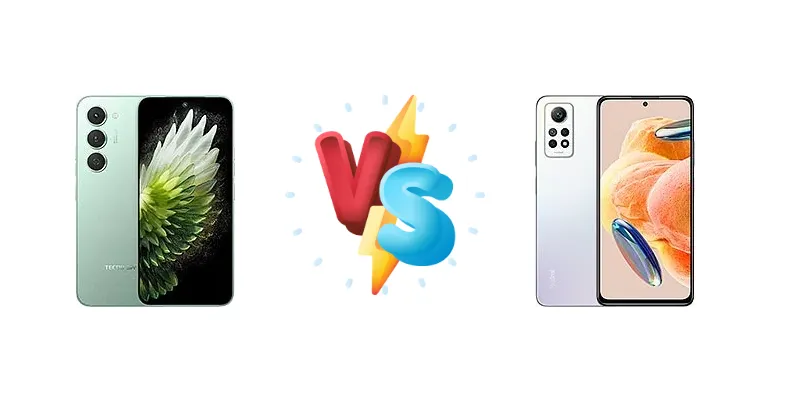
The Tecno Spark 40 Pro and Xiaomi Redmi Note 12 Pro 4G represent compelling options in the increasingly competitive mid-range smartphone market. While both aim to deliver a balanced experience, they take different approaches to chipset selection and charging technology, creating a clear distinction for potential buyers. This comparison dives deep into the specifics to determine which device offers the best value.
🏆 Quick Verdict
For the average user prioritizing fast charging and a slightly more efficient chipset, the Xiaomi Redmi Note 12 Pro 4G emerges as the winner. Its 67W charging significantly reduces downtime, and the Snapdragon 732G, built on an 8nm process, offers a slight edge in power efficiency compared to the Tecno's 6nm Helio G100.
| Network |
|---|
| 2G bands | GSM 850 / 900 / 1800 / 1900 | GSM 850 / 900 / 1800 / 1900 |
| 3G bands | HSDPA 850 / 900 / 1700(AWS) / 1900 / 2100 | HSDPA 850 / 900 / 1700(AWS) / 1900 / 2100 |
| 4G bands | 1, 2, 3, 4, 5, 7, 8, 12, 20, 28, 38, 40, 41, 66 | 1, 2, 3, 4, 5, 7, 8, 20, 28, 38, 40, 41, 66 |
| Speed | HSPA, LTE | HSPA, LTE |
| Technology | GSM / HSPA / LTE | GSM / HSPA / LTE |
| Launch |
|---|
| Announced | 2025, July 02 | 2023, March 03 |
| Status | Available. Released 2025, July 07 | Available. Released 2023, April 11 |
| Body |
|---|
| Build | Glass front (Gorilla Glass 7i), plastic back, plastic frame | - |
| Dimensions | 163.7 x 75.9 x 6.7 mm (6.44 x 2.99 x 0.26 in) | 164.2 x 76.1 x 8.1 mm (6.46 x 3.00 x 0.32 in) |
| SIM | Nano-SIM + Nano-SIM | Nano-SIM + Nano-SIM |
| Weight | - | 201.8 g (7.13 oz) |
| Display |
|---|
| Protection | Corning Gorilla Glass 7i | - |
| Resolution | 1224 x 2720 pixels, 20:9 ratio (~440 ppi density) | 1080 x 2400 pixels, 20:9 ratio (~395 ppi density) |
| Size | 6.78 inches, 111.0 cm2 (~89.3% screen-to-body ratio) | 6.67 inches, 107.4 cm2 (~86.0% screen-to-body ratio) |
| Type | AMOLED, 1B colors, 144Hz, 1600 nits (HBM), 4500 nits (peak) | AMOLED, 120Hz, Dolby Vision, 700 nits (HBM), 1100 nits (peak) |
| Platform |
|---|
| CPU | Octa-core (2x2.2 GHz Cortex-A76 & 6x2.0 GHz Cortex-A55) | Octa-core (2x2.2 GHz Kryo 470 Gold & 6x1.8 GHz Kryo 470 Silver) |
| Chipset | Mediatek Helio G100 Ultimate (6 nm) | Qualcomm SM7150 Snapdragon 732G (8 nm) |
| GPU | Mali-G57 MC2 | Adreno 618 |
| OS | Android 15, HIOS 15.1 | Android 11, MIUI 13 |
| Memory |
|---|
| Card slot | microSDXC | microSDXC (uses shared SIM slot) |
| Internal | 128GB 8GB RAM, 256GB 8GB RAM | 128GB 6GB RAM, 128GB 8GB RAM, 256GB 8GB RAM |
| | - | UFS 2.2 |
| Main Camera |
|---|
| Features | Dual-LED flash, HDR | LED flash, HDR, panorama |
| Quad | - | 108 MP, f/1.9, (wide), 1/1.52", 0.7µm, PDAF
8 MP, 120˚, (ultrawide)
2 MP (macro)
Auxiliary lens |
| Single | 50 MP, f/1.6, (wide), 1/2.8", 0.64µm, PDAF
Auxiliary lens | - |
| Video | 1440p@30fps, 1080p@30fps | 4K@30fps, 1080p@30/60fps |
| Selfie camera |
|---|
| Features | Dual-LED flash | - |
| Single | 13 MP, f/2.2, (wide), 1/3.1", 1.12µm | 16 MP, f/2.4, (wide) |
| Video | 1080p@30fps | 1080p@30fps |
| Sound |
|---|
| 3.5mm jack | - | Yes |
| 35mm jack | Yes | Yes |
| Loudspeaker | Yes, with stereo speakers | Yes, with stereo speakers |
| Comms |
|---|
| Bluetooth | 5.3, A2DP, LE | 5.0, A2DP, LE |
| Infrared port | Yes | Yes |
| NFC | Yes (market/region dependent) | Yes (market/region dependent) |
| Positioning | GPS | GPS, GLONASS, GALILEO, BDS |
| Radio | FM radio | Unspecified |
| USB | USB Type-C 2.0, OTG | USB Type-C 2.0, OTG |
| WLAN | Wi-Fi 802.11 a/b/g/n/ac, dual-band | Wi-Fi 802.11 a/b/g/n/ac, dual-band |
| Features |
|---|
| Sensors | Fingerprint (under display, optical), accelerometer, proximity, compass | Fingerprint (side-mounted), accelerometer, gyro, compass |
| Battery |
|---|
| Charging | 45W wired
10W reverse wired | 67W wired |
| Type | 5200 mAh | Li-Po 5000 mAh |
| Misc |
|---|
| Colors | Ink Black, Moon Titanium, Lake Blue, Bamboo Green | Star Blue, Graphite Gray, Polar White, Ice blue |
| Models | KM6 | 2209116AG, 2209116AG |
| Price | About 160 EUR | About 150 EUR |
Tecno Spark 40 Pro
- Potentially stronger multi-tasking due to octa-core CPU.
- Includes 10W reverse wired charging.
- 6nm process node offers some efficiency gains.
- Slower 45W charging.
- Helio G100 chipset may throttle more under sustained load.
Xiaomi Redmi Note 12 Pro 4G
- Faster 67W wired charging.
- More power-efficient Snapdragon 732G chipset.
- Qualcomm ISP offers potentially better image processing.
- Lacks reverse wired charging.
- CPU architecture slightly older than the Helio G100.
Display Comparison
Neither device boasts a standout display. While specific display specs (resolution, refresh rate, panel type) are missing, the focus here is on the underlying chipsets. Display performance will likely be similar, relying on software optimization. However, the chipset's ability to efficiently drive the display is a factor; the Snapdragon 732G's ISP and image signal processing capabilities could translate to slightly better image quality when viewing photos and videos.
Camera Comparison
Without detailed camera specifications, a direct comparison is limited. However, the chipset plays a crucial role in image processing. Qualcomm’s Snapdragon 732G is known for its strong image signal processor (ISP), which can deliver better dynamic range and noise reduction. The Tecno Spark 40 Pro will rely on MediaTek’s image processing capabilities, which have improved but generally lag behind Qualcomm’s in terms of overall image quality. The absence of information regarding sensor size and OIS makes a definitive judgment impossible, but the Snapdragon 732G’s ISP gives the Redmi Note 12 Pro 4G a likely advantage.
Performance
The core difference lies in the chipsets. The Xiaomi Redmi Note 12 Pro 4G utilizes the Qualcomm Snapdragon 732G, fabricated on an 8nm process. This process node generally leads to better thermal efficiency than the 6nm process used for the Tecno Spark 40 Pro’s MediaTek Helio G100 Ultimate. While both CPUs feature a 2x2.2 GHz prime core configuration, the Snapdragon’s Kryo 470 Gold cores are architecturally more refined than the Cortex-A76 cores in the Helio G100. This translates to potentially better sustained performance under load, particularly in gaming. The Helio G100’s strength lies in its octa-core configuration, potentially offering better multi-tasking capabilities for users running numerous apps simultaneously.
Battery Life
The Xiaomi Redmi Note 12 Pro 4G’s 67W wired charging is a significant advantage over the Tecno Spark 40 Pro’s 45W charging. This difference translates to substantially faster charging times – potentially reducing a full charge from over an hour to under 45 minutes. While battery capacity isn’t specified, the Snapdragon 732G’s 8nm process contributes to better power efficiency, meaning the Redmi Note 12 Pro 4G could potentially offer comparable or even better battery life despite a potentially smaller battery capacity. The Tecno Spark 40 Pro does offer 10W reverse wired charging, a feature absent on the Redmi Note 12 Pro 4G, allowing it to charge accessories or other devices.
Buying Guide
Buy the Tecno Spark 40 Pro if you prioritize maximizing CPU performance for multitasking and light gaming, and appreciate the inclusion of reverse wired charging. Buy the Xiaomi Redmi Note 12 Pro 4G if you value faster charging speeds, a more power-efficient chipset for sustained performance, and a generally smoother user experience thanks to Qualcomm's optimizations.
Frequently Asked Questions
❓ Will the Helio G100 in the Tecno Spark 40 Pro struggle with demanding games like Genshin Impact?
While the Helio G100 is capable, Genshin Impact and similar graphically intensive games will likely require reduced graphics settings for a smooth experience. The Snapdragon 732G in the Redmi Note 12 Pro 4G, with its more efficient architecture, may offer slightly better sustained frame rates in these titles.
❓ How much faster is the 67W charging on the Redmi Note 12 Pro 4G compared to the 45W charging on the Tecno Spark 40 Pro?
Expect a significant difference. The Redmi Note 12 Pro 4G can potentially charge from 0-100% in under 45 minutes, while the Tecno Spark 40 Pro will likely take over an hour. This is particularly beneficial for users who frequently need to top up their battery quickly.
❓ Is the reverse charging feature on the Tecno Spark 40 Pro useful in everyday scenarios?
Reverse charging is a niche feature, but can be convenient for charging accessories like wireless earbuds or a smartwatch in a pinch. However, the 10W output is relatively slow, so it's not a replacement for a dedicated charger.