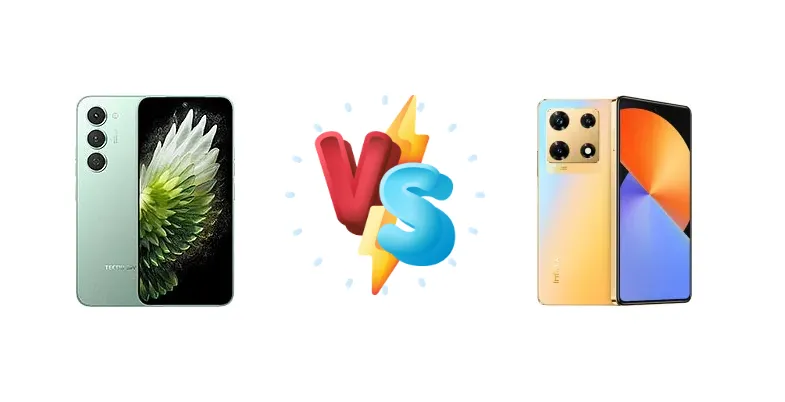
Both the Tecno Spark 40 Pro and the Infinix Note 30 Pro target the competitive mid-range smartphone market, but they approach it with different strengths. The Spark 40 Pro focuses on delivering solid performance at a potentially lower price point, while the Note 30 Pro emphasizes faster charging and added convenience features like wireless charging. This comparison will dissect their key specifications to determine which device best suits your needs.
🏆 Quick Verdict
For the average user prioritizing convenience and speed, the Infinix Note 30 Pro is the better choice. Its 68W wired charging, coupled with 15W wireless and reverse wireless capabilities, significantly outperforms the Tecno Spark 40 Pro’s 45W charging. While both share a similar CPU architecture, the Note 30 Pro’s charging ecosystem provides a more complete user experience.
| Network |
|---|
| 2G bands | GSM 850 / 900 / 1800 / 1900 | GSM 850 / 900 / 1800 / 1900 |
| 3G bands | HSDPA 850 / 900 / 1700(AWS) / 1900 / 2100 | HSDPA 850 / 900 / 1700(AWS) / 1900 / 2100 |
| 4G bands | 1, 2, 3, 4, 5, 7, 8, 12, 20, 28, 38, 40, 41, 66 | 1, 2, 3, 4, 5, 7, 8, 12, 17, 20, 28, 38, 40, 41, 66 |
| Speed | HSPA, LTE | HSPA, LTE |
| Technology | GSM / HSPA / LTE | GSM / HSPA / LTE |
| Launch |
|---|
| Announced | 2025, July 02 | 2023, May 22 |
| Status | Available. Released 2025, July 07 | Available. Released 2023, May 22 |
| Body |
|---|
| Build | Glass front (Gorilla Glass 7i), plastic back, plastic frame | Glass front, plastic frame, glass back |
| Dimensions | 163.7 x 75.9 x 6.7 mm (6.44 x 2.99 x 0.26 in) | 162.7 x 76 x 8.2 mm (6.41 x 2.99 x 0.32 in) |
| SIM | Nano-SIM + Nano-SIM | Nano-SIM + Nano-SIM |
| Weight | - | 203 g (7.16 oz) |
| | - | IP53 |
| Display |
|---|
| Protection | Corning Gorilla Glass 7i | - |
| Resolution | 1224 x 2720 pixels, 20:9 ratio (~440 ppi density) | 1080 x 2400 pixels, 20:9 ratio (~395 ppi density) |
| Size | 6.78 inches, 111.0 cm2 (~89.3% screen-to-body ratio) | 6.67 inches, 107.4 cm2 (~86.9% screen-to-body ratio) |
| Type | AMOLED, 1B colors, 144Hz, 1600 nits (HBM), 4500 nits (peak) | AMOLED, 1B colors, 120Hz, 900 nits (peak) |
| | - | * the display diagonal size and resolution is unconfirmed |
| Platform |
|---|
| CPU | Octa-core (2x2.2 GHz Cortex-A76 & 6x2.0 GHz Cortex-A55) | Octa-core (2x2.2 GHz Cortex-A76 & 6x2.0 GHz Cortex-A55) |
| Chipset | Mediatek Helio G100 Ultimate (6 nm) | Mediatek Helio G99 (6 nm) |
| GPU | Mali-G57 MC2 | Mali-G57 MC2 |
| OS | Android 15, HIOS 15.1 | Android 13, XOS 13 |
| Memory |
|---|
| Card slot | microSDXC | microSDXC (dedicated slot) |
| Internal | 128GB 8GB RAM, 256GB 8GB RAM | 256GB 8GB RAM |
| Main Camera |
|---|
| Features | Dual-LED flash, HDR | Quad-LED flash, HDR, panorama |
| Single | 50 MP, f/1.6, (wide), 1/2.8", 0.64µm, PDAF
Auxiliary lens | - |
| Triple | - | 108 MP, (wide), 1/1.67", PDAF
2 MP (macro)
Auxiliary lens |
| Video | 1440p@30fps, 1080p@30fps | 1440p@30fps, 1080p@30fps |
| Selfie camera |
|---|
| Features | Dual-LED flash | LED flash, HDR |
| Single | 13 MP, f/2.2, (wide), 1/3.1", 1.12µm | 32 MP, f/2.0, (wide), 1/2.8" |
| Video | 1080p@30fps | 1080p@30fps |
| Sound |
|---|
| 3.5mm jack | - | Yes |
| 35mm jack | Yes | Yes |
| Loudspeaker | Yes, with stereo speakers | Yes, with dual speakers |
| | - | Sound by JBL
24-bit/192kHz audio |
| Comms |
|---|
| Bluetooth | 5.3, A2DP, LE | Yes |
| Infrared port | Yes | - |
| NFC | Yes (market/region dependent) | Yes (market/region dependent) |
| Positioning | GPS | GPS |
| Radio | FM radio | FM radio |
| USB | USB Type-C 2.0, OTG | USB Type-C 2.0, OTG |
| WLAN | Wi-Fi 802.11 a/b/g/n/ac, dual-band | Wi-Fi 802.11 a/b/g/n/ac, dual-band, Wi-Fi Direct |
| Features |
|---|
| Sensors | Fingerprint (under display, optical), accelerometer, proximity, compass | Fingerprint (side-mounted), accelerometer, gyro, proximity, compass |
| Battery |
|---|
| Charging | 45W wired
10W reverse wired | 68W wired, PD3.0, 80% in 30 min
15W wireless
Reverse wireless |
| Type | 5200 mAh | 5000 mAh |
| Misc |
|---|
| Colors | Ink Black, Moon Titanium, Lake Blue, Bamboo Green | Magic Black, Variable Gold |
| Models | KM6 | X678B |
| Price | About 160 EUR | - |
Tecno Spark 40 Pro
- Potentially lower price point
- Capable performance for everyday tasks
- Mediatek Helio G100 Ultimate offers good efficiency
- Slower 45W charging
- Lacks wireless charging
- Potentially less refined software experience
Infinix Note 30 Pro
- 68W fast charging with PD3.0
- 15W wireless and reverse wireless charging
- Slightly better GPU performance with Helio G99
- Likely higher price than the Spark 40 Pro
- May not offer significant camera improvements
- Potential for software bloat
Display Comparison
Neither device’s display specifications are provided, so a direct comparison is limited. However, given the market segment, both likely feature 1080p LCD panels. The absence of LTPO technology suggests neither will offer adaptive refresh rates for power saving. Bezels are likely comparable, and color accuracy will depend on software calibration, a known strength of Transsion Holdings (parent company of both brands).
Camera Comparison
Without detailed camera specifications, a precise comparison is difficult. However, both brands often prioritize megapixel count over sensor size. It’s reasonable to assume both phones will feature a multi-camera setup with a primary sensor, ultrawide, and depth/macro lenses. The absence of Optical Image Stabilization (OIS) is likely on both, relying on software stabilization. Image processing will likely differ, with Tecno potentially favoring brighter, more saturated images, while Infinix might aim for a more natural look. The usefulness of any 2MP macro lens on either device is questionable.
Performance
Both the Tecno Spark 40 Pro and Infinix Note 30 Pro utilize the same octa-core CPU configuration – 2x2.2 GHz Cortex-A76 and 6x2.0 GHz Cortex-A55 cores. The key difference lies in the chipset: the Spark 40 Pro uses the MediaTek Helio G100 Ultimate (6nm), while the Note 30 Pro employs the Helio G99 (also 6nm). While the core architecture is identical, the G99 generally offers slightly improved GPU performance and efficiency. This translates to a potentially smoother gaming experience on the Note 30 Pro, though the difference won’t be dramatic. Both devices will likely pair this with LPDDR4X RAM, limiting memory bandwidth compared to newer standards.
Battery Life
The Infinix Note 30 Pro clearly wins in the charging department. Its 68W wired charging, supporting PD3.0 and claiming 80% charge in 30 minutes, is significantly faster than the Tecno Spark 40 Pro’s 45W charging. Furthermore, the Note 30 Pro adds 15W wireless charging and reverse wireless charging, offering unparalleled convenience. While battery capacity isn’t specified, the faster charging speeds of the Note 30 Pro mitigate the impact of a potentially smaller battery, allowing for quicker top-ups throughout the day.
Buying Guide
Buy the Tecno Spark 40 Pro if you need a capable all-rounder with a focus on core performance and are on a tighter budget. It’s ideal for everyday tasks, social media, and casual gaming. Buy the Infinix Note 30 Pro if you prioritize fast charging, wireless convenience, and a more versatile power solution, even if it means spending slightly more. This phone is perfect for users who are frequently on the go and need to quickly top up their battery.
Frequently Asked Questions
❓ Does the Helio G99 in the Infinix Note 30 Pro offer a noticeable gaming advantage over the Helio G100 Ultimate in the Tecno Spark 40 Pro?
While both chipsets share the same CPU architecture, the Helio G99 generally provides a slight edge in GPU performance. This translates to marginally higher frame rates and smoother gameplay in demanding titles, but the difference won't be dramatic. Both phones are best suited for medium-settings gaming rather than pushing for ultra-high fidelity.
❓ How long does it realistically take to fully charge the Infinix Note 30 Pro from 0% using the 68W charger?
Infinix claims 80% charge in 30 minutes. Real-world charging times will vary based on usage and ambient temperature, but a full 0-100% charge should be achievable in approximately 45-55 minutes with the included 68W charger. This is a significant improvement over the Tecno Spark 40 Pro’s 45W charging.
❓ Is the reverse wireless charging feature on the Infinix Note 30 Pro useful for charging accessories like earbuds?
Yes, the 15W reverse wireless charging is quite practical for topping up accessories like wireless earbuds or smartwatches. While it won't charge them as quickly as a wired connection, it provides a convenient way to share power on the go without needing a separate power bank.