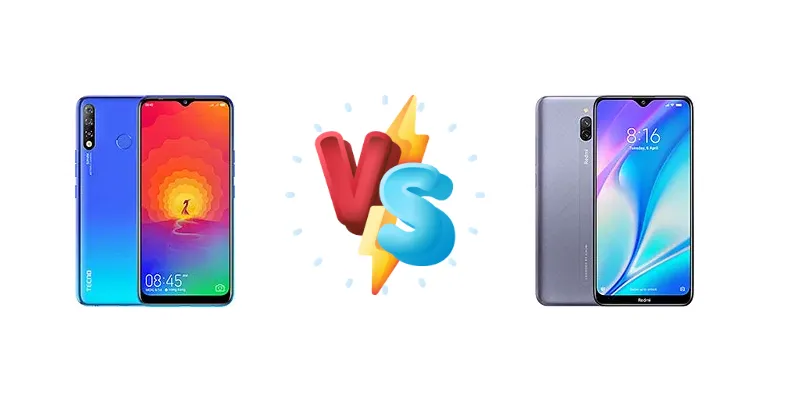
The Tecno Spark 4 and Xiaomi Redmi 8A Pro represent two compelling options in the ultra-budget smartphone segment. While both aim to deliver essential smartphone functionality at a low price point, they take different approaches to achieving this. The Spark 4 relies on a simpler quad-core processor, while the Redmi 8A Pro boasts a more complex octa-core Snapdragon chipset and faster charging capabilities. This comparison will dissect their key differences to help you determine which device best suits your needs.
🏆 Quick Verdict
For the average user prioritizing responsiveness and future-proofing, the Xiaomi Redmi 8A Pro is the clear winner. Its Snapdragon 439 chipset, with its eight cores, offers significantly better performance than the Tecno Spark 4’s quad-core processor, and the 18W fast charging is a substantial convenience. While the Spark 4 may be cheaper, the performance trade-off is too significant for most.
| Network |
|---|
| 2G bands | GSM 850 / 900 / 1800 / 1900 | GSM 850 / 900 / 1800 / 1900 |
| 3G bands | HSDPA 850 / 900 / 2100 | HSDPA 850 / 900 / 1900 / 2100 |
| 4G bands | 1, 3, 5, 8, 38, 40, 41 | 1, 3, 5, 8, 40, 41 |
| Speed | HSPA 42.2/5.76 Mbps, LTE Cat4 150/50 Mbps | HSPA, LTE |
| Technology | GSM / HSPA / LTE | GSM / HSPA / LTE |
| Launch |
|---|
| Announced | 2019, September 25. Released 2019, September 25 | 2020, April 02. Released 2020, April 02 |
| Status | Discontinued | Discontinued |
| Body |
|---|
| Build | Glass front, plastic back, plastic frame | Glass front (Gorilla Glass 5), plastic back, plastic frame |
| Dimensions | 165.3 x 75.9 x 8.2 mm (6.51 x 2.99 x 0.32 in) | 156.5 x 75.4 x 9.4 mm (6.16 x 2.97 x 0.37 in) |
| SIM | Nano-SIM + Nano-SIM | Nano-SIM + Nano-SIM |
| Weight | - | 188 g (6.63 oz) |
| | - | Water-repellent coating |
| Display |
|---|
| Protection | - | Corning Gorilla Glass 5 |
| Resolution | 720 x 1600 pixels, 20:9 ratio (~269 ppi density) | 720 x 1520 pixels, 19:9 ratio (~270 ppi density) |
| Size | 6.52 inches, 102.6 cm2 (~81.8% screen-to-body ratio) | 6.22 inches, 96.6 cm2 (~81.8% screen-to-body ratio) |
| Type | IPS LCD | IPS LCD, 400 nits (typ) |
| Platform |
|---|
| CPU | Quad-core 2.0 GHz | Octa-core (4x1.95 GHz Cortex-A53 & 4x1.45 GHz Cortex A53) |
| Chipset | - | Qualcomm SDM439 Snapdragon 439 (12 nm) |
| GPU | - | Adreno 505 |
| OS | Android 9.0 (Pie), HIOS 5.5 | Android 9.0 (Pie), planned upgrade to Android 10, MIUI 12 |
| Memory |
|---|
| Card slot | microSDXC (dedicated slot) | microSDXC (dedicated slot) |
| Internal | 32GB 2GB RAM, 32GB 3GB RAM | 32GB 2GB RAM, 32GB 3GB RAM |
| | eMMC 5.1 | eMMC 5.1 |
| Main Camera |
|---|
| Dual | - | 13 MP, f/2.2, (wide), 1/3.1", 1.12µm, PDAF
Auxiliary lens |
| Features | Dual LED flash, HDR, panorama | LED flash, HDR, panorama |
| Triple | 13 MP, AF
Auxiliary lenses | - |
| Video | 1080p@30fps | 1080p@30fps |
| Selfie camera |
|---|
| Features | LED flash | HDR |
| Single | 8 MP | 8 MP, f/2.0, 1/4.0", 1.12µm |
| Video | 1080p@30fps | 1080p@30fps |
| Sound |
|---|
| 3.5mm jack | Yes | Yes |
| 35mm jack | Yes | Yes |
| Loudspeaker | Yes | Yes |
| Comms |
|---|
| Bluetooth | 4.2, A2DP, LE | 4.2, A2DP, LE |
| NFC | No | No |
| Positioning | GPS | GPS, GLONASS, BDS |
| Radio | FM radio | FM Radio, built-in antenna |
| USB | microUSB 2.0, OTG | USB Type-C 2.0, OTG |
| WLAN | Wi-Fi 802.11 b/g/n | Wi-Fi 802.11 b/g/n, Wi-Fi Direct |
| Features |
|---|
| Sensors | Fingerprint (rear-mounted), accelerometer, proximity | Accelerometer, proximity, compass |
| Battery |
|---|
| Charging | - | 18W wired
2.5W reverse wired |
| Type | Li-Ion 4000 mAh | Li-Po 5000 mAh |
| Misc |
|---|
| Colors | Royal Purple, Vacation Blue | Sky White, Sea Blue, Midnight Grey |
| Models | KC8 | - |
| Price | - | About 90 EUR |
Tecno Spark 4
- Potentially lower price point
- Simple and easy-to-use interface
- May include features like dedicated microSD card slot
- Significantly slower performance
- Less efficient processor
- Likely slower charging speeds
Xiaomi Redmi 8A Pro
- Faster and more responsive performance
- 18W fast charging
- More efficient Snapdragon 439 chipset
- May be slightly more expensive
- Basic camera system
- Still utilizes a plastic build
Display Comparison
Neither device is known for display prowess. The context data lacks specifics on panel type or resolution for the Tecno Spark 4, suggesting a basic LCD. The Redmi 8A Pro also utilizes an LCD, but its focus is on maximizing battery life rather than visual fidelity. Bezels are likely to be substantial on both, typical of this price bracket. Color accuracy and brightness are expected to be average, making them best suited for indoor use.
Camera Comparison
Both phones likely feature modest camera setups. Without detailed sensor information, it’s safe to assume both rely on primary sensors with limited capabilities. The Redmi 8A Pro’s chipset likely offers slightly better image signal processing (ISP) capabilities, potentially resulting in marginally better image quality. The prevalence of 2MP auxiliary sensors on phones in this segment often adds little value, and their inclusion should not be a deciding factor.
Performance
The core difference lies in the processors. The Tecno Spark 4’s quad-core 2.0 GHz CPU is a basic configuration, suitable for light tasks. In contrast, the Xiaomi Redmi 8A Pro’s Qualcomm Snapdragon 439 is an octa-core processor (4x1.95 GHz Cortex-A53 & 4x1.45 GHz Cortex A53) built on a more efficient 12nm process. This means the Redmi 8A Pro will handle multitasking, app loading, and even light gaming significantly better. The Snapdragon 439 also benefits from Qualcomm’s optimized software and GPU, providing a smoother overall experience. The 12nm process node also contributes to better thermal management, reducing the likelihood of throttling under sustained load.
Battery Life
While the battery capacity isn't specified for the Tecno Spark 4, it's likely comparable to the Redmi 8A Pro's. However, the Redmi 8A Pro’s 18W wired charging is a significant advantage. This allows for much faster charging times compared to the standard charging speeds typically found on devices in this price range. The 2.5W reverse wired charging is a niche feature, allowing the Redmi 8A Pro to act as a power bank for smaller accessories, a convenience the Spark 4 lacks.
Buying Guide
Buy the Tecno Spark 4 if you absolutely need the lowest possible price and your smartphone usage is limited to basic tasks like calls, texts, and light social media. It's suitable for first-time smartphone users or as a secondary device. Buy the Xiaomi Redmi 8A Pro if you value a smoother user experience, enjoy occasional gaming, or appreciate the convenience of faster charging. It’s a better long-term investment for users who demand more from their device.
Frequently Asked Questions
❓ Will the Redmi 8A Pro struggle with popular apps like WhatsApp and Facebook?
While the Snapdragon 439 isn't a powerhouse, it's more than capable of handling everyday apps like WhatsApp and Facebook smoothly. The octa-core configuration and optimized software ensure a responsive experience, unlike the Tecno Spark 4 which may exhibit noticeable lag with multiple apps open.
❓ Is the 18W charging on the Redmi 8A Pro a significant improvement over standard charging?
Yes, it is. Standard charging typically takes several hours to fully charge a phone. The Redmi 8A Pro’s 18W charging can significantly reduce this time, potentially bringing a full charge from 0% to 100% in under two hours, offering a much more convenient experience.
❓ Can the Tecno Spark 4 handle basic mobile games like Candy Crush or Subway Surfers?
The Tecno Spark 4 can run basic mobile games, but expect lower frame rates and potential stuttering, especially in more demanding scenes. The quad-core processor is simply not as powerful as the Snapdragon 439 in the Redmi 8A Pro, which will provide a smoother gaming experience.