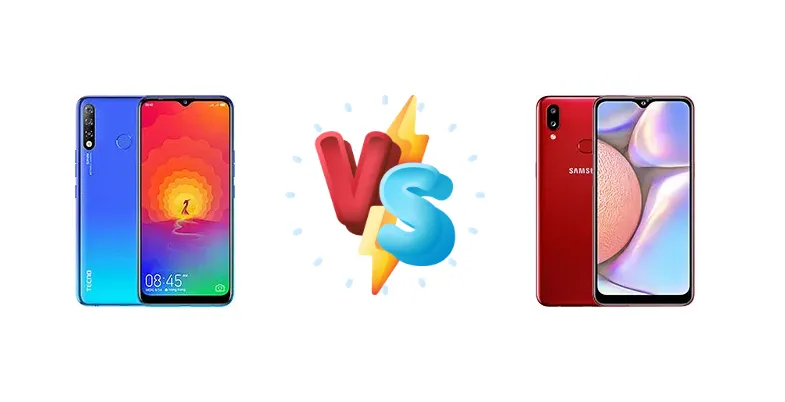
The Tecno Spark 4 and Samsung Galaxy A10s represent the entry-level smartphone segment, catering to users prioritizing affordability. While both aim to deliver essential smartphone functionality, they differ significantly in their underlying hardware, impacting performance and overall user experience. This comparison dissects these differences to determine which device offers the best value.
🏆 Quick Verdict
For the average user, the Samsung Galaxy A10s is the better choice. Its Mediatek Helio P22 chipset, with its octa-core configuration, provides a more responsive and efficient experience than the Tecno Spark 4’s quad-core processor, despite both being clocked at 2.0 GHz. This translates to smoother multitasking and better app loading times.
| Network |
|---|
| 2G bands | GSM 850 / 900 / 1800 / 1900 | GSM 850 / 900 / 1800 / 1900 |
| 3G bands | HSDPA 850 / 900 / 2100 | HSDPA 850 / 900 / 1900 / 2100 |
| 4G bands | 1, 3, 5, 8, 38, 40, 41 | 1, 2, 3, 5, 7, 8, 20, 38, 40, 41 |
| Speed | HSPA 42.2/5.76 Mbps, LTE Cat4 150/50 Mbps | HSPA 42.2/5.76 Mbps, LTE Cat4 150/50 Mbps |
| Technology | GSM / HSPA / LTE | GSM / HSPA / LTE |
| | - | 1, 2, 3, 5, 7, 8, 12, 17, 28 - SM-A107M/DS |
| Launch |
|---|
| Announced | 2019, September 25. Released 2019, September 25 | 2019, August 12. Released 2019, August 27 |
| Status | Discontinued | Discontinued |
| Body |
|---|
| Build | Glass front, plastic back, plastic frame | Glass front, plastic back, plastic frame |
| Dimensions | 165.3 x 75.9 x 8.2 mm (6.51 x 2.99 x 0.32 in) | 156.9 x 75.8 x 7.8 mm (6.18 x 2.98 x 0.31 in) |
| SIM | Nano-SIM + Nano-SIM | · Nano-SIM· Nano-SIM + Nano-SIM |
| Weight | - | 168 g (5.93 oz) |
| Display |
|---|
| Resolution | 720 x 1600 pixels, 20:9 ratio (~269 ppi density) | 720 x 1520 pixels, 19:9 ratio (~271 ppi density) |
| Size | 6.52 inches, 102.6 cm2 (~81.8% screen-to-body ratio) | 6.2 inches, 95.9 cm2 (~80.7% screen-to-body ratio) |
| Type | IPS LCD | PLS LCD |
| Platform |
|---|
| CPU | Quad-core 2.0 GHz | Octa-core 2.0 GHz Cortex-A53 |
| Chipset | - | Mediatek MT6762 Helio P22 (12 nm) |
| GPU | - | PowerVR GE8320 |
| OS | Android 9.0 (Pie), HIOS 5.5 | Android 9.0 (Pie), upgradable to Android 11, One UI 3.1 |
| Memory |
|---|
| Card slot | microSDXC (dedicated slot) | microSDXC (dedicated slot) |
| Internal | 32GB 2GB RAM, 32GB 3GB RAM | 32GB 2GB RAM, 32GB 3GB RAM |
| | eMMC 5.1 | eMMC 5.1 |
| Main Camera |
|---|
| Dual | - | 13 MP, f/1.8, 28mm (wide), AF
Auxiliary lens |
| Features | Dual LED flash, HDR, panorama | LED flash, panorama, HDR |
| Triple | 13 MP, AF
Auxiliary lenses | - |
| Video | 1080p@30fps | 1080p@30fps |
| Selfie camera |
|---|
| Features | LED flash | - |
| Single | 8 MP | 8 MP, f/2.0 |
| Video | 1080p@30fps | 1080p@30fps |
| Sound |
|---|
| 3.5mm jack | Yes | Yes |
| 35mm jack | Yes | Yes |
| Loudspeaker | Yes | Yes |
| Comms |
|---|
| Bluetooth | 4.2, A2DP, LE | 4.2, A2DP, LE |
| NFC | No | No |
| Positioning | GPS | GPS, GLONASS, GALILEO |
| Radio | FM radio | FM radio |
| USB | microUSB 2.0, OTG | microUSB 2.0, OTG |
| WLAN | Wi-Fi 802.11 b/g/n | Wi-Fi 802.11 b/g/n, Wi-Fi Direct |
| Features |
|---|
| Sensors | Fingerprint (rear-mounted), accelerometer, proximity | Fingerprint (rear-mounted), accelerometer, proximity |
| Battery |
|---|
| Type | Li-Ion 4000 mAh | Li-Po 4000 mAh, non-removable |
| Misc |
|---|
| Colors | Royal Purple, Vacation Blue | Blue, Green, Red, Black |
| Models | KC8 | SM-A107F, SM-A107M |
| Price | - | About 180 EUR |
| SAR | - | 0.25 W/kg (head) 1.06 W/kg (body) |
Tecno Spark 4
- Potentially lower price point
- Simple and straightforward user experience
- May offer larger storage options (depending on variant)
- Less powerful processor for multitasking
- Potentially lower battery efficiency
- Likely less refined software experience
Samsung Galaxy A10s
- More powerful and efficient octa-core processor
- Better multitasking capabilities
- Potentially better camera image processing
- May be slightly more expensive
- Software updates may be less frequent than other Samsung models
- Basic display quality
Display Comparison
Neither device boasts a standout display. Specifics regarding panel type (IPS, TFT) and resolution are missing, but both likely feature basic LCD panels typical of this price point. The focus here is on processing power, not visual fidelity. Bezels are expected to be substantial on both, impacting screen-to-body ratio. Color accuracy and brightness are likely to be average, suitable for indoor use but potentially washed out in direct sunlight.
Camera Comparison
Camera performance is likely to be similar, with both devices targeting basic photography needs. Details regarding sensor size and aperture are unavailable, but both likely feature a primary camera paired with auxiliary sensors of limited utility (often 2MP depth or macro sensors). Image processing will be crucial, and Samsung generally offers more refined image processing algorithms, potentially resulting in more pleasing photos in various lighting conditions. The A10s may offer slightly better dynamic range and noise reduction.
Performance
The core difference lies in the chipset. The Tecno Spark 4 utilizes a quad-core 2.0 GHz processor, while the Samsung Galaxy A10s features the Mediatek MT6762 Helio P22, an octa-core 2.0 GHz Cortex-A53 processor. While clock speeds are identical, the A10s’ octa-core architecture allows for more efficient parallel processing. This means the A10s can handle multiple tasks simultaneously with less strain, resulting in smoother app switching and a more responsive user interface. The Helio P22’s 12nm process node also contributes to better power efficiency compared to the likely larger node process used in the Spark 4, potentially extending battery life during sustained use.
Battery Life
Battery capacity details are missing for both devices. However, the Mediatek Helio P22’s superior power efficiency in the A10s will likely translate to longer real-world battery life, even if the Spark 4 has a slightly larger capacity. Charging wattage is also unknown, but both are expected to ship with basic 5W or 10W chargers, resulting in relatively slow charging times – likely exceeding 3 hours for a full charge.
Buying Guide
Buy the Tecno Spark 4 if your primary need is a basic smartphone for calls, texts, and light social media use, and you are operating on an extremely tight budget. Buy the Samsung Galaxy A10s if you prioritize a more fluid user experience, better multitasking capabilities, and a slightly more refined software experience, even if it means spending a bit more.
Frequently Asked Questions
❓ Does the Mediatek Helio P22 in the Samsung Galaxy A10s struggle with demanding games like PUBG?
While the Helio P22 isn't a gaming powerhouse, it can handle PUBG Mobile at lower graphics settings. Expect frame rate drops during intense action, but it's playable. The Tecno Spark 4's quad-core processor will likely struggle even more with the same game.
❓ Is the software experience significantly different between the Tecno Spark 4 and Samsung Galaxy A10s?
Yes. Samsung's One UI, even in its lighter form on the A10s, offers a more polished and feature-rich experience compared to Tecno's HiOS. Samsung also generally provides more consistent software updates, although long-term support for these entry-level devices is limited.
❓ How much storage does each phone typically come with, and can it be expanded?
Both phones typically ship with 32GB of internal storage, which is expandable via microSD card. However, the actual usable storage will be less due to pre-installed apps and the operating system.