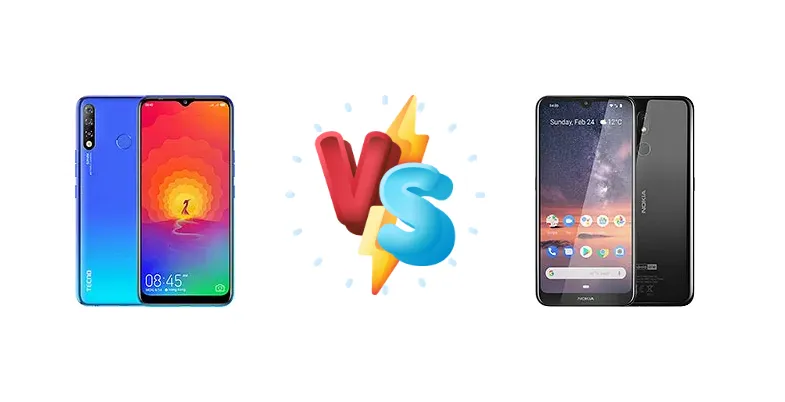
The Tecno Spark 4 and Nokia 3.2 represent two distinct approaches to the ultra-budget smartphone market. The Spark 4 prioritizes raw clock speed, while the Nokia 3.2 leverages Qualcomm’s Snapdragon 429 chipset for a more efficient, albeit slightly slower, experience. This comparison dissects their key differences to determine which device delivers the best value for users seeking an affordable Android experience.
🏆 Quick Verdict
For the average user prioritizing consistent performance and a more refined software experience, the Nokia 3.2 is the better choice. While the Tecno Spark 4 boasts a higher clocked CPU, the Snapdragon 429’s architecture and 12nm process provide a smoother, more power-efficient experience, especially for everyday tasks.
| Network |
|---|
| 2G bands | GSM 850 / 900 / 1800 / 1900 | GSM 850 / 900 / 1800 / 1900 |
| 3G bands | HSDPA 850 / 900 / 2100 | HSDPA 850 / 900 / 2100 |
| 4G bands | 1, 3, 5, 8, 38, 40, 41 | 1, 3, 5, 7, 8, 20, 28, 38, 40 - EMEA, APAC, MENA |
| Speed | HSPA 42.2/5.76 Mbps, LTE Cat4 150/50 Mbps | HSPA 42.2/5.76 Mbps, LTE Cat4 150/50 Mbps |
| Technology | GSM / HSPA / LTE | GSM / HSPA / LTE |
| | - | 1, 3, 5, 8, 40, 41 - India |
| Launch |
|---|
| Announced | 2019, September 25. Released 2019, September 25 | 2019, February 24. Released 2019, May 22 |
| Status | Discontinued | Discontinued |
| Body |
|---|
| Build | Glass front, plastic back, plastic frame | Glass front, plastic back, plastic frame |
| Dimensions | 165.3 x 75.9 x 8.2 mm (6.51 x 2.99 x 0.32 in) | 159.4 x 76.2 x 8.6 mm (6.28 x 3.00 x 0.34 in) |
| SIM | Nano-SIM + Nano-SIM | Nano-SIM + Nano-SIM |
| Weight | - | 181 g (6.38 oz) |
| Display |
|---|
| Resolution | 720 x 1600 pixels, 20:9 ratio (~269 ppi density) | 720 x 1520 pixels, 19:9 ratio (~269 ppi density) |
| Size | 6.52 inches, 102.6 cm2 (~81.8% screen-to-body ratio) | 6.26 inches, 97.8 cm2 (~80.5% screen-to-body ratio) |
| Type | IPS LCD | IPS LCD |
| Platform |
|---|
| CPU | Quad-core 2.0 GHz | Quad-core 1.8 GHz Cortex-A53 |
| Chipset | - | Qualcomm SDM429 Snapdragon 429 (12 nm) |
| GPU | - | Adreno 504 |
| OS | Android 9.0 (Pie), HIOS 5.5 | Android 9.0 (Pie), upgradable to Android 11, Android One |
| Memory |
|---|
| Card slot | microSDXC (dedicated slot) | microSDXC (dedicated slot) |
| Internal | 32GB 2GB RAM, 32GB 3GB RAM | 16GB 2GB RAM, 32GB 3GB RAM, 64GB 3GB RAM |
| | eMMC 5.1 | eMMC 5.1 |
| Main Camera |
|---|
| Features | Dual LED flash, HDR, panorama | LED flash |
| Single | - | 13 MP, f/2.2, 1/3.1", 1.12µm, AF |
| Triple | 13 MP, AF
Auxiliary lenses | - |
| Video | 1080p@30fps | 1080p@30fps |
| Selfie camera |
|---|
| Features | LED flash | - |
| Single | 8 MP | 5 MP, f/2.2, 27mm (wide), 1/5.0", 1.12µm |
| Video | 1080p@30fps | - |
| Sound |
|---|
| 3.5mm jack | Yes | Yes |
| 35mm jack | Yes | Yes |
| Loudspeaker | Yes | Yes |
| Comms |
|---|
| Bluetooth | 4.2, A2DP, LE | 4.2, A2DP, LE, aptX |
| NFC | No | No |
| Positioning | GPS | GPS, GLONASS, BDS |
| Radio | FM radio | FM radio |
| USB | microUSB 2.0, OTG | microUSB 2.0, OTG |
| WLAN | Wi-Fi 802.11 b/g/n | Wi-Fi 802.11 b/g/n |
| Features |
|---|
| Sensors | Fingerprint (rear-mounted), accelerometer, proximity | Fingerprint (rear-mounted, 32/3GB only), accelerometer, proximity |
| Battery |
|---|
| Charging | - | 10W wired |
| Type | Li-Ion 4000 mAh | Li-Ion 4000 mAh, non-removable |
| Misc |
|---|
| Colors | Royal Purple, Vacation Blue | Black, Steel |
| Models | KC8 | TA-1156, TA-1159, TA-1164 |
| Price | - | About 140 EUR |
| SAR EU | - | 0.24 W/kg (head) 1.63 W/kg (body) |
Tecno Spark 4
- Potentially higher peak CPU performance
- May offer a larger display size
- Likely more affordable upfront cost
- Less efficient CPU architecture
- Potential for thermal throttling
- Likely less refined software experience
Nokia 3.2
- More efficient Snapdragon 429 chipset
- Potentially cleaner Android experience (Android One)
- Better sustained performance
- Slightly lower CPU clock speed
- 10W charging is relatively slow
- May be slightly more expensive
Display Comparison
Neither device’s display specifications are provided, so we must infer. Given their price points, both likely feature 720p LCD panels. However, the Nokia 3.2, benefiting from Nokia’s quality control, likely has slightly better color accuracy and viewing angles. The Tecno Spark 4 may prioritize size over quality, potentially offering a larger screen at the expense of color fidelity. The absence of information on PWM dimming rates makes it impossible to assess potential eye strain.
Camera Comparison
Without detailed camera specifications, a direct comparison is difficult. Both phones likely feature basic camera setups geared towards social media sharing. The Nokia 3.2’s image processing, benefiting from Qualcomm’s ISP, is likely more refined, producing more natural-looking photos. The Tecno Spark 4 may rely on aggressive image sharpening to compensate for a potentially lower-quality sensor. The presence of a 2MP macro lens on either device is largely a marketing gimmick and unlikely to deliver significant image quality improvements.
Performance
The Tecno Spark 4’s quad-core 2.0 GHz CPU appears more powerful on paper than the Nokia 3.2’s quad-core 1.8 GHz Cortex-A53 processor within the Snapdragon 429. However, the Snapdragon 429’s architecture and 12nm manufacturing process are crucial. The 12nm process is significantly more efficient than the likely larger node used in the Spark 4’s CPU, resulting in better thermal management and sustained performance. The Cortex-A53 cores, while older, are well-optimized for Android Go Edition (likely running on the Nokia 3.2), leading to a smoother experience with limited RAM. The Spark 4 may exhibit more throttling under sustained load.
Battery Life
Battery capacity is not specified for either device. However, the Nokia 3.2’s 10W charging and the Snapdragon 429’s power efficiency give it an advantage. The Spark 4’s higher clocked CPU will consume more power, potentially requiring more frequent charging. While the Spark 4 might initially appear faster, the Nokia 3.2 will likely offer longer battery life and more consistent performance throughout the day. The 10W charging on the Nokia 3.2, while slow by modern standards, is adequate for its likely battery capacity.
Buying Guide
Buy the Tecno Spark 4 if you need maximum processing power for basic tasks and are comfortable with potentially less optimized software. This phone suits users who prioritize a higher number on a spec sheet over overall refinement. Buy the Nokia 3.2 if you prefer a more balanced experience with a focus on efficiency, a cleaner Android experience (potentially Android One), and a chipset designed for sustained performance, even if it means slightly slower peak speeds.
Frequently Asked Questions
❓ Will the Tecno Spark 4 struggle with multitasking compared to the Nokia 3.2?
The Tecno Spark 4’s higher clock speed might offer a slight advantage in single-core tasks, but the Nokia 3.2’s Snapdragon 429 and potentially optimized software (Android Go Edition) will likely handle multitasking more smoothly due to better memory management and sustained performance.
❓ Is the Snapdragon 429 in the Nokia 3.2 powerful enough for basic social media and web browsing?
Yes, the Snapdragon 429 is more than capable of handling everyday tasks like social media, web browsing, and messaging. It’s designed for efficient performance in entry-level smartphones, providing a responsive experience for these common use cases.
❓ Does the Nokia 3.2 support software updates and security patches?
Nokia is known for providing relatively consistent software updates and security patches, even for its budget devices. The Nokia 3.2 is likely to receive at least a few major Android updates and regular security patches, enhancing its long-term usability and security.