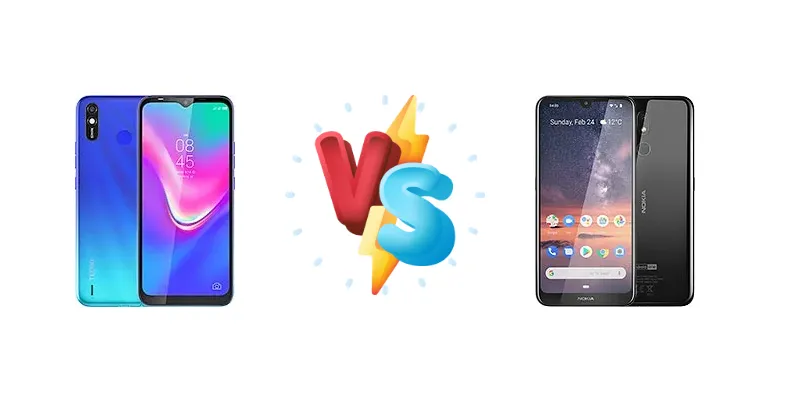
The Tecno Spark 4 Lite and Nokia 3.2 represent the entry-level of the Android smartphone market. Both aim to deliver essential smartphone functionality at an incredibly affordable price point. However, they achieve this with different chipsets – MediaTek’s Helio A22 in the Tecno and Qualcomm’s Snapdragon 429 in the Nokia – leading to subtle but important differences in performance and user experience. This comparison dives deep into those differences to help you choose the right phone for your needs.
🏆 Quick Verdict
For the average user prioritizing a slightly smoother experience and the benefit of Qualcomm’s optimized software support, the Nokia 3.2 emerges as the better choice. While both phones offer similar core functionality, the Snapdragon 429 provides a marginal performance edge and the inclusion of 10W charging is a practical advantage.
| Network |
|---|
| 2G bands | GSM 850 / 900 / 1800 / 1900 | GSM 850 / 900 / 1800 / 1900 |
| 3G bands | HSDPA 850 / 900 / 2100 | HSDPA 850 / 900 / 2100 |
| 4G bands | 1, 3, 5, 8, 38, 40, 41 | 1, 3, 5, 7, 8, 20, 28, 38, 40 - EMEA, APAC, MENA |
| Speed | HSPA 42.2/5.76 Mbps, LTE Cat4 150/50 Mbps | HSPA 42.2/5.76 Mbps, LTE Cat4 150/50 Mbps |
| Technology | GSM / HSPA / LTE | GSM / HSPA / LTE |
| | - | 1, 3, 5, 8, 40, 41 - India |
| Launch |
|---|
| Announced | 2019, December. Released 2019, December | 2019, February 24. Released 2019, May 22 |
| Status | Discontinued | Discontinued |
| Body |
|---|
| Build | Glass front, plastic back, plastic frame | Glass front, plastic back, plastic frame |
| Dimensions | 166.7 x 75.8 x 8.4 mm (6.56 x 2.98 x 0.33 in) | 159.4 x 76.2 x 8.6 mm (6.28 x 3.00 x 0.34 in) |
| SIM | Nano-SIM + Nano-SIM | Nano-SIM + Nano-SIM |
| Weight | - | 181 g (6.38 oz) |
| Display |
|---|
| Resolution | 720 x 1600 pixels, 20:9 ratio (~269 ppi density) | 720 x 1520 pixels, 19:9 ratio (~269 ppi density) |
| Size | 6.52 inches, 102.6 cm2 (~81.2% screen-to-body ratio) | 6.26 inches, 97.8 cm2 (~80.5% screen-to-body ratio) |
| Type | IPS LCD | IPS LCD |
| Platform |
|---|
| CPU | Quad-core 1.8 GHz Cortex-A53 | Quad-core 1.8 GHz Cortex-A53 |
| Chipset | Mediatek MT6761 Helio A22 (12 nm) | Qualcomm SDM429 Snapdragon 429 (12 nm) |
| GPU | PowerVR GE8320 | Adreno 504 |
| OS | Android 9.0 (Pie), HIOS 5.5 | Android 9.0 (Pie), upgradable to Android 11, Android One |
| Memory |
|---|
| Card slot | microSDXC (dedicated slot) | microSDXC (dedicated slot) |
| Internal | 32GB 2GB RAM | 16GB 2GB RAM, 32GB 3GB RAM, 64GB 3GB RAM |
| | eMMC 5.1 | eMMC 5.1 |
| Main Camera |
|---|
| Features | LED flash, HDR, panorama | LED flash |
| Single | 8 MP, AF | 13 MP, f/2.2, 1/3.1", 1.12µm, AF |
| Video | 1080p@30fps | 1080p@30fps |
| Selfie camera |
|---|
| Features | LED flash, HDR | - |
| Single | 8 MP, f/2.0 | 5 MP, f/2.2, 27mm (wide), 1/5.0", 1.12µm |
| Video | 1080p@30fps | - |
| Sound |
|---|
| 3.5mm jack | Yes | Yes |
| 35mm jack | Yes | Yes |
| Loudspeaker | Yes | Yes |
| Comms |
|---|
| Bluetooth | 4.2, A2DP, LE | 4.2, A2DP, LE, aptX |
| NFC | No | No |
| Positioning | GPS | GPS, GLONASS, BDS |
| Radio | FM radio | FM radio |
| USB | microUSB 2.0 | microUSB 2.0, OTG |
| WLAN | Wi-Fi 802.11 b/g/n | Wi-Fi 802.11 b/g/n |
| Features |
|---|
| Sensors | Fingerprint (rear-mounted), accelerometer, proximity | Fingerprint (rear-mounted, 32/3GB only), accelerometer, proximity |
| Battery |
|---|
| Charging | - | 10W wired |
| Type | 4000 mAh | Li-Ion 4000 mAh, non-removable |
| Misc |
|---|
| Colors | Midnight Black, Vacation Blue, Hillier Purple | Black, Steel |
| Models | KC8S | TA-1156, TA-1159, TA-1164 |
| Price | - | About 140 EUR |
| SAR EU | - | 0.24 W/kg (head) 1.63 W/kg (body) |
Tecno Spark 4 Lite
- Extremely affordable price point
- Likely larger battery capacity (speculative)
- Simple and straightforward Android experience
- Helio A22 chipset offers lower performance
- Slower charging speeds (likely)
- Potentially less optimized software
Nokia 3.2
- Qualcomm Snapdragon 429 provides better performance
- 10W wired charging for faster top-ups
- Potentially better software optimization
- Slightly higher price compared to Tecno Spark 4 Lite
- Battery life may be comparable to Tecno (speculative)
- Still a basic smartphone experience
Display Comparison
Neither Tecno nor Nokia provide detailed display specifications beyond the basic panel size. Both likely utilize IPS LCD panels, common in this price bracket. Without knowing the resolution or peak brightness, it’s difficult to declare a clear winner. However, the Nokia 3.2’s brand reputation suggests slightly better color calibration, though this is speculative. The absence of features like high refresh rates or HDR support is expected at this price point.
Camera Comparison
Camera performance on both devices is expected to be basic. Detailed camera specs are unavailable, but both likely feature a primary camera and potentially a depth sensor. The image processing capabilities of the Snapdragon 429 may provide a slight edge to the Nokia 3.2 in terms of image clarity and dynamic range, but significant improvements shouldn’t be expected. Focusing on the primary sensor resolution would be more impactful than analyzing potentially low-resolution secondary sensors.
Performance
Both the Tecno Spark 4 Lite and Nokia 3.2 are powered by quad-core 1.8 GHz Cortex-A53 CPUs. However, the chipset difference is crucial. The Nokia 3.2’s Qualcomm Snapdragon 429, built on a 12nm process, generally exhibits better sustained performance and more efficient power management compared to the Tecno’s MediaTek Helio A22, also on a 12nm process. Qualcomm’s optimizations for Android, even on a lower-tier chip, often translate to a smoother user experience, particularly when multitasking. While the CPU clock speeds are identical, the Snapdragon 429’s GPU is typically more capable, offering a slight advantage in light gaming.
Battery Life
Battery capacity is not specified for either device. However, given the similar chipsets and target market, they likely feature batteries in the 3000-4000 mAh range. The Nokia 3.2 includes 10W wired charging, a practical advantage over the Tecno Spark 4 Lite, which likely relies on slower charging speeds. While neither phone will offer exceptional battery life, the 10W charging on the Nokia 3.2 will reduce downtime between charges.
Buying Guide
Buy the Tecno Spark 4 Lite if you need a phone primarily for basic communication – calls, texts, and light social media – and are on an extremely tight budget. Its focus is on affordability above all else. Buy the Nokia 3.2 if you prefer a slightly more responsive user interface, appreciate the benefits of Qualcomm’s chipset optimization, and value the convenience of wired charging, even at a modest 10W.
Frequently Asked Questions
❓ Will the Nokia 3.2 handle popular apps like WhatsApp and Facebook smoothly?
Yes, the Snapdragon 429 in the Nokia 3.2 is generally capable of running apps like WhatsApp and Facebook without significant lag. While it won't offer a high-end experience, it provides a more responsive experience than the Helio A22 in the Tecno Spark 4 Lite, especially when multitasking between these apps.
❓ Is the Nokia 3.2 a good choice for mobile gaming?
The Nokia 3.2 is not ideal for demanding mobile games. The Snapdragon 429 can handle basic 2D games and some lighter 3D titles at low settings, but it will struggle with more graphically intensive games like PUBG or Call of Duty. The Tecno Spark 4 Lite will offer a similar gaming experience.
❓ Does the Tecno Spark 4 Lite support 4G LTE connectivity?
Yes, the MediaTek Helio A22 chipset in the Tecno Spark 4 Lite supports 4G LTE connectivity, allowing you to access mobile data networks for browsing, streaming, and using apps. However, speeds may be limited by the chipset's capabilities.
❓ What version of Android do these phones run?
The Nokia 3.2 was initially released with Android 9 Pie and has received updates. The Tecno Spark 4 Lite likely shipped with Android Go Edition, a lightweight version of Android designed for devices with limited resources. This means it has fewer pre-installed apps and is optimized for lower RAM configurations.