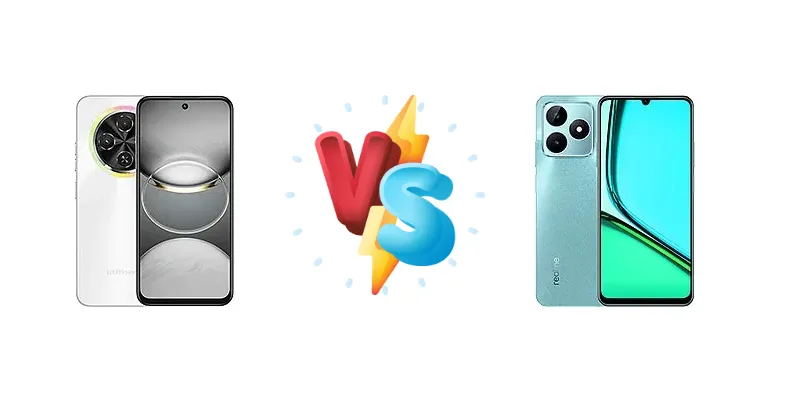
The sub-$150 smartphone market is fiercely competitive. The Tecno Spark 30C and Realme C51s both aim to deliver essential features at an accessible price point, but they take different approaches. The Spark 30C leverages the established Mediatek Helio G81, while the C51s opts for the newer Unisoc Tiger T612. This comparison dissects their key differences to help you choose the right device.
🏆 Quick Verdict
For most users, the Realme C51s emerges as the better choice. Its 33W fast charging, capable of reaching 50% in just 28 minutes, significantly outperforms the Tecno Spark 30C’s 18W charging. While the Helio G81 in the Spark 30C offers a slight CPU clock speed advantage, the C51s’ faster charging and modern chipset architecture provide a more compelling overall experience.
| Network |
|---|
| 2G bands | GSM 850 / 900 / 1800 / 1900 | GSM 850 / 900 / 1800 / 1900 |
| 3G bands | HSDPA 900 / 2100 | HSDPA 900 / 2100 |
| 4G bands | LTE | 1, 3, 5, 8, 38, 40 |
| Speed | HSPA, LTE | HSPA, LTE |
| Technology | GSM / HSPA / LTE | GSM / HSPA / LTE |
| Launch |
|---|
| Announced | 2024, September 09 | 2024, March 15 |
| Status | Available. Released 2024, October | Available. Released 2024, March 15 |
| Body |
|---|
| Build | Glass front, plastic back, plastic frame | Glass front, plastic frame, plastic back |
| Dimensions | - | 167.2 x 76.7 x 7.5 mm (6.58 x 3.02 x 0.30 in) |
| SIM | Nano-SIM + Nano-SIM | Nano-SIM + Nano-SIM |
| Weight | - | 182 g (6.42 oz) |
| Display |
|---|
| Resolution | 720 x 1600 pixels, 20:9 ratio (~263 ppi density) | 720 x 1600 pixels, 20:9 ratio (~260 ppi density) |
| Size | 6.67 inches, 107.4 cm2 | 6.74 inches, 109.7 cm2 (~85.5% screen-to-body ratio) |
| Type | IPS LCD, 120Hz | IPS LCD, 90Hz, 560 nits (peak) |
| Platform |
|---|
| CPU | Octa-core (2x2.0 GHz Cortex-A75 & 6x1.8 GHz Cortex-A55) | Octa-core (2x1.8 GHz Cortex-A75 & 6x1.8 GHz Cortex-A55) |
| Chipset | Mediatek Helio G81 | Unisoc Tiger T612 (12 nm) |
| GPU | Mali-G52 MC2 | Mali-G57 |
| OS | Android 14 | Android 13, Realme UI |
| Memory |
|---|
| Card slot | microSDXC | microSDXC (dedicated slot) |
| Internal | 128GB 4GB RAM, 128GB 6GB RAM, 256GB 4GB RAM, 256GB 8GB RAM | 128GB 6GB RAM |
| Main Camera |
|---|
| Features | LED flash, HDR | LED flash, HDR, panorama |
| Single | 50 MP, (wide), 1/2.8", PDAF
Auxiliary lens | 50 MP, f/1.8, 27mm (wide), 1/2.76", 0.64µm, PDAF
Auxiliary lens |
| Video | 1080p@30fps | 1080p@30fps |
| Selfie camera |
|---|
| Features | - | HDR |
| Single | 8 MP | 5 MP, f/2.2, 28mm (wide), 1/5.0", 1.12µm |
| Video | Yes | 720p@30fps |
| Sound |
|---|
| 35mm jack | Yes | Yes |
| Loudspeaker | Yes, with stereo speakers | Yes |
| Comms |
|---|
| Bluetooth | Yes | 5.0, A2DP, LE |
| Infrared port | Yes | - |
| NFC | No | Yes, 360˚ (market/region dependent) |
| Positioning | GPS | GPS, GLONASS, GALILEO |
| Radio | Unspecified | Unspecified |
| USB | USB Type-C, OTG | USB Type-C |
| WLAN | Yes | Wi-Fi 802.11 a/b/g/n/ac, dual-band |
| Features |
|---|
| Sensors | Fingerprint (side-mounted), accelerometer, compass | Fingerprint (side-mounted), accelerometer, gyro, proximity, compass |
| Battery |
|---|
| Charging | 18W wired | 33W wired, 0-50% in 28 min |
| Type | 5000 mAh | 5000 mAh |
| Misc |
|---|
| Colors | Orbit Black, Orbit White, Magic Skin 3.0 | Shiny Green, Mighty Black |
| Models | kl5, kl5n | RMX3765 |
| Price | $ 131.27 / € 149.99 | About 100 EUR |
Tecno Spark 30C
- Slightly higher CPU clock speed for potential multitasking benefits.
- Established Mediatek chipset with known performance characteristics.
- Likely lower price point (depending on regional availability).
- Slower 18W charging.
- Older chipset architecture potentially leading to lower efficiency.
Realme C51s
- Faster 33W charging with a 0-50% charge in 28 minutes.
- More modern Unisoc Tiger T612 chipset with a 12nm process.
- Potentially better thermal management due to chipset architecture.
- Slightly lower CPU clock speed.
- Unisoc chipset may have less software optimization compared to Mediatek.
Display Comparison
Neither device boasts a standout display. Given the context data focuses on internals, we can infer both likely utilize standard LCD panels common in this price bracket. Bezels are expected to be noticeable on both. Color accuracy will likely be tuned for vibrancy rather than precision. The absence of high refresh rates or advanced panel technologies like LTPO suggests a focus on cost optimization over visual fidelity.
Camera Comparison
Without detailed camera specifications, it’s safe to assume both phones feature basic camera setups geared towards casual photography. The market segment suggests a primary sensor around 13-50MP, paired with auxiliary lenses of limited utility (likely a 2MP macro and depth sensor). Image processing will likely prioritize scene recognition and software enhancements over raw sensor quality. The absence of Optical Image Stabilization (OIS) on either device means low-light performance will be heavily reliant on software algorithms.
Performance
The core difference lies in the chipsets. The Tecno Spark 30C’s Mediatek Helio G81, with its 2x2.0 GHz Cortex-A75 cores and 6x1.8 GHz Cortex-A55 cores, offers a slightly higher peak CPU clock speed compared to the Realme C51s’ Unisoc Tiger T612 (2x1.8 GHz Cortex-A75 & 6x1.8 GHz Cortex-A55). However, the T612 is built on a more efficient 12nm process, potentially leading to better thermal management during sustained loads. While both CPUs share the same core configuration, the newer architecture of the T612 may offer improvements in per-clock performance. The impact on real-world usage will be noticeable in demanding tasks like gaming, where sustained performance is crucial.
Battery Life
The Realme C51s’ 33W wired charging is a clear advantage. The advertised 0-50% charge in 28 minutes is a significant improvement over the Tecno Spark 30C’s 18W charging. While battery capacity isn’t specified, the faster charging speed mitigates the impact of a potentially smaller battery. Users who frequently top up their phones or need a quick boost before leaving the house will greatly benefit from the C51s’ charging capabilities.
Buying Guide
Buy the Tecno Spark 30C if you prioritize a slightly higher CPU clock speed for potentially smoother multitasking, and are less concerned about charging speed. Buy the Realme C51s if you value significantly faster charging, a more modern chipset architecture, and a generally more responsive user experience, even if it means a minor trade-off in peak CPU performance.
Frequently Asked Questions
❓ Will the Unisoc Tiger T612 in the Realme C51s struggle with demanding games like PUBG Mobile?
While the T612 isn't a gaming powerhouse, it's capable of running PUBG Mobile at medium settings. The 12nm process should help with thermal throttling, allowing for sustained gameplay. However, don't expect the highest frame rates or graphics settings.
❓ How much faster is the 33W charging on the Realme C51s compared to the 18W charging on the Tecno Spark 30C in real-world use?
The 33W charging on the C51s will noticeably reduce charging times. The advertised 0-50% in 28 minutes is a substantial improvement. The Spark 30C’s 18W charging will likely take over an hour to reach 50%, making the C51s a better option for users who need a quick power boost.
❓ Does the Tecno Spark 30C's Helio G81 offer a significant advantage for multitasking compared to the Realme C51s?
The slightly higher CPU clock speed of the Helio G81 *may* provide a marginal improvement in multitasking, but the difference is unlikely to be dramatic in everyday use. The Unisoc T612's architecture and software optimization will also play a role, potentially offsetting the clock speed advantage.