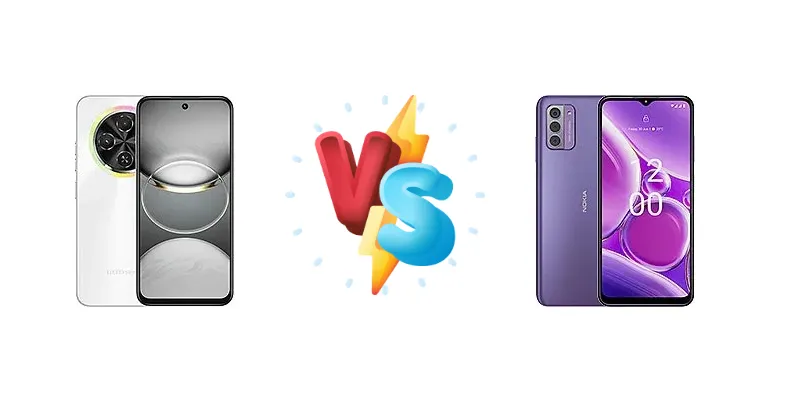
The sub-$200 smartphone market is fiercely competitive, and the Tecno Spark 30C and Nokia G42 represent compelling options for users seeking 5G connectivity without breaking the bank. While both aim for affordability, they take different approaches to achieving it, primarily through chipset selection. This comparison dissects the key differences between the MediaTek Helio G81-powered Spark 30C and the Qualcomm Snapdragon 480+-equipped G42, revealing which device delivers the best overall experience.
🏆 Quick Verdict
For the average user prioritizing 5G connectivity and a more efficient processor, the Nokia G42 emerges as the better choice. Its Snapdragon 480+ offers a noticeable performance edge and benefits from a more modern 8nm manufacturing process, translating to better thermal management. However, the Tecno Spark 30C remains a viable option for those focused on basic tasks and less demanding applications.
| Network |
|---|
| 2G bands | GSM 850 / 900 / 1800 / 1900 | GSM 850 / 900 / 1800 / 1900 |
| 3G bands | HSDPA 900 / 2100 | HSDPA 850 / 900 / 1700(AWS) / 1900 / 2100 |
| 4G bands | LTE | 1, 2, 3, 4, 5, 7, 8, 12, 17, 13, 20, 28, 38, 39, 40, 41, 66 |
| 5G bands | - | 1, 2, 3, 5, 7, 8, 28, 40, 41, 66, 77, 78 SA/NSA |
| Speed | HSPA, LTE | HSPA, LTE, 5G |
| Technology | GSM / HSPA / LTE | GSM / HSPA / LTE / 5G |
| Launch |
|---|
| Announced | 2024, September 09 | 2023, June 28 |
| Status | Available. Released 2024, October | Available. Released 2023, June 28 |
| Body |
|---|
| Build | Glass front, plastic back, plastic frame | Glass front, plastic back, plastic frame |
| Dimensions | - | 165 x 75.8 x 8.6 mm (6.50 x 2.98 x 0.34 in) |
| SIM | Nano-SIM + Nano-SIM | · Nano-SIM· Nano-SIM + Nano-SIM |
| Weight | - | 193.8 g (6.84 oz) |
| Display |
|---|
| Protection | - | Corning Gorilla Glass 3 |
| Resolution | 720 x 1600 pixels, 20:9 ratio (~263 ppi density) | 720 x 1612 pixels, 20:9 ratio (~269 ppi density) |
| Size | 6.67 inches, 107.4 cm2 | 6.56 inches, 103.4 cm2 (~82.7% screen-to-body ratio) |
| Type | IPS LCD, 120Hz | IPS LCD, 90Hz, 450 nits (typ), 560 nits (peak) |
| Platform |
|---|
| CPU | Octa-core (2x2.0 GHz Cortex-A75 & 6x1.8 GHz Cortex-A55) | Octa-core (2x2.2 GHz Kryo 460 & 6x1.8 GHz Kryo 460) |
| Chipset | Mediatek Helio G81 | Qualcomm SM4350-AC Snapdragon 480+ 5G (8 nm) |
| GPU | Mali-G52 MC2 | Adreno 619 |
| OS | Android 14 | Android 13, upgradable to Android 14 |
| Memory |
|---|
| Card slot | microSDXC | microSDXC |
| Internal | 128GB 4GB RAM, 128GB 6GB RAM, 256GB 4GB RAM, 256GB 8GB RAM | 128GB 4GB RAM, 128GB 6GB RAM, 256GB 8GB RAM |
| Main Camera |
|---|
| Features | LED flash, HDR | LED flash, HDR, panorama |
| Single | 50 MP, (wide), 1/2.8", PDAF
Auxiliary lens | - |
| Triple | - | 50 MP, f/1.8, (wide), AF
2 MP (macro)
Auxiliary lens |
| Video | 1080p@30fps | 1080p@30fps |
| Selfie camera |
|---|
| Single | 8 MP | 8 MP |
| Video | Yes | Yes |
| Sound |
|---|
| 35mm jack | Yes | Yes |
| Loudspeaker | Yes, with stereo speakers | Yes |
| Comms |
|---|
| Bluetooth | Yes | 5.1, A2DP, LE |
| Infrared port | Yes | - |
| NFC | No | Yes (market/region dependent) |
| Positioning | GPS | GPS, GLONASS, GALILEO, BDS |
| Radio | Unspecified | FM radio |
| USB | USB Type-C, OTG | USB Type-C 2.0, OTG |
| WLAN | Yes | Wi-Fi 802.11 a/b/g/n/ac/6, dual-band |
| Features |
|---|
| Sensors | Fingerprint (side-mounted), accelerometer, compass | Fingerprint (side-mounted), accelerometer, proximity, compass |
| Battery |
|---|
| Charging | 18W wired | 20W wired, PD3.0, QC3 |
| Type | 5000 mAh | Li-Po 5000 mAh |
| Misc |
|---|
| Colors | Orbit Black, Orbit White, Magic Skin 3.0 | Gray, Purple, Red |
| Models | kl5, kl5n | - |
| Price | $ 131.27 / € 149.99 | $ 545.00 / £ 124.99 |
Tecno Spark 30C
- Potentially lower price point
- Simple and straightforward user experience
- Adequate for basic smartphone tasks
- Less powerful processor
- Slower charging speeds
- Less efficient chipset leading to potential throttling
Nokia G42
- Faster and more efficient Snapdragon 480+ processor
- 20W fast charging with PD3.0/QC3
- 5G connectivity for faster data speeds
- Potentially higher price
- May not offer significantly improved camera performance without further specs
- Software update commitment unclear
Display Comparison
Neither device boasts a standout display. While specific panel details (like brightness in nits) are unavailable, the focus here is on the underlying processing power impacting UI smoothness. The Nokia G42’s Snapdragon 480+ is more capable of driving a fluid user experience, even if both phones likely utilize similar LCD panels. The absence of high refresh rates on either device suggests a focus on power conservation rather than visual fidelity.
Camera Comparison
Without detailed camera specs beyond the presence of cameras, a direct comparison is difficult. However, the processing capabilities of the Snapdragon 480+ in the Nokia G42 likely provide better image processing algorithms, potentially resulting in more detailed and vibrant photos, especially in challenging lighting conditions. The Helio G81 in the Tecno Spark 30C will likely struggle more with dynamic range and noise reduction. The absence of Optical Image Stabilization (OIS) on either device suggests a reliance on software stabilization, where the Snapdragon’s ISP will again have an advantage.
Performance
The core difference lies in the chipsets. The Nokia G42’s Qualcomm Snapdragon 480+ (8nm) significantly outperforms the Tecno Spark 30C’s MediaTek Helio G81. The Snapdragon 480+ features Kryo 460 cores clocked at 2.2 GHz, compared to the Helio G81’s 2.0 GHz Cortex-A75 cores. The 8nm process node of the Snapdragon is a key advantage, offering superior power efficiency and reduced thermal throttling during sustained workloads. This translates to smoother multitasking, faster app loading times, and a more responsive overall experience on the Nokia G42. While both have octa-core CPUs with a similar 2+6 configuration, the architectural improvements in the Snapdragon give it a clear edge.
Battery Life
The Nokia G42’s 20W charging with PD3.0 and QC3 support is a significant advantage over the Tecno Spark 30C’s 18W wired charging. This faster charging capability translates to quicker top-ups, minimizing downtime. While battery capacity isn’t specified, the Snapdragon 480+’s superior power efficiency means the Nokia G42 is likely to achieve comparable or even better battery life despite potentially having a similar capacity to the Tecno Spark 30C. The inclusion of Quick Charge support also suggests broader compatibility with existing chargers.
Buying Guide
Buy the Tecno Spark 30C if you need a phone primarily for essential tasks like calling, texting, and light social media browsing, and are less concerned with demanding gaming or sustained performance. Buy the Nokia G42 if you prioritize 5G connectivity, smoother multitasking, and a more future-proof processor, even if it means a slightly higher initial investment. The G42 is also the better choice for users who value faster charging speeds and potentially longer software support.
Frequently Asked Questions
❓ Will the Snapdragon 480+ in the Nokia G42 handle graphically demanding games like PUBG Mobile?
While the Snapdragon 480+ isn't a gaming powerhouse, it's significantly more capable than the Helio G81. You can expect playable frame rates in PUBG Mobile at medium settings, but don't anticipate a consistently smooth experience at the highest graphical presets. The 8nm process will help mitigate thermal throttling during extended gaming sessions.
❓ How much faster is the charging on the Nokia G42 compared to the Tecno Spark 30C?
The Nokia G42's 20W charging with Quick Charge and Power Delivery support will noticeably reduce charging times compared to the Tecno Spark 30C's 18W charging. Expect a faster 0-50% charge on the Nokia G42, and a quicker overall time to reach 100%, though exact times depend on the charger used.
❓ Does the Nokia G42 support carrier aggregation for improved 5G speeds?
The Snapdragon 480+ generally supports carrier aggregation, which can significantly improve 5G download speeds in areas with good network coverage. However, specific carrier aggregation band support varies by region and carrier, so it's best to check with your mobile provider for compatibility.