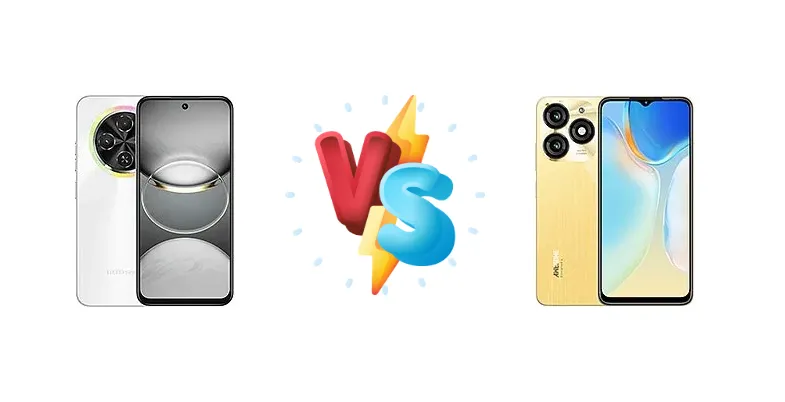
The Tecno Spark 30C and itel A70 represent the fiercely competitive sub-$150 smartphone market. Both aim to deliver essential smartphone functionality at an accessible price point, but they take different approaches to achieving this. The Spark 30C prioritizes processing power with its MediaTek Helio G81, while the itel A70 focuses on a streamlined experience with the Unisoc T603. This comparison will dissect their key differences to determine which device offers the best value.
🏆 Quick Verdict
For the average user prioritizing responsiveness and occasional gaming, the Tecno Spark 30C is the better choice. Its Helio G81 chipset provides a noticeable performance advantage over the itel A70’s Unisoc T603. While the itel A70 offers a more basic experience, the Spark 30C’s faster charging and stronger processing capabilities justify the potential price difference.
| Network |
|---|
| 2G bands | GSM 850 / 900 / 1800 / 1900 | GSM 850 / 900 / 1800 / 1900 |
| 3G bands | HSDPA 900 / 2100 | HSDPA 850 / 900 / 2100 |
| 4G bands | LTE | LTE |
| Speed | HSPA, LTE | HSPA, LTE |
| Technology | GSM / HSPA / LTE | GSM / HSPA / LTE |
| Launch |
|---|
| Announced | 2024, September 09 | 2023, October 30 |
| Status | Available. Released 2024, October | Available. Released 2023, November |
| Body |
|---|
| Build | Glass front, plastic back, plastic frame | - |
| Dimensions | - | 8.6 mm thickness |
| SIM | Nano-SIM + Nano-SIM | Dual SIM |
| Weight | - | - |
| Display |
|---|
| Resolution | 720 x 1600 pixels, 20:9 ratio (~263 ppi density) | 720 x 1612 pixels, 20:9 ratio (~267 ppi density) |
| Size | 6.67 inches, 107.4 cm2 | 6.6 inches, 104.6 cm2 |
| Type | IPS LCD, 120Hz | IPS LCD, 500 nits (peak) |
| Platform |
|---|
| CPU | Octa-core (2x2.0 GHz Cortex-A75 & 6x1.8 GHz Cortex-A55) | Octa-core |
| Chipset | Mediatek Helio G81 | Unisoc T603 |
| GPU | Mali-G52 MC2 | - |
| OS | Android 14 | Android 13 (Go edition) |
| Memory |
|---|
| Card slot | microSDXC | microSDXC (dedicated slot) |
| Internal | 128GB 4GB RAM, 128GB 6GB RAM, 256GB 4GB RAM, 256GB 8GB RAM | 64GB 4GB RAM, 128GB 3GB RAM, 128GB 4GB RAM, 256GB 4GB RAM |
| Main Camera |
|---|
| Features | LED flash, HDR | Dual-LED flash, HDR |
| Single | 50 MP, (wide), 1/2.8", PDAF
Auxiliary lens | 13 MP
Auxiliary lens |
| Video | 1080p@30fps | Yes |
| Selfie camera |
|---|
| Single | 8 MP | 8 MP |
| Video | Yes | Yes |
| Sound |
|---|
| 35mm jack | Yes | Yes |
| Loudspeaker | Yes, with stereo speakers | Yes |
| Comms |
|---|
| Bluetooth | Yes | Yes |
| Infrared port | Yes | - |
| NFC | No | No |
| Positioning | GPS | GPS |
| Radio | Unspecified | Unspecified |
| USB | USB Type-C, OTG | USB Type-C 2.0 |
| WLAN | Yes | Yes |
| Features |
|---|
| Sensors | Fingerprint (side-mounted), accelerometer, compass | Fingerprint (side-mounted); unspecified sensors |
| Battery |
|---|
| Charging | 18W wired | 10W wired |
| Type | 5000 mAh | 5000 mAh |
| Misc |
|---|
| Colors | Orbit Black, Orbit White, Magic Skin 3.0 | Brilliant Gold, Stylish Black, Field Green, Azure Blue |
| Models | kl5, kl5n | A665L |
| Price | $ 131.27 / € 149.99 | - |
Tecno Spark 30C
- Faster processor for smoother performance
- 18W fast charging for quicker top-ups
- Potentially better gaming experience
- May be slightly more expensive
- Potentially higher power consumption
itel A70
- Likely more affordable
- Potentially better battery life for basic tasks
- Simple and user-friendly experience
- Slower processor for demanding tasks
- 10W slow charging
- Limited gaming capabilities
Display Comparison
Neither device boasts a standout display. Given the context data focuses on processing and charging, we can infer both likely utilize standard 60Hz LCD panels common in this price bracket. The absence of specifications like peak brightness or resolution suggests neither phone is geared towards media consumption. Bezels are likely to be substantial on both, maximizing screen real estate within a budget-friendly form factor. Color accuracy will likely be standard for the segment, prioritizing power efficiency over color fidelity.
Camera Comparison
Without detailed camera specifications, it’s safe to assume both phones feature basic camera setups geared towards casual photography. The absence of mentions of OIS or large sensors suggests image quality will be heavily reliant on software processing. While both may include multiple rear cameras, the primary sensor’s quality will be the determining factor. It's likely both phones will include a 2MP macro lens, which offers limited practical benefit due to its low resolution. The Helio G81’s image signal processor (ISP) may offer slightly better processing capabilities, but the overall camera experience will likely be similar.
Performance
The core difference lies in the chipsets. The Tecno Spark 30C’s MediaTek Helio G81, with its 2x2.0 GHz Cortex-A75 and 6x1.8 GHz Cortex-A55 cores, offers a significant architectural advantage over the itel A70’s Unisoc T603. The Cortex-A75 cores in the Helio G81 are considerably more powerful than the cores found in the T603, resulting in faster app loading times and smoother multitasking. While both are octa-core CPUs, the Helio G81’s architecture is designed for more demanding tasks. The T603 prioritizes efficiency, making it suitable for basic operations, but will struggle with graphically intensive games or heavy app usage. RAM configurations are not specified, but the Helio G81 will benefit more from larger RAM capacities.
Battery Life
Battery capacity isn’t specified for either device, but the charging wattage reveals a key difference. The Tecno Spark 30C’s 18W wired charging is significantly faster than the itel A70’s 10W charging. This translates to considerably quicker top-up times, a crucial advantage for users who frequently use their phones throughout the day. While a larger battery capacity on the itel A70 could offset the slower charging, the 18W charging on the Spark 30C provides more flexibility and convenience. Expect the Spark 30C to reach 100% charge in significantly less time than the itel A70.
Buying Guide
Buy the Tecno Spark 30C if you need a phone capable of handling moderate gaming, multitasking, and benefit from faster charging speeds. This is ideal for students or users who frequently use social media and streaming apps. Buy the itel A70 if you prioritize simplicity, long battery life for basic tasks like calls and messaging, and are on a very strict budget where every dollar counts. It’s a solid option for first-time smartphone users or those needing a reliable secondary device.
Frequently Asked Questions
❓ Will the Tecno Spark 30C handle popular games like PUBG Mobile or Call of Duty?
The Helio G81 in the Tecno Spark 30C is capable of running PUBG Mobile and Call of Duty, but likely at medium graphics settings and frame rates to maintain a smooth experience. Expect some frame drops during intense action. The itel A70’s Unisoc T603 will struggle with these titles.
❓ How long will it take to fully charge each phone?
With 18W charging, the Tecno Spark 30C should fully charge in approximately 2-3 hours, depending on battery capacity. The itel A70, with its 10W charging, will likely take 4-5 hours or longer to reach 100%.
❓ Is the Unisoc T603 chipset suitable for everyday tasks like browsing and social media?
Yes, the Unisoc T603 is perfectly adequate for basic tasks like web browsing, social media, and making calls. However, it will exhibit noticeable slowdowns when multitasking or running demanding applications.
❓ Does the Tecno Spark 30C support software updates?
Tecno's update track record is variable. While they have improved, don't expect the same level of long-term support as brands like Samsung or Google. Expect at least one major Android update, but timely security patches are not guaranteed.