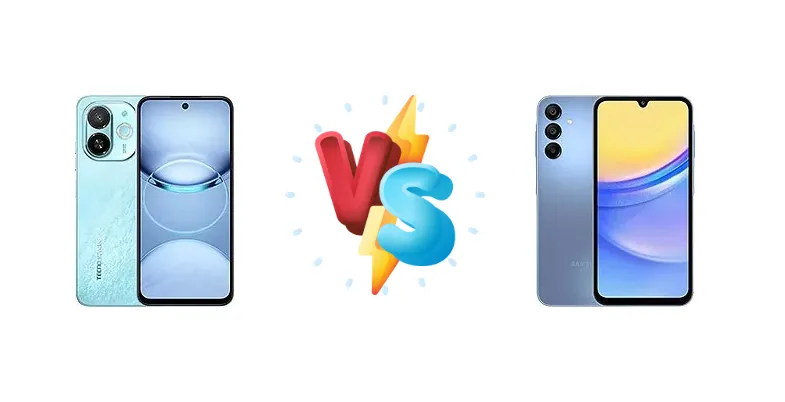
The sub-$200 5G smartphone market is heating up, with the Tecno Spark 30C 5G and Samsung Galaxy A15 5G vying for dominance. Both devices aim to deliver 5G connectivity without breaking the bank, but they take different approaches to achieving this. This comparison dissects their key specifications to determine which phone offers the best overall experience for budget-conscious consumers.
🏆 Quick Verdict
For most users, the Samsung Galaxy A15 5G emerges as the slightly better choice. Its significantly brighter display and longer battery life in active use outweigh the modest performance edge of the Tecno Spark 30C 5G. However, the Tecno offers a compelling alternative for those prioritizing raw processing power within this price bracket.
| Network |
|---|
| 2G bands | GSM 850 / 900 / 1800 / 1900 | GSM 850 / 900 / 1800 / 1900 |
| 3G bands | HSDPA 900 / 2100 | HSDPA 850 / 900 / 1700(AWS) / 1900 / 2100 |
| 4G bands | LTE | 1, 2, 3, 4, 5, 7, 8, 12, 17, 20, 26, 28, 38, 40, 41, 66 |
| 5G bands | SA/NSA | 1, 3, 5, 7, 8, 26, 28, 40, 41, 66, 77, 78 SA/NSA/Sub6 |
| Speed | HSPA, LTE, 5G | HSPA, LTE, 5G |
| Technology | GSM / HSPA / LTE / 5G | GSM / HSPA / LTE / 5G |
| Launch |
|---|
| Announced | 2024, October 02 | 2023, December 11 |
| Status | Available. Released 2024, October | Available. Released 2023, December 16 |
| Body |
|---|
| Build | Glass front, plastic back, plastic frame | Glass front, plastic back, plastic frame |
| Dimensions | 165 x 77 x 8 mm (6.50 x 3.03 x 0.31 in) | 160.1 x 76.8 x 8.4 mm (6.30 x 3.02 x 0.33 in) |
| SIM | Nano-SIM + Nano-SIM | · Nano-SIM· Nano-SIM + Nano-SIM |
| Weight | - | 200 g (7.05 oz) |
| Display |
|---|
| Resolution | 720 x 1600 pixels, 20:9 ratio (~263 ppi density) | 1080 x 2340 pixels, 19.5:9 ratio (~396 ppi density) |
| Size | 6.67 inches, 107.4 cm2 (~84.5% screen-to-body ratio) | 6.5 inches, 103.7 cm2 (~84.3% screen-to-body ratio) |
| Type | IPS LCD, 120Hz | Super AMOLED, 90Hz, 800 nits (HBM) |
| Platform |
|---|
| CPU | Octa-core (2x2.4 GHz Cortex-A76 & 6x2.0 GHz Cortex-A55) | Octa-core (2x2.2 GHz Cortex-A76 & 6x2.0 GHz Cortex-A55) |
| Chipset | Mediatek Dimensity 6300 (6 nm) | Mediatek Dimensity 6100+ (6 nm) |
| GPU | Mali-G57 MC2 | Mali-G57 MC2 |
| OS | Android 14 | Android 14, upgradable to Android 16, One UI 8, up to 4 major Android upgrades |
| Memory |
|---|
| Card slot | microSDXC | microSDXC (uses shared SIM slot) |
| Internal | 64GB 4GB RAM, 128GB 4GB RAM, 128GB 8GB RAM, 256GB 4GB RAM | 64GB 4GB RAM, 128GB 4GB RAM, 128GB 6GB RAM, 128GB 8GB RAM, 256GB 8GB RAM |
| Main Camera |
|---|
| Features | Tripple-LED flash | LED flash, panorama, HDR |
| Single | 48 MP, (wide), 1/2.0", 0.8µm, AF
Auxiliary lens | - |
| Triple | - | 50 MP, f/1.8, (wide), AF
5 MP, f/2.2, (ultrawide)
2 MP (macro) |
| Video | 1080p@30fps | 1080p@30fps, gyro-EIS |
| Selfie camera |
|---|
| Features | Dual-LED flash | - |
| Single | 8 MP | 13 MP, f/2.0, (wide) |
| Video | Yes | 1080p@30fps |
| Sound |
|---|
| 35mm jack | Yes | Yes |
| Loudspeaker | Yes, with stereo speakers | Yes |
| Comms |
|---|
| Bluetooth | Yes | 5.3, A2DP, LE |
| Infrared port | Yes | - |
| NFC | Yes | Yes (market/region dependent) |
| Positioning | GPS | GPS, GALILEO, GLONASS, BDS, QZSS |
| Radio | Unspecified | No |
| USB | USB Type-C | USB Type-C 2.0 |
| WLAN | Yes | Wi-Fi 802.11 a/b/g/n/ac, dual-band, Wi-Fi Direct |
| Features |
|---|
| Sensors | Fingerprint (side-mounted); unspecified sensors | Fingerprint (side-mounted), accelerometer, gyro, compass |
| Battery |
|---|
| Charging | 18W wired | 25W wired |
| Type | 5000 mAh | 5000 mAh |
| Misc |
|---|
| Colors | Aurora Cloud, Azure Sky, Midnight Shadow | Brave Black, Personality Yellow, Magical Blue, Optimistic Blue |
| Models | KL8H | SM-A156B, SM-A156B/DS, SM-A156P, SM-A156P/DS, SM-A156U, SM-A156U1, SM-A156U1/DS, SM-A156W, SM-A156P/N, SM-A156P/DSN, SM-S156VL, SM-A156M, SM-A156E, SM-A156E/DSN |
| Price | - | € 167.00 / $ 79.97 / ₹ 17,490 |
| SAR EU | - | 0.80 W/kg (head) 1.46 W/kg (body) |
Tecno Spark 30C 5G
- Potentially faster CPU performance due to Dimensity 6300
- Competitive 5G connectivity
- Likely more affordable price point
- Lower display brightness compared to the A15
- Slower 18W charging
Samsung Galaxy A15 5G
- Significantly brighter display for outdoor visibility
- Excellent battery life (14:31h active use)
- Faster 25W charging
- Slightly slower CPU performance
- May be marginally more expensive
Display Comparison
The Samsung Galaxy A15 5G boasts a clear advantage in display quality, achieving a measured peak brightness of 786 nits. This is crucial for outdoor visibility, a common pain point in this price segment. While the Tecno Spark 30C 5G’s display specifications are not provided, it’s reasonable to assume it falls short of this brightness level given its focus on cost optimization. The A15’s panel likely offers a more comfortable viewing experience in direct sunlight. We can assume both use LCD panels at this price point, but Samsung’s calibration and brightness control are superior.
Camera Comparison
Without detailed camera specifications beyond the presence of sensors, a direct comparison is difficult. However, it’s safe to assume both phones prioritize affordability over camera prowess. The inclusion of a 2MP macro camera on either device is largely a marketing tactic, offering limited practical benefit due to the small sensor size and lack of optical image stabilization (OIS). Image processing will likely be the differentiating factor, with Samsung’s software typically offering more refined results, particularly in challenging lighting conditions. Sensor size and aperture are key, but unavailable for comparison.
Performance
Both phones utilize Mediatek Dimensity chipsets fabricated on a 6nm process, indicating similar efficiency. However, the Tecno Spark 30C 5G features the Dimensity 6300, with a CPU configuration of 2x2.4 GHz Cortex-A76 and 6x2.0 GHz Cortex-A55 cores. The Samsung Galaxy A15 5G uses the Dimensity 6100+, clocked slightly lower at 2x2.2 GHz Cortex-A76 and 6x2.0 GHz Cortex-A55. The higher clock speed of the A76 cores in the Tecno suggests a slight edge in single-core performance, beneficial for app launch times and responsiveness. However, the real-world difference will likely be minimal for everyday tasks. Neither phone specifies RAM type or speed, but LPDDR4X is the likely standard, limiting overall memory bandwidth.
Battery Life
The Samsung Galaxy A15 5G shines in battery life, achieving an active use score of 14 hours and 31 minutes. This indicates excellent power efficiency and a well-optimized software experience. The Tecno Spark 30C 5G’s battery capacity is not specified, but its 18W charging speed is slower than the A15’s 25W charging. While charging speed isn’t everything, the A15’s faster charging allows for quicker top-ups, mitigating the impact of a potentially smaller battery capacity. The A15’s longer active use time suggests a more efficient chipset and display combination.
Buying Guide
Buy the Tecno Spark 30C 5G if you prioritize maximizing CPU performance for multitasking and light gaming, and are willing to compromise slightly on display brightness and battery endurance. Buy the Samsung Galaxy A15 5G if you value a vibrant, easily visible display, all-day battery life, and the established Samsung ecosystem, even if it means a small performance trade-off.
Frequently Asked Questions
❓ Does the Mediatek Dimensity 6100+ in the Galaxy A15 5G struggle with demanding games like PUBG Mobile?
While not a gaming powerhouse, the Dimensity 6100+ is capable of running PUBG Mobile at medium settings with acceptable frame rates. Expect some frame drops during intense firefights. The Tecno Spark 30C 5G with the Dimensity 6300 might offer slightly better performance, but neither phone is designed for high-end gaming.
❓ How significant is the difference in charging speed between the 18W charging on the Tecno Spark 30C 5G and the 25W charging on the Samsung Galaxy A15 5G?
The 25W charging on the A15 will noticeably reduce charging times. While a full 0-100% time isn't specified, expect the A15 to charge significantly faster, potentially shaving off 30-60 minutes compared to the Tecno. This is particularly useful for quick top-ups throughout the day.
❓ Is the display on the Samsung Galaxy A15 5G prone to noticeable PWM flicker, and could this cause eye strain for sensitive users?
Unfortunately, PWM frequency data isn't available for either device. However, Samsung generally employs higher PWM frequencies in their displays, reducing the likelihood of flicker-induced eye strain compared to some other budget brands. Further testing would be needed to confirm.