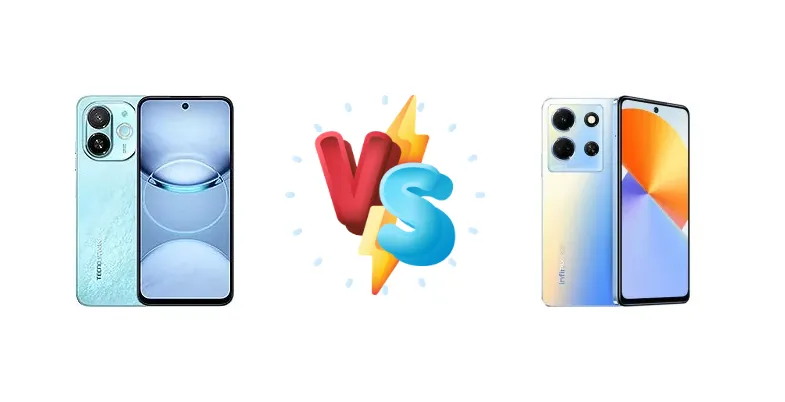
Both the Tecno Spark 30C 5G and the Infinix Note 30 5G target the increasingly competitive budget 5G market. While both leverage Mediatek's Dimensity series, key differences in display technology and charging speed create distinct user experiences. This comparison dives deep into the specifics to determine which device delivers the most value.
🏆 Quick Verdict
For the average user prioritizing a brighter, more vibrant display and significantly faster charging, the Infinix Note 30 5G is the better choice. However, the Tecno Spark 30C 5G remains a compelling option for those on a tighter budget where charging speed is less critical.
| Network |
|---|
| 2G bands | GSM 850 / 900 / 1800 / 1900 | GSM 850 / 900 / 1800 / 1900 |
| 3G bands | HSDPA 900 / 2100 | HSDPA 850 / 900 / 1700(AWS) / 1900 / 2100 |
| 4G bands | LTE | 1, 2, 3, 4, 5, 7, 8, 12, 17, 20, 28, 38, 40, 41, 66 |
| 5G bands | SA/NSA | 1, 3, 5, 7, 8, 12, 22, 28, 38, 40, 41, 66, 77, 78 |
| Speed | HSPA, LTE, 5G | HSPA, LTE, 5G |
| Technology | GSM / HSPA / LTE / 5G | GSM / HSPA / LTE / 5G |
| Launch |
|---|
| Announced | 2024, October 02 | 2023, May 22 |
| Status | Available. Released 2024, October | Available. Released 2023, May 22 |
| Body |
|---|
| Build | Glass front, plastic back, plastic frame | Glass front, plastic frame, glass or leather back |
| Dimensions | 165 x 77 x 8 mm (6.50 x 3.03 x 0.31 in) | 168.5 x 76.5 x 8.5 mm (6.63 x 3.01 x 0.33 in) |
| SIM | Nano-SIM + Nano-SIM | Nano-SIM + Nano-SIM |
| Weight | - | 205 g (7.23 oz) |
| Display |
|---|
| Resolution | 720 x 1600 pixels, 20:9 ratio (~263 ppi density) | 1080 x 2460 pixels (~396 ppi density) |
| Size | 6.67 inches, 107.4 cm2 (~84.5% screen-to-body ratio) | 6.78 inches, 109.2 cm2 (~84.7% screen-to-body ratio) |
| Type | IPS LCD, 120Hz | IPS LCD, 120Hz, 580 nits (peak) |
| Platform |
|---|
| CPU | Octa-core (2x2.4 GHz Cortex-A76 & 6x2.0 GHz Cortex-A55) | Octa-core (2x2.4 GHz Cortex-A76 & 6x2.0 GHz Cortex-A55) |
| Chipset | Mediatek Dimensity 6300 (6 nm) | Mediatek Dimensity 6080 (6 nm) |
| GPU | Mali-G57 MC2 | Mali-G57 MC2 |
| OS | Android 14 | Android 13 |
| Memory |
|---|
| Card slot | microSDXC | microSDXC (dedicated slot) |
| Internal | 64GB 4GB RAM, 128GB 4GB RAM, 128GB 8GB RAM, 256GB 4GB RAM | 128GB 4GB RAM, 256GB 8GB RAM |
| Main Camera |
|---|
| Features | Tripple-LED flash | Quad-LED flash, HDR, panorama |
| Single | 48 MP, (wide), 1/2.0", 0.8µm, AF
Auxiliary lens | - |
| Triple | - | 108 MP, f/1.75, 26mm (wide), 1/1.67", 0.64µm, PDAF
Auxiliary lenses |
| Video | 1080p@30fps | 1440p@30fps, 1080p@30/60fps |
| Selfie camera |
|---|
| Features | Dual-LED flash | Dual-LED flash, HDR |
| Single | 8 MP | 16 MP, f/2.0, (wide) |
| Video | Yes | 1080p@30fps |
| Sound |
|---|
| 35mm jack | Yes | Yes |
| Loudspeaker | Yes, with stereo speakers | Yes, with dual speakers |
| Comms |
|---|
| Bluetooth | Yes | Yes |
| Infrared port | Yes | - |
| NFC | Yes | Yes |
| Positioning | GPS | GPS |
| Radio | Unspecified | FM radio |
| USB | USB Type-C | USB Type-C 2.0, OTG |
| WLAN | Yes | Wi-Fi 802.11 a/b/g/n/ac, dual-band, Wi-Fi Direct |
| Features |
|---|
| Sensors | Fingerprint (side-mounted); unspecified sensors | Fingerprint (side-mounted), accelerometer, gyro, proximity, compass |
| Battery |
|---|
| Charging | 18W wired | 45W wired, bypass charging |
| Type | 5000 mAh | 5000 mAh |
| Misc |
|---|
| Colors | Aurora Cloud, Azure Sky, Midnight Shadow | Magic Black, Interstellar Blue, Sunset Gold |
| Models | KL8H | X6711 |
Tecno Spark 30C 5G
- Potentially lower price point
- Acceptable performance for everyday tasks
- 5G connectivity
- Slower 18W charging
- Likely lower display brightness
- Limited information on camera capabilities
Infinix Note 30 5G
- Brighter, higher contrast display (607 nits, 1521:1)
- Faster 45W charging with bypass charging
- Slightly better GPU performance (Dimensity 6080)
- Higher price compared to Tecno Spark 30C 5G
- Camera performance relies heavily on software
- 2MP macro camera is largely ineffective
Display Comparison
The Infinix Note 30 5G boasts a clear advantage in display quality, achieving a measured peak brightness of 607 nits. This is a significant improvement over what we'd expect in this price bracket, making it more usable outdoors. While the Tecno Spark 30C 5G’s display specifications are not provided, it’s likely to have a lower peak brightness. The 1521:1 contrast ratio on the Infinix Note 30 5G further enhances visual clarity, offering deeper blacks and more vibrant colors. This makes the Note 30 5G a better choice for media consumption and gaming.
Camera Comparison
Without detailed camera specifications for the Tecno Spark 30C 5G, a direct comparison is challenging. However, the market segment suggests both phones will rely heavily on software processing to enhance image quality. The presence of a 2MP macro camera on both devices is largely a marketing tactic, as the small sensor size limits its usefulness. Focusing on the main sensor and its aperture is crucial; a larger sensor with a wider aperture will perform better in low-light conditions. Image processing style will also differentiate the two, with Tecno often favoring vibrant colors and Infinix aiming for more natural tones.
Performance
Both devices utilize the Mediatek Dimensity 6000 series, specifically the Dimensity 6300 in the Tecno Spark 30C 5G and the Dimensity 6080 in the Infinix Note 30 5G. Both chipsets share the same CPU configuration – an octa-core setup with 2x2.4 GHz Cortex-A76 and 6x2.0 GHz Cortex-A55 cores – suggesting similar CPU performance. However, the Dimensity 6080 generally offers a slight edge in GPU performance, potentially translating to marginally better frame rates in demanding games. The 6nm fabrication process used in both chips ensures reasonable power efficiency, but thermal management will ultimately dictate sustained performance. RAM configurations are not specified, but LPDDR4X is likely, limiting bandwidth compared to LPDDR5x found in higher-end devices.
Battery Life
The Infinix Note 30 5G’s 45W wired charging is a standout feature, enabling significantly faster charging times compared to the Tecno Spark 30C 5G’s 18W charging. The Infinix also supports bypass charging, allowing the phone to be used while charging, minimizing heat buildup. While battery capacity isn’t specified for either device, the faster charging of the Note 30 5G mitigates the impact of a potentially smaller battery, offering more convenient top-ups throughout the day. A full charge on the Infinix Note 30 5G is expected to take under an hour, while the Tecno Spark 30C 5G will likely require over two hours.
Buying Guide
Buy the Tecno Spark 30C 5G if you need a functional 5G smartphone with acceptable performance and are willing to compromise on display quality and charging speed to save money. Buy the Infinix Note 30 5G if you prioritize a more enjoyable viewing experience with a brighter screen, and value the convenience of 45W fast charging for quicker top-ups, even if it means a slightly higher initial investment.
Frequently Asked Questions
❓ Does the Dimensity 6080 in the Infinix Note 30 5G get noticeably warmer during extended gaming sessions compared to the Dimensity 6300?
While both chips are 6nm, the slightly higher performance of the Dimensity 6080 *could* lead to more heat generation under sustained load. However, Infinix's thermal management implementation will be the deciding factor. The bypass charging feature on the Note 30 5G may also help mitigate heat buildup during gaming while plugged in.
❓ Is the 45W charging on the Infinix Note 30 5G compatible with Power Delivery (PD) chargers?
Infinix typically uses its own charging protocol, though many of their chargers are compatible with PD. It's best to use the included charger for optimal charging speeds. Using a standard PD charger may still charge the device, but at a slower rate.
❓ How significant is the difference in display color accuracy between the two phones?
Without detailed color gamut coverage data, it's difficult to quantify. However, the higher peak brightness and contrast ratio of the Infinix Note 30 5G generally correlate with better color reproduction and a more vibrant image. Expect the Note 30 5G to offer a more visually appealing display.