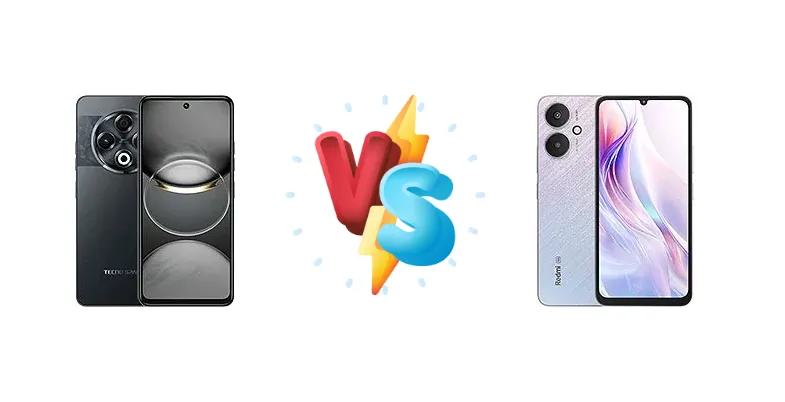
The sub-$200 5G smartphone market is heating up, and the Tecno Spark 30 and Xiaomi Redmi 13C 5G are two key players vying for dominance. While both aim to deliver 5G connectivity at an accessible price, they take distinctly different approaches to achieving this, primarily through their chipset choices. This comparison dissects those differences and determines which phone offers the best overall experience.
🏆 Quick Verdict
For the average user prioritizing consistent performance and future-proofing, the Xiaomi Redmi 13C 5G emerges as the stronger contender. Its Mediatek Dimensity 6100+ chipset, built on a more efficient 6nm process, provides a noticeable performance advantage over the Tecno Spark 30’s Helio G91, despite both featuring similar CPU core configurations.
| Network |
|---|
| 2G bands | GSM 850 / 900 / 1800 / 1900 | GSM 850 / 900 / 1800 / 1900 |
| 3G bands | HSDPA 900 / 2100 | HSDPA 800 / 850 / 900 / 1700(AWS) / 1900 / 2100 - International |
| 4G bands | LTE | 1, 2, 3, 4, 5, 7, 8, 12, 13, 17, 18, 19, 20, 26, 28, 32, 38, 40, 41, 66 - International |
| 5G bands | - | 1, 3, 5, 7, 8, 20, 28, 38, 40, 41, 66, 77, 78 SA/NSA - International |
| Speed | HSPA, LTE | HSPA, LTE, 5G |
| Technology | GSM / HSPA / LTE | GSM / HSPA / LTE / 5G |
| Launch |
|---|
| Announced | 2024, September 21 | 2023, December 06 |
| Status | Available. Released 2024, October | Available. Released 2023, December 16 |
| Body |
|---|
| Build | Glass front, plastic frame, plastic back or silicone polymer (eco leather) back | Glass front (Gorilla Glass 3), plastic frame, plastic back |
| Dimensions | 168 x 76.4 x 7.7 mm or 7.9 mm | 168.1 x 77.9 x 8.2 mm (6.62 x 3.07 x 0.32 in) |
| SIM | Nano-SIM + Nano-SIM | Nano-SIM + Nano-SIM |
| Weight | - | 192 g or 195 g (6.77 oz) |
| Display |
|---|
| Protection | - | Corning Gorilla Glass 3 |
| Resolution | 1080 x 2460 pixels (~396 ppi density) | 720 x 1600 pixels, 20:9 ratio (~260 ppi density) |
| Size | 6.78 inches, 109.2 cm2 (~85.0% screen-to-body ratio) | 6.74 inches, 109.7 cm2 (~83.8% screen-to-body ratio) |
| Type | IPS LCD, 90Hz, 800 nits | IPS LCD, 90Hz, 450 nits (typ), 600 nits (HBM) |
| Platform |
|---|
| CPU | Octa-core (2x2.0 GHz Cortex-A75 & 6x1.8 GHz Cortex-A55) | Octa-core (2x2.2 GHz Cortex-A76 & 6x2.0 GHz Cortex-A55) |
| Chipset | Mediatek Helio G91 (12 nm) | Mediatek Dimensity 6100+ (6 nm) |
| GPU | Mali-G52 MC2 | Mali-G57 MC2 |
| OS | Android 14, HIOS 14 | Android 13, MIUI 14 |
| Memory |
|---|
| Card slot | microSDXC | microSDXC (dedicated slot) |
| Internal | 128GB 8GB RAM, 256GB 8GB RAM | 64GB 4GB RAM, 128GB 4GB RAM, 128GB 6GB RAM, 256GB 8GB RAM |
| Main Camera |
|---|
| Features | Quad-LED flash, HDR | LED flash, HDR |
| Single | 64 MP, (wide), 1/1.73", 0.8µm, PDAF
Auxiliary lens | 50 MP, f/1.8, 28mm (wide), 1/2.76", 1.12µm, PDAF
Auxiliary lens |
| Video | 1440p@30fps, 1080p@30fps | 1080p@30fps |
| Selfie camera |
|---|
| Features | Dual-LED dual-tone flash | HDR |
| Single | 13 MP, (wide) | 5 MP, f/2.2, (wide) |
| Video | 1080p@30fps | 1080p@30fps |
| Sound |
|---|
| 35mm jack | Yes | Yes |
| Loudspeaker | Yes, with stereo speakers | Yes |
| Comms |
|---|
| Bluetooth | Yes | 5.3, A2DP, LE |
| Infrared port | Yes | - |
| NFC | Yes | Yes (market/region dependent) |
| Positioning | GPS | GPS, GLONASS, GALILEO, BDS |
| Radio | Unspecified | FM radio |
| USB | USB Type-C | USB Type-C 2.0, OTG |
| WLAN | Yes | Wi-Fi 802.11 a/b/g/n/ac, dual-band |
| Features |
|---|
| Sensors | Fingerprint (side-mounted); unspecified sensors | Fingerprint (side-mounted), accelerometer, compass |
| Battery |
|---|
| Charging | 18W wired | 18W wired, PD |
| Type | 5000 mAh | 5000 mAh |
| Misc |
|---|
| Colors | Stellar Shadow, Astral Ice, Magic Skin 3.0, Bumblebee Edition | Starry Black, Twilight Blue, Starry Silver, Starlight Black, Startrail Green, Startrail Silver |
| Models | KL6 | 23124RN87G, 23124RN87I, 23124RN87C |
| Price | - | $ 198.99 / £ 119.00 / € 116.99 / ₹ 10,895 |
| SAR | - | 1.09 W/kg (head) 1.09 W/kg (body) |
| SAR EU | - | 0.98 W/kg (head) 0.98 W/kg (body) |
Tecno Spark 30
- Potentially lower price point (depending on region)
- Established brand presence in select markets
- 18W wired charging
- Older, less efficient Helio G91 chipset
- 12nm process leads to higher heat generation
- Likely less future-proof
Xiaomi Redmi 13C 5G
- More efficient Dimensity 6100+ chipset (6nm)
- Power Delivery (PD) charging support
- Better long-term performance potential
- May be slightly more expensive
- Xiaomi's MIUI software can be polarizing
- Potentially less brand recognition in some regions
Display Comparison
Neither device boasts a standout display. Both likely utilize LCD panels, a common cost-saving measure in this segment. However, the lack of detailed display specs necessitates focusing on the chipset's impact on graphics rendering. The Redmi 13C 5G’s Dimensity 6100+ benefits from a newer GPU architecture, potentially offering smoother visuals during gaming and video playback, even if the resolution and refresh rate are similar.
Camera Comparison
Without detailed camera specs, a direct comparison is difficult. However, it’s safe to assume both phones feature a primary camera paired with auxiliary lenses of limited utility (likely a 2MP macro and depth sensor). The image signal processor (ISP) within the Dimensity 6100+ generally offers more advanced image processing capabilities, potentially resulting in better dynamic range and noise reduction in the Redmi 13C 5G’s photos. The larger process node of the Helio G91 might limit the ISP's capabilities.
Performance
The core difference lies in the chipsets. The Xiaomi Redmi 13C 5G’s Mediatek Dimensity 6100+ (6nm) is a significant upgrade over the Tecno Spark 30’s Mediatek Helio G91 (12nm). The 6nm process inherently offers better power efficiency, translating to less heat generation and sustained performance. While both CPUs feature a 2x2.0 GHz Cortex-A75 & 6x1.8 GHz Cortex-A55 configuration, the A76 cores in the Dimensity 6100+ are a generation newer and more efficient. This means the Redmi 13C 5G will likely handle demanding apps and multitasking with greater ease. The Helio G91, while capable, will likely show its age sooner under sustained load.
Battery Life
Both devices feature 18W wired charging, but the Redmi 13C 5G adds Power Delivery (PD) support, offering broader charger compatibility and potentially faster charging speeds with compatible adapters. While battery capacity isn't specified, the Dimensity 6100+'s 6nm efficiency will likely result in longer battery life for the Redmi 13C 5G, even with a similar capacity, as the chipset consumes less power during operation. The more efficient chipset will also reduce heat, which can degrade battery health over time.
Buying Guide
Buy the Tecno Spark 30 if you prioritize a slightly more established brand reputation within certain African markets and are primarily focused on basic smartphone tasks like calling, texting, and light social media use. Buy the Xiaomi Redmi 13C 5G if you value a more modern chipset architecture, better long-term performance potential, and the convenience of Power Delivery (PD) charging compatibility, making it ideal for users who stream videos, play mobile games, or multitask frequently.
Frequently Asked Questions
❓ Will the Redmi 13C 5G's Dimensity 6100+ handle demanding games like PUBG Mobile smoothly?
The Dimensity 6100+ is capable of running PUBG Mobile at medium settings with stable frame rates. While it won't deliver a flagship gaming experience, its newer GPU architecture provides a noticeable advantage over the Helio G91, allowing for smoother gameplay and reduced frame drops, especially during intense firefights.
❓ Does the Tecno Spark 30 overheat during prolonged use, like video recording or gaming?
The Helio G91, being built on a 12nm process, is more prone to heat generation under sustained load. While it won't necessarily become unusable, users may experience thermal throttling, leading to reduced performance during extended gaming sessions or lengthy video recordings. The Redmi 13C 5G's 6nm Dimensity 6100+ manages heat more effectively.
❓ Is Power Delivery (PD) charging on the Redmi 13C 5G a significant advantage?
Yes, PD charging offers greater flexibility. It allows you to use a wider range of USB-C chargers, including those for laptops and tablets, to charge your phone. While both phones support 18W charging, PD ensures compatibility and potentially faster charging speeds with compatible adapters.