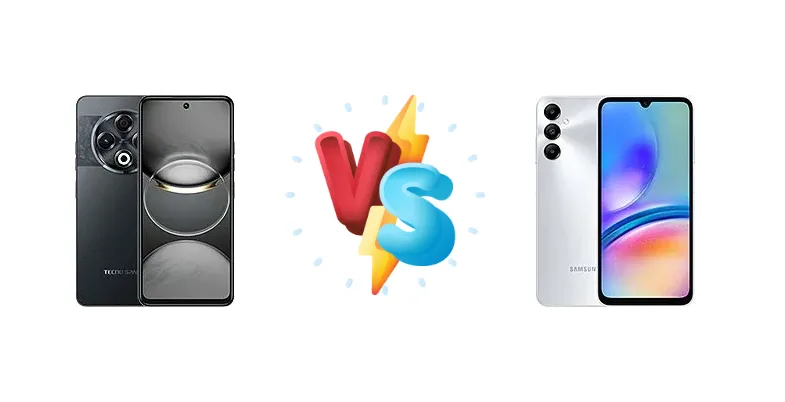
The sub-$150 smartphone market is fiercely competitive. The Tecno Spark 30 and Samsung Galaxy A05s represent compelling options, but cater to slightly different priorities. The Spark 30 aims for a balance of performance and features, while the A05s prioritizes long-lasting battery life and the Samsung brand reputation. This comparison dives deep into the specs to determine which device delivers the best value.
🏆 Quick Verdict
For the average user prioritizing all-day battery life and a trusted brand, the Samsung Galaxy A05s is the better choice. Its 11:32h active use score significantly outperforms what we'd expect from the Spark 30. However, the Tecno Spark 30’s newer Helio G91 chipset offers a performance edge for those who occasionally game or multitask.
| Network |
|---|
| 2G bands | GSM 850 / 900 / 1800 / 1900 | GSM 850 / 900 / 1800 / 1900 |
| 3G bands | HSDPA 900 / 2100 | HSDPA 850 / 900 / 2100 |
| 4G bands | LTE | 1, 3, 5, 7, 8, 20, 28, 38, 40, 41 |
| Speed | HSPA, LTE | HSPA, LTE |
| Technology | GSM / HSPA / LTE | GSM / HSPA / LTE |
| Launch |
|---|
| Announced | 2024, September 21 | 2023, September 25 |
| Status | Available. Released 2024, October | Available. Released 2023, October 18 |
| Body |
|---|
| Build | Glass front, plastic frame, plastic back or silicone polymer (eco leather) back | Glass front, plastic back, plastic frame |
| Dimensions | 168 x 76.4 x 7.7 mm or 7.9 mm | 168 x 77.8 x 8.8 mm (6.61 x 3.06 x 0.35 in) |
| SIM | Nano-SIM + Nano-SIM | · Nano-SIM· Nano-SIM + Nano-SIM |
| Weight | - | 194 g (6.84 oz) |
| Display |
|---|
| Resolution | 1080 x 2460 pixels (~396 ppi density) | 1080 x 2400 pixels, 20:9 ratio (~393 ppi density) |
| Size | 6.78 inches, 109.2 cm2 (~85.0% screen-to-body ratio) | 6.7 inches, 108.4 cm2 (~82.9% screen-to-body ratio) |
| Type | IPS LCD, 90Hz, 800 nits | PLS LCD, 90Hz |
| Platform |
|---|
| CPU | Octa-core (2x2.0 GHz Cortex-A75 & 6x1.8 GHz Cortex-A55) | Octa-core (4x2.4 GHz Kryo 265 Gold & 4x1.9 GHz Kryo 265 Silver) |
| Chipset | Mediatek Helio G91 (12 nm) | Qualcomm SM6225 Snapdragon 680 4G (6 nm) |
| GPU | Mali-G52 MC2 | Adreno 610 |
| OS | Android 14, HIOS 14 | Android 13, up to 2 major Android upgrades, One UI 7 |
| Memory |
|---|
| Card slot | microSDXC | microSDXC (dedicated slot) |
| Internal | 128GB 8GB RAM, 256GB 8GB RAM | 64GB 4GB RAM, 128GB 4GB RAM, 128GB 6GB RAM |
| Main Camera |
|---|
| Features | Quad-LED flash, HDR | LED flash |
| Single | 64 MP, (wide), 1/1.73", 0.8µm, PDAF
Auxiliary lens | - |
| Triple | - | 50 MP, f/1.8, (wide), 1/2.8", 0.64µm, AF
2 MP (macro)
Auxiliary lens |
| Video | 1440p@30fps, 1080p@30fps | 1080p@30/60fps |
| Selfie camera |
|---|
| Features | Dual-LED dual-tone flash | - |
| Single | 13 MP, (wide) | 13 MP, f/2.0, (wide), 1/3.X", 1.12µm |
| Video | 1080p@30fps | 1080p@30fps |
| Sound |
|---|
| 35mm jack | Yes | Yes |
| Loudspeaker | Yes, with stereo speakers | Yes |
| Comms |
|---|
| Bluetooth | Yes | 5.1, A2DP, LE |
| Infrared port | Yes | - |
| NFC | Yes | Yes (market/region dependent) |
| Positioning | GPS | GPS, GLONASS, GALILEO, BDS, QZSS |
| Radio | Unspecified | Unspecified |
| USB | USB Type-C | USB Type-C 2.0 |
| WLAN | Yes | Wi-Fi 802.11 a/b/g/n/ac, dual-band, Wi-Fi Direct |
| Features |
|---|
| Sensors | Fingerprint (side-mounted); unspecified sensors | Fingerprint (side-mounted), accelerometer, proximity |
| Battery |
|---|
| Charging | 18W wired | 25W wired |
| Type | 5000 mAh | Li-Po 5000 mAh |
| Misc |
|---|
| Colors | Stellar Shadow, Astral Ice, Magic Skin 3.0, Bumblebee Edition | Black, Silver, Light Green, Violet |
| Models | KL6 | SM-A057F, SM-A057F/DS, SM-A057M, SM-A057M/DS, SM-A057G/DSN, SM-A057G |
| Price | - | $ 134.00 / C$ 146.99 / £ 83.94 / € 100.99 |
| SAR EU | - | 0.58 W/kg (head) 1.31 W/kg (body) |
Tecno Spark 30
- Potentially better CPU performance for gaming
- More modern chipset architecture (Helio G91)
- Likely more aggressive pricing
- Less efficient 12nm process
- Unknown battery capacity
- Slower 18W charging
Samsung Galaxy A05s
- Exceptional 11:32h battery life
- Faster 25W charging
- More efficient 6nm Snapdragon 680
- Slightly older chipset
- Lower peak CPU clock speed
- Samsung’s software can be bloated
Display Comparison
The Samsung Galaxy A05s boasts a measured peak brightness of 468 nits and a 1418:1 contrast ratio, indicating a more vibrant and visible display, especially outdoors. While the Tecno Spark 30’s display specifications are not provided, Samsung’s panel offers a tangible advantage in visual quality. The contrast ratio suggests deeper blacks and more dynamic colors, enhancing media consumption. The A05s’ brightness is crucial for usability in direct sunlight, a common scenario for budget smartphone users.
Camera Comparison
Both phones’ camera capabilities are likely to be similar, focusing on basic photography. The context data only mentions 'Photo / Video' for the A05s, suggesting a standard camera setup. Without sensor size or aperture information for either device, it’s difficult to make a definitive judgment. However, the prevalence of 2MP macro lenses on both brands suggests these are largely marketing features with limited real-world utility. Image processing will likely be the differentiating factor, with Samsung’s software generally offering more refined results, though this is speculative without sample images.
Performance
The core difference lies in the chipsets. The Samsung Galaxy A05s utilizes the Qualcomm Snapdragon 680 (6nm), featuring a Kryo CPU with a 2.4 GHz peak clock speed. This 6nm process node is more efficient than the 12nm process used in the Tecno Spark 30’s MediaTek Helio G91. While the Helio G91’s Cortex-A75 cores offer a 2.0 GHz clock speed, the Snapdragon 680’s architecture and fabrication process provide a more balanced and efficient performance profile. This translates to potentially better sustained performance and thermal management in the A05s, despite the Spark 30 having a slightly different core configuration (2x2.0 GHz A75 + 6x1.8 GHz A55 vs 4x2.4 GHz Kryo 265 Gold + 4x1.9 GHz Kryo 265 Silver).
Battery Life
The Samsung Galaxy A05s clearly wins in battery endurance with an impressive 11:32h active use score. The Tecno Spark 30’s battery capacity is unknown, but the A05s sets a high bar. Furthermore, the A05s supports 25W wired charging, significantly faster than the Spark 30’s 18W charging. This faster charging speed minimizes downtime and ensures quicker top-ups, a crucial advantage for users who rely heavily on their phones throughout the day. The efficiency of the Snapdragon 680 also contributes to the A05s’ superior battery life.
Buying Guide
Buy the Tecno Spark 30 if you need a phone capable of handling moderate gaming and multitasking without significant slowdowns, and you're comfortable with a less established brand. Buy the Samsung Galaxy A05s if you prioritize exceptional battery life, a reliable user experience, and the peace of mind that comes with the Samsung ecosystem. The A05s is ideal for users who primarily browse, message, and make calls.
Frequently Asked Questions
❓ Does the Snapdragon 680 in the Galaxy A05s get hot during prolonged use, like gaming?
The Snapdragon 680, built on a 6nm process, is known for its thermal efficiency. While it won't deliver flagship-level gaming performance, it's unlikely to overheat significantly during moderate gaming sessions. The A05s’ thermal design should handle typical usage without substantial throttling.
❓ Is the 18W charging on the Tecno Spark 30 slow compared to the 25W on the A05s?
Yes, 18W charging is noticeably slower than 25W. While 18W will still charge the phone overnight, the A05s will provide a significantly faster top-up when you're short on time. Expect a substantial difference in 0-100% charge times.
❓ How does the Helio G91 handle multitasking compared to the Snapdragon 680?
The Snapdragon 680’s more efficient architecture and process node generally lead to smoother multitasking. While the Helio G91 has capable cores, the Snapdragon 680 is optimized for sustained performance, meaning fewer slowdowns when switching between apps.