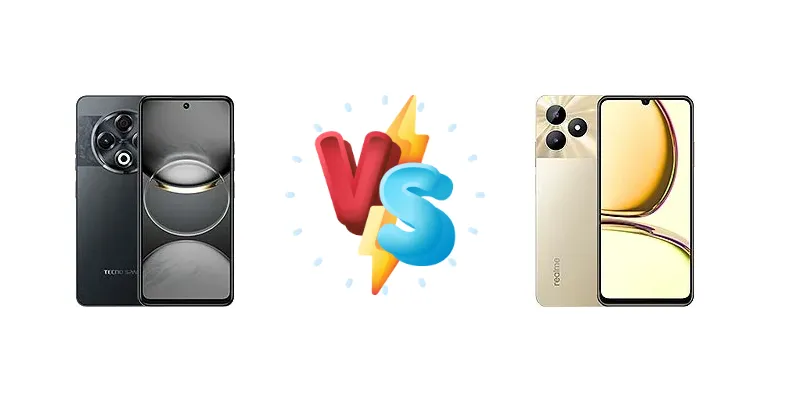
The sub-₹15,000 (approximately $180 USD) smartphone segment is fiercely competitive, and the Tecno Spark 30 and Realme C53 (India variant) are two contenders vying for your attention. Both aim to deliver a solid experience without breaking the bank, but they take different approaches to achieving this. This comparison dives deep into their core components – chipset, performance, and charging – to determine which phone offers the best value.
🏆 Quick Verdict
For users prioritizing consistent performance in demanding apps and light gaming, the Tecno Spark 30 emerges as the better choice. Its Mediatek Helio G91 chipset, featuring slightly higher clocked Cortex-A75 cores, provides a noticeable edge over the Realme C53’s Unisoc Tiger T612. While both offer 18W charging, the Spark 30’s processor gives it a slight advantage for the average user.
| Network |
|---|
| 2G bands | GSM 850 / 900 / 1800 / 1900 | GSM 850 / 900 / 1800 / 1900 |
| 3G bands | HSDPA 900 / 2100 | HSDPA 850 / 900 / 2100 |
| 4G bands | LTE | 1, 3, 5, 8, 38, 40, 41 |
| Speed | HSPA, LTE | HSPA, LTE |
| Technology | GSM / HSPA / LTE | GSM / HSPA / LTE |
| Launch |
|---|
| Announced | 2024, September 21 | 2023, July 19 |
| Status | Available. Released 2024, October | Available. Released 2023, July 26 |
| Body |
|---|
| Build | Glass front, plastic frame, plastic back or silicone polymer (eco leather) back | Glass front, plastic frame, plastic back |
| Dimensions | 168 x 76.4 x 7.7 mm or 7.9 mm | 167.2 x 76.7 x 8 mm (6.58 x 3.02 x 0.31 in) |
| SIM | Nano-SIM + Nano-SIM | Nano-SIM + Nano-SIM |
| Weight | - | 186 g (6.56 oz) |
| Display |
|---|
| Resolution | 1080 x 2460 pixels (~396 ppi density) | 1080 x 2400 pixels, 20:9 ratio (~390 ppi density) |
| Size | 6.78 inches, 109.2 cm2 (~85.0% screen-to-body ratio) | 6.74 inches, 109.7 cm2 (~85.5% screen-to-body ratio) |
| Type | IPS LCD, 90Hz, 800 nits | IPS LCD, 90Hz, 560 nits (peak) |
| Platform |
|---|
| CPU | Octa-core (2x2.0 GHz Cortex-A75 & 6x1.8 GHz Cortex-A55) | Octa-core (2x1.8 GHz Cortex-A75 & 6x1.8 GHz Cortex-A55) |
| Chipset | Mediatek Helio G91 (12 nm) | Unisoc Tiger T612 (12 nm) |
| GPU | Mali-G52 MC2 | Mali-G57 |
| OS | Android 14, HIOS 14 | Android 13, Realme UI |
| Memory |
|---|
| Card slot | microSDXC | microSDXC (dedicated slot) |
| Internal | 128GB 8GB RAM, 256GB 8GB RAM | 64GB 6GB RAM, 128GB 4GB RAM, 128GB 6GB RAM |
| Main Camera |
|---|
| Dual | - | 108 MP, (wide), PDAF
Auxiliary lens |
| Features | Quad-LED flash, HDR | LED flash, HDR, panorama |
| Single | 64 MP, (wide), 1/1.73", 0.8µm, PDAF
Auxiliary lens | - |
| Video | 1440p@30fps, 1080p@30fps | 1080p@30fps |
| Selfie camera |
|---|
| Features | Dual-LED dual-tone flash | HDR |
| Single | 13 MP, (wide) | 8 MP, (wide) |
| Video | 1080p@30fps | 720p@30fps |
| Sound |
|---|
| 35mm jack | Yes | Yes |
| Loudspeaker | Yes, with stereo speakers | Yes |
| Comms |
|---|
| Bluetooth | Yes | 5.0, A2DP, LE |
| Infrared port | Yes | - |
| NFC | Yes | No |
| Positioning | GPS | GPS, GLONASS, GALILEO |
| Radio | Unspecified | Unspecified |
| USB | USB Type-C | USB Type-C 2.0 |
| WLAN | Yes | Wi-Fi 802.11 a/b/g/n/ac, dual-band |
| Features |
|---|
| Sensors | Fingerprint (side-mounted); unspecified sensors | Fingerprint (side-mounted), accelerometer, gyro, proximity, compass |
| Battery |
|---|
| Charging | 18W wired | 18W wired |
| Type | 5000 mAh | 5000 mAh |
| Misc |
|---|
| Colors | Stellar Shadow, Astral Ice, Magic Skin 3.0, Bumblebee Edition | Gold, Black |
| Models | KL6 | RMX3762 |
| Price | - | About 110 EUR |
Tecno Spark 30
- More powerful processor (Helio G91)
- Potentially better gaming performance
- Slightly more responsive UI
- Software experience may be less refined than Realme UI
- Camera performance is unknown without further specs
Realme C53 (India)
- Potentially cleaner software experience (Realme UI)
- May benefit from Realme’s ecosystem integration
- Competitive pricing
- Less powerful processor (Tiger T612)
- Lower CPU clock speeds
- Potentially slower performance in demanding apps
Display Comparison
Neither Tecno nor Realme provide display specifications beyond the basic resolution. However, given the price point, both likely utilize IPS LCD panels. The real difference lies under the hood. While both are manufactured on a 12nm process, the chipset impacts the overall responsiveness of the UI. A smoother experience is expected on the Tecno Spark 30 due to its more powerful processor.
Camera Comparison
Without detailed camera specs, a direct comparison is difficult. Both phones likely feature a primary camera and depth/macro sensors. However, given the target market, image processing will be key. Realme’s image processing tends to be more saturated and vibrant, while Tecno often aims for a more natural look. The quality of the primary sensor and aperture will be the deciding factor, but without that data, it’s difficult to declare a winner. The inclusion of a 2MP macro lens on either device is largely a marketing tactic and offers limited practical benefit.
Performance
The core of the difference between these two phones lies in their chipsets. The Tecno Spark 30’s Mediatek Helio G91 features two Cortex-A75 cores clocked at 2.0 GHz, while the Realme C53’s Unisoc Tiger T612 has its Cortex-A75 cores clocked at 1.8 GHz. This 0.2 GHz difference, combined with the G91’s generally more mature software optimization, translates to a tangible performance advantage for the Tecno in CPU-intensive tasks. Both utilize the same Cortex-A55 efficiency cores clocked at 1.8 GHz, meaning multi-core performance will be closer, but the G91 still holds an edge. The GPU performance will also favor the G91, offering a slightly better gaming experience.
Battery Life
Both the Tecno Spark 30 and Realme C53 support 18W wired charging. While the battery capacity isn’t specified, typical capacities for phones in this segment range from 5000mAh to 5500mAh. The 18W charging won’t deliver blazing-fast speeds, but it should be sufficient for a full charge in around 2-3 hours. The more efficient Helio G91 in the Tecno Spark 30 *could* translate to slightly better battery life during heavy use, offsetting any potential capacity differences.
Buying Guide
Buy the Tecno Spark 30 if you need a phone capable of handling moderately demanding tasks like multitasking and casual gaming with a bit more fluidity. Buy the Realme C53 (India) if you prioritize a potentially more streamlined software experience (based on Realme’s UI history) and are primarily focused on basic smartphone functions like calling, messaging, and light social media use. The C53 may also appeal to those who prefer Realme’s ecosystem.
Frequently Asked Questions
❓ Will the Unisoc Tiger T612 in the Realme C53 struggle with multitasking?
The Unisoc Tiger T612 is a capable chip for basic tasks, but it may exhibit slowdowns when handling numerous apps simultaneously. Users who frequently switch between applications or run resource-intensive apps will likely notice a smoother experience on the Tecno Spark 30 with its Helio G91.
❓ Is the 18W charging on either phone considered fast charging in 2024?
No, 18W charging is considered relatively slow by 2024 standards. While it will charge the phone overnight or over a few hours, it won’t provide a quick top-up like the 33W or 67W charging found on more expensive devices. Expect a full charge to take approximately 2-3 hours.
❓ Can the Tecno Spark 30 handle popular games like PUBG Mobile or Call of Duty Mobile?
The Tecno Spark 30’s Helio G91 can run PUBG Mobile and Call of Duty Mobile, but you’ll likely need to lower the graphics settings to medium or low to achieve a playable frame rate. The Unisoc Tiger T612 in the Realme C53 will likely require even lower settings for a similar experience.