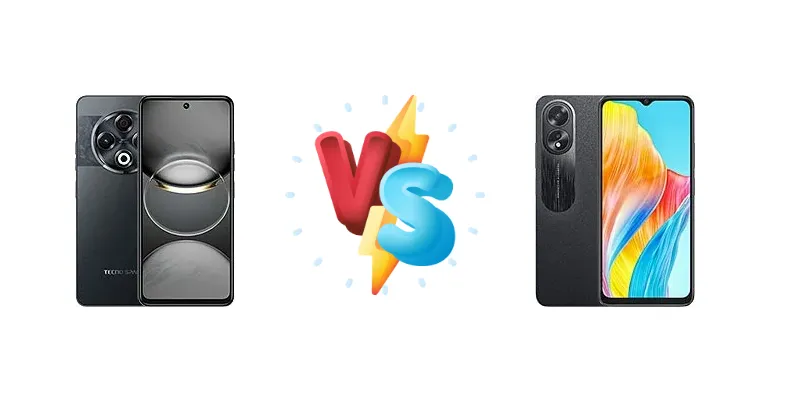
The Tecno Spark 30 and Oppo A18 represent the fiercely competitive sub-$150 smartphone market. Both devices aim to deliver essential features at an accessible price point, but subtle differences in their core hardware – specifically the chipset – dictate their strengths. This comparison dissects those differences to help you choose the right phone for your needs.
🏆 Quick Verdict
For most users, the Tecno Spark 30 edges out the Oppo A18. While both utilize the same CPU core configuration, the Helio G91 chipset offers a slight performance advantage, potentially translating to smoother multitasking and gaming. However, the Oppo A18 remains a viable option for users prioritizing a known brand and potentially better software optimization.
| Network |
|---|
| 2G bands | GSM 850 / 900 / 1800 / 1900 | GSM 850 / 900 / 1800 / 1900 |
| 3G bands | HSDPA 900 / 2100 | HSDPA 850 / 900 / 2100 |
| 4G bands | LTE | 1, 3, 5, 7, 8, 20, 28, 38, 40, 41 |
| Speed | HSPA, LTE | HSPA, LTE |
| Technology | GSM / HSPA / LTE | GSM / HSPA / LTE |
| Launch |
|---|
| Announced | 2024, September 21 | 2023, September 27 |
| Status | Available. Released 2024, October | Available. Released 2023, October 05 |
| Body |
|---|
| Build | Glass front, plastic frame, plastic back or silicone polymer (eco leather) back | - |
| Dimensions | 168 x 76.4 x 7.7 mm or 7.9 mm | 163.7 x 75 x 8.2 mm (6.44 x 2.95 x 0.32 in) |
| SIM | Nano-SIM + Nano-SIM | Nano-SIM + Nano-SIM |
| Weight | - | 188 g (6.63 oz) |
| Display |
|---|
| Resolution | 1080 x 2460 pixels (~396 ppi density) | 720 x 1612 pixels, 20:9 ratio (~269 ppi density) |
| Size | 6.78 inches, 109.2 cm2 (~85.0% screen-to-body ratio) | 6.56 inches, 103.4 cm2 (~84.2% screen-to-body ratio) |
| Type | IPS LCD, 90Hz, 800 nits | IPS LCD, 90Hz, 720 nits (peak) |
| Platform |
|---|
| CPU | Octa-core (2x2.0 GHz Cortex-A75 & 6x1.8 GHz Cortex-A55) | Octa-core (2x2.0 GHz Cortex-A75 & 6x1.8 GHz Cortex-A55) |
| Chipset | Mediatek Helio G91 (12 nm) | Mediatek MT6769 Helio G85 (12 nm) |
| GPU | Mali-G52 MC2 | Mali-G52 MC2 |
| OS | Android 14, HIOS 14 | Android 13, upgradable to Android 15, ColorOS 15 |
| Memory |
|---|
| Card slot | microSDXC | microSDXC |
| Internal | 128GB 8GB RAM, 256GB 8GB RAM | 64GB 4GB RAM, 128GB 4GB RAM |
| Main Camera |
|---|
| Dual | - | 8 MP, f/2.0, (wide), AF
Auxiliary lens |
| Features | Quad-LED flash, HDR | LED flash, panorama |
| Single | 64 MP, (wide), 1/1.73", 0.8µm, PDAF
Auxiliary lens | - |
| Video | 1440p@30fps, 1080p@30fps | 1080p@30fps |
| Selfie camera |
|---|
| Features | Dual-LED dual-tone flash | Panorama |
| Single | 13 MP, (wide) | 5 MP, f/2.2, (wide) |
| Video | 1080p@30fps | 1080p@30fps |
| Sound |
|---|
| 35mm jack | Yes | Yes |
| Loudspeaker | Yes, with stereo speakers | Yes |
| Comms |
|---|
| Bluetooth | Yes | 5.3, A2DP, LE, aptX HD |
| Infrared port | Yes | - |
| NFC | Yes | No |
| Positioning | GPS | GPS, GALILEO, GLONASS, BDS, QZSS |
| Radio | Unspecified | No |
| USB | USB Type-C | USB Type-C 2.0, OTG |
| WLAN | Yes | Wi-Fi 802.11 a/b/g/n/ac, dual-band |
| Features |
|---|
| Sensors | Fingerprint (side-mounted); unspecified sensors | Fingerprint (side-mounted), accelerometer, proximity, compass |
| Battery |
|---|
| Charging | 18W wired | - |
| Type | 5000 mAh | Li-Po 5000 mAh |
| Misc |
|---|
| Colors | Stellar Shadow, Astral Ice, Magic Skin 3.0, Bumblebee Edition | Glowing Black, Glowing Blue |
| Models | KL6 | CPH2591 |
| Price | - | ₹ 10,290 |
Tecno Spark 30
- Slightly more powerful Helio G91 chipset
- 18W fast charging support
- Potentially better value for performance
- Less established brand
- Software experience may be less refined
Oppo A18
- Well-known and trusted brand (Oppo)
- Potentially better software optimization
- Wider service network
- Less powerful Helio G85 chipset
- Charging speed potentially slower than Tecno Spark 30
Display Comparison
Neither Tecno nor Oppo provide detailed display specifications beyond resolution. Given the price bracket, both likely employ LCD panels. The absence of information regarding peak brightness, color gamut coverage, or PWM dimming rates suggests a focus on cost reduction. Users sensitive to screen flicker should research independent reviews for PWM frequency data, as this is a critical factor for eye comfort. Bezels are expected to be substantial on both devices, typical for this segment.
Camera Comparison
Detailed camera specifications are lacking for both devices. It's safe to assume both will feature a primary camera and potentially depth/macro sensors. The absence of Optical Image Stabilization (OIS) is almost certain. Image quality will heavily rely on software processing and the size of the primary sensor, which is currently unknown. Focusing on megapixel counts alone is misleading; sensor size and lens aperture are far more critical for low-light performance. The inclusion of a 2MP macro camera on either device is largely a marketing tactic and offers limited practical benefit.
Performance
Both the Tecno Spark 30 and Oppo A18 are powered by octa-core CPUs featuring the same core configuration: 2x2.0 GHz Cortex-A75 and 6x1.8 GHz Cortex-A55. However, the Tecno Spark 30 utilizes the Mediatek Helio G91, while the Oppo A18 employs the Helio G85. While the CPU architecture is identical, the G91 generally offers a slightly higher clock speed for the GPU, potentially leading to a modest improvement in graphics performance. Both chipsets are fabricated on a 12nm process, meaning thermal management will be a consideration during prolonged gaming sessions. The impact of RAM speed (likely LPDDR4X in both cases) is minimal given the chipset limitations.
Battery Life
Battery capacity is not specified in the provided data. However, given the target price point, both devices likely house batteries in the 5000mAh range. The Tecno Spark 30 supports 18W wired charging. The Oppo A18's charging speed is unknown, but is likely similar. Real-world battery life will depend heavily on usage patterns, but both phones should comfortably last a full day with moderate use. The 18W charging on the Tecno Spark 30 will offer a faster 0-100% charge compared to a potentially slower charging Oppo A18.
Buying Guide
Buy the Tecno Spark 30 if you prioritize maximizing performance within a tight budget and are comfortable with a less established brand. Its Helio G91 chipset offers a marginal, but measurable, advantage for demanding tasks. Buy the Oppo A18 if you value brand recognition, potentially more refined software experience, and are willing to trade a small amount of processing power for that peace of mind.
Frequently Asked Questions
❓ Will the Helio G91 in the Tecno Spark 30 handle demanding games like PUBG Mobile?
The Helio G91 can run PUBG Mobile, but expect to use medium graphics settings for a smooth experience. The 12nm process and limited thermal headroom mean prolonged gaming at high settings may lead to throttling and reduced performance. The G85 in the Oppo A18 will perform similarly, but potentially with slightly lower frame rates.
❓ Is the software experience significantly different between Tecno's HiOS and Oppo's ColorOS?
Yes. Oppo's ColorOS is generally considered more polished and feature-rich, with a larger user base and more frequent updates. Tecno's HiOS is improving, but often includes more pre-installed bloatware and may receive fewer software updates. This difference in software support is a key consideration for long-term usability.
❓ Does either phone support fast charging beyond the specified 18W?
While the Tecno Spark 30 supports 18W charging, it's unlikely either phone supports significantly faster charging protocols like USB Power Delivery (USB-PD). Using a higher wattage charger may not result in faster charging speeds due to limitations within the device's charging circuitry.