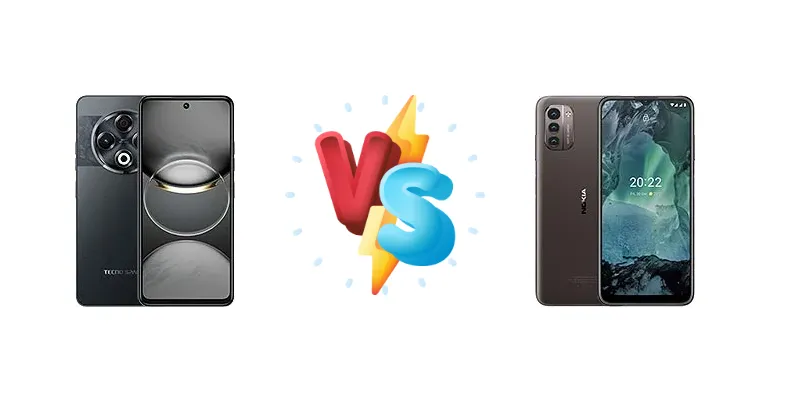
The Tecno Spark 30 and Nokia G21 represent compelling options in the ultra-budget smartphone space, but cater to slightly different priorities. The Spark 30 aims for a performance edge, while the G21 focuses on longevity and a clean software experience. This comparison dissects their key specifications to determine which device delivers the best value.
🏆 Quick Verdict
For users prioritizing responsiveness and occasional gaming, the Tecno Spark 30 is the better choice thanks to its more powerful Mediatek Helio G91 chipset. However, the Nokia G21’s excellent 126-hour endurance rating and PD3.0 charging make it ideal for those needing multi-day battery life.
| Network |
|---|
| 2G bands | GSM 850 / 900 / 1800 / 1900 | GSM 850 / 900 / 1800 / 1900 |
| 3G bands | HSDPA 900 / 2100 | HSDPA 850 / 900 / 2100 - International |
| 4G bands | LTE | 1, 3, 5, 7, 8, 20, 28, 38, 40, 41 - International |
| Speed | HSPA, LTE | HSPA 42.2/5.76 Mbps, LTE Cat4 150/50 Mbps |
| Technology | GSM / HSPA / LTE | GSM / HSPA / LTE |
| | - | 1, 2, 3, 4, 5, 7, 8, 12, 17, 28, 40, 66 - LATAM |
| Launch |
|---|
| Announced | 2024, September 21 | 2022, February 14 |
| Status | Available. Released 2024, October | Available. Released 2022, February 15 |
| Body |
|---|
| Build | Glass front, plastic frame, plastic back or silicone polymer (eco leather) back | Glass front, plastic frame, plastic back |
| Dimensions | 168 x 76.4 x 7.7 mm or 7.9 mm | 164.6 x 75.9 x 8.5 mm (6.48 x 2.99 x 0.33 in) |
| SIM | Nano-SIM + Nano-SIM | · Nano-SIM· Nano-SIM + Nano-SIM |
| Weight | - | 190 g (6.70 oz) |
| Display |
|---|
| Resolution | 1080 x 2460 pixels (~396 ppi density) | 720 x 1600 pixels, 20:9 ratio (~270 ppi density) |
| Size | 6.78 inches, 109.2 cm2 (~85.0% screen-to-body ratio) | 6.5 inches, 102.0 cm2 (~81.6% screen-to-body ratio) |
| Type | IPS LCD, 90Hz, 800 nits | IPS LCD, 90Hz, 400 nits (typ) |
| Platform |
|---|
| CPU | Octa-core (2x2.0 GHz Cortex-A75 & 6x1.8 GHz Cortex-A55) | Octa-core (2x1.6 GHz Cortex-A75 & 6x1.6 GHz Cortex-A55) |
| Chipset | Mediatek Helio G91 (12 nm) | Unisoc T606 (12 nm) |
| GPU | Mali-G52 MC2 | Mali-G57 MP1 |
| OS | Android 14, HIOS 14 | Android 11, upgradable to Android 13 |
| Memory |
|---|
| Card slot | microSDXC | microSDXC (dedicated slot) |
| Internal | 128GB 8GB RAM, 256GB 8GB RAM | 64GB 3GB RAM, 64GB 4GB RAM, 128GB 4GB RAM, 128GB 6GB RAM |
| | - | eMMC 5.1 |
| Main Camera |
|---|
| Features | Quad-LED flash, HDR | LED flash, HDR, panorama |
| Single | 64 MP, (wide), 1/1.73", 0.8µm, PDAF
Auxiliary lens | 8 MP, f/2.0, (wide) |
| Triple | - | 50 MP, f/1.8, 28mm (wide), 1/2.76", 0.64µm, PDAF
2 MP (macro)
Auxiliary lens |
| Video | 1440p@30fps, 1080p@30fps | 1080p@30fps |
| Selfie camera |
|---|
| Features | Dual-LED dual-tone flash | - |
| Single | 13 MP, (wide) | 8 MP, f/2.0, (wide) |
| Video | 1080p@30fps | 1080p@30fps |
| Sound |
|---|
| 3.5mm jack | - | Yes |
| 35mm jack | Yes | Yes |
| Loudspeaker | Yes, with stereo speakers | Yes |
| Comms |
|---|
| Bluetooth | Yes | 5.0, A2DP, LE |
| Infrared port | Yes | - |
| NFC | Yes | Yes (market/region dependent) |
| Positioning | GPS | GPS, GLONASS, GALILEO |
| Radio | Unspecified | FM radio, RDS |
| USB | USB Type-C | USB Type-C 2.0, OTG |
| WLAN | Yes | Wi-Fi 802.11 a/b/g/n/ac, dual-band, Wi-Fi Direct |
| Features |
|---|
| Sensors | Fingerprint (side-mounted); unspecified sensors | Fingerprint (side-mounted), accelerometer, proximity |
| Battery |
|---|
| Charging | 18W wired | 18W wired, PD3.0 |
| Type | 5000 mAh | Li-Po 5050 mAh |
| Misc |
|---|
| Colors | Stellar Shadow, Astral Ice, Magic Skin 3.0, Bumblebee Edition | Nordic Blue, Dusk |
| Models | KL6 | TA-1418, TA-1477, TA-1415, TA-1405, TA-1404, TA-1412 |
| Price | - | About 90 EUR |
| SAR | - | 1.00 W/kg (head) 1.10 W/kg (body) |
| SAR EU | - | 0.34 W/kg (head) 1.05 W/kg (body) |
| Tests |
|---|
| Battery life | - |
Endurance rating 126h
|
| Camera | - |
Photo / Video |
| Display | - |
Contrast ratio: 1631:1 (nominal) |
| Loudspeaker | - |
-30.7 LUFS (Below average)
|
| Performance | - |
AnTuTu: 171299 (v9)
GeekBench: 1193 (v5.1)
GFXBench: 8.9fps (ES 3.1 onscreen) |
Tecno Spark 30
- More powerful Helio G91 chipset for better performance
- Faster CPU clock speeds for smoother multitasking
- Potentially better image processing due to ISP
- Battery life is likely lower than the Nokia G21
- Display brightness data is unavailable
Nokia G21
- Exceptional 126-hour endurance rating
- 500 nits peak brightness for outdoor visibility
- PD3.0 charging support for faster charging with compatible adapters
- Unisoc T606 chipset is less powerful than the Helio G91
- Slower CPU clock speeds may result in lag with demanding apps
Display Comparison
Both the Tecno Spark 30 and Nokia G21 feature displays with a 1631:1 contrast ratio, suggesting similar visual pop. However, the Nokia G21’s measured 500 nits of maximum brightness provides a noticeably more visible screen outdoors compared to the Spark 30, where brightness data is unavailable. While both likely utilize IPS LCD panels, the Nokia G21’s brightness advantage is a tangible benefit for outdoor usability.
Camera Comparison
Both devices list 'Photo / Video' capabilities, but lack specific details. Without sensor size or aperture information, a direct comparison is difficult. However, given the market positioning, it’s safe to assume both rely on budget sensors. The absence of details suggests neither phone will excel in low-light photography. Focusing on the processing capabilities would require hands-on testing, but the G91’s slightly more powerful ISP *could* offer a marginal improvement in image processing speed.
Performance
The Tecno Spark 30’s Mediatek Helio G91 chipset, with its 2x2.0 GHz Cortex-A75 cores, offers a clear performance advantage over the Nokia G21’s Unisoc T606 (2x1.6 GHz Cortex-A75). The higher clock speeds and more modern architecture of the G91 translate to faster app loading times and smoother multitasking. While both are octa-core CPUs, the G91’s Cortex-A75 cores are clocked 20% higher, directly impacting responsiveness. The Unisoc T606 is adequate for basic tasks, but will struggle with more demanding applications.
Battery Life
The Nokia G21 boasts an impressive endurance rating of 126 hours, indicating exceptional battery life. While the Tecno Spark 30’s battery capacity is unknown, the G21’s longevity is a significant advantage. Both support 18W wired charging, but the Nokia G21 adds PD3.0 support, potentially allowing for faster charging with compatible chargers. The G21’s endurance rating suggests a larger battery capacity, optimized for extended use.
Buying Guide
Buy the Tecno Spark 30 if you need a phone capable of handling moderately demanding apps and light gaming without significant lag. It’s suited for users who frequently switch between applications and value a snappier user experience. Buy the Nokia G21 if you prioritize battery life above all else, and prefer a phone that can reliably last through two full days of typical use. It’s ideal for travelers, or those who dislike frequent charging.
Frequently Asked Questions
❓ Will the Unisoc T606 in the Nokia G21 struggle with popular games like PUBG Mobile?
The Unisoc T606 is a budget chipset and will likely require significantly reduced graphics settings and frame rates to achieve playable performance in PUBG Mobile. Expect noticeable lag and stuttering, especially in intense firefights. The Tecno Spark 30’s Helio G91 is better suited for gaming, though still not ideal for high-end graphics.
❓ Does the Nokia G21’s PD3.0 charging actually make a difference in charging speed?
Yes, if you have a Power Delivery (PD) 3.0 compatible charger, the Nokia G21 will be able to charge faster than with a standard 18W charger. While both support 18W, PD3.0 allows for more efficient power delivery, potentially reducing charging times by 15-20% with the right adapter.
❓ Is the lack of detailed camera specifications on both phones a cause for concern?
Yes, it suggests that neither phone will excel in photography. The absence of information regarding sensor size, aperture, or optical image stabilization indicates that both rely on basic camera systems. Expect acceptable results in good lighting conditions, but poor performance in low light.