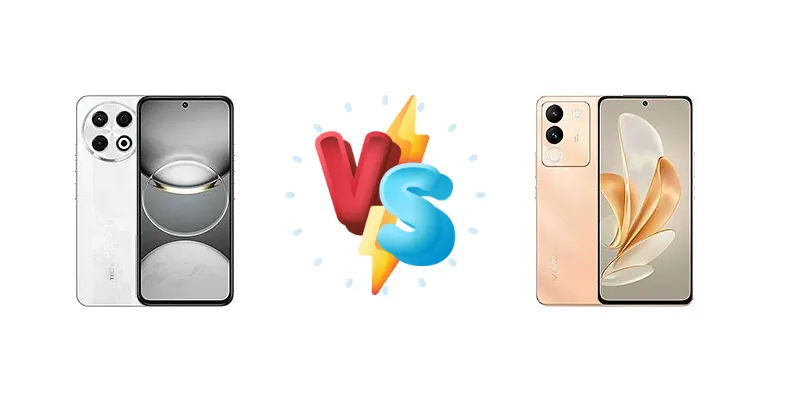
The sub-$300 smartphone market is fiercely competitive, and the Tecno Spark 30 Pro and vivo V29e are two recent contenders vying for attention. Both aim to deliver 5G connectivity and a modern smartphone experience without breaking the bank, but they take different approaches to achieving this. This comparison will dissect their key specifications and performance characteristics to determine which device offers the best value.
🏆 Quick Verdict
For the average user prioritizing faster charging and a slightly more refined software experience, the vivo V29e emerges as the winner. However, the Tecno Spark 30 Pro offers a compelling alternative for those who prioritize raw CPU performance in multi-threaded tasks, and don't mind a slower charging speed.
| Network |
|---|
| 2G bands | GSM 850 / 900 / 1800 / 1900 | GSM 850 / 900 / 1800 / 1900 |
| 3G bands | HSDPA 900 / 2100 | HSDPA 850 / 900 / 1700(AWS) / 1900 / 2100 |
| 4G bands | LTE | 1, 2, 3, 4, 5, 7, 8, 18, 19, 20, 26, 28, 38, 39, 40, 41 |
| 5G bands | - | 1, 3, 5, 7, 8, 28, 38, 40, 41, 77, 78 SA/NSA |
| Speed | HSPA, LTE | HSPA, LTE, 5G |
| Technology | GSM / HSPA / LTE | GSM / HSPA / LTE / 5G |
| Launch |
|---|
| Announced | 2024, September 23 | 2023, October 23 |
| Status | Available. Released 2024, October | Available. Released 2023, October 23 |
| Body |
|---|
| Build | - | Glass front, plastic frame, glass back |
| Dimensions | 166.6 x 77 x 7.4 mm (6.56 x 3.03 x 0.29 in) | 162.4 x 74.9 x 7.7 mm (6.39 x 2.95 x 0.30 in) |
| SIM | Nano-SIM + Nano-SIM | Nano-SIM + Nano-SIM |
| Weight | - | 190 g (6.70 oz) |
| Display |
|---|
| Resolution | 1080 x 2436 pixels (~393 ppi density) | 1080 x 2400 pixels, 20:9 ratio (~395 ppi density) |
| Size | 6.78 inches, 109.9 cm2 (~85.7% screen-to-body ratio) | 6.67 inches, 107.4 cm2 (~88.3% screen-to-body ratio) |
| Type | AMOLED, 1B colors, 120Hz, 2160Hz PWM, 1700 nits (peak) | AMOLED, 120Hz, 1150 nits (peak) |
| Platform |
|---|
| CPU | Octa-core (2x2.2 GHz Cortex-A76 & 6x2.0 GHz Cortex-A55) | Octa-core (2x2.2 GHz Kryo 660 Gold & 6x1.8 GHz Kryo 660 Silver) |
| Chipset | Mediatek Helio G100 (6 nm) | Qualcomm SM6375 Snapdragon 695 5G (6 nm) |
| GPU | Mali-G57 MC2 | Adreno 619 |
| OS | Android 14, HIOS 14 | Android 13, Funtouch 13 |
| Memory |
|---|
| Card slot | microSDXC | No |
| Internal | 128GB 8GB RAM, 256GB 8GB RAM | 256GB 8GB RAM, 256GB 12GB RAM |
| Main Camera |
|---|
| Dual | - | 64 MP, f/1.8, (wide), PDAF, OIS
8 MP, f/2.2, (ultrawide) |
| Features | Quad-LED flash, HDR | Ring-LED flash, panorama, HDR |
| Single | 108 MP, f/1.9, (wide), 1/1.52", PDAF
Auxiliary lens | - |
| Video | 1440p@30fps, 1080p@30fps | 1080p@30fps |
| Selfie camera |
|---|
| Features | Dual-LED dual-tone flash | - |
| Single | 13 MP, (wide) | 50 MP, f/2.0, 22mm (wide), AF |
| Video | 1080p@30fps | 1080p@30fps |
| Sound |
|---|
| 35mm jack | Yes | No |
| Loudspeaker | Yes, with stereo speakers | Yes |
| Comms |
|---|
| Bluetooth | 5.3, A2DP, LE | 5.1, A2DP, LE |
| Infrared port | Yes | - |
| NFC | Yes | No |
| Positioning | GPS | GPS, GLONASS, GALILEO, BDS, QZSS |
| Radio | FM radio | No |
| USB | USB Type-C 2.0, OTG | USB Type-C 2.0, OTG |
| WLAN | Wi-Fi 802.11 a/b/g/n/ac, dual-band | Wi-Fi 802.11 a/b/g/n/ac, dual-band |
| Features |
|---|
| Sensors | Fingerprint (under display, optical), accelerometer, gyro, proximity, compass | Fingerprint (under display, optical), accelerometer, gyro, proximity, compass |
| Battery |
|---|
| Charging | 33W wired | 44W wired |
| Type | 5000 mAh | Li-Ion 4800 mAh |
| Misc |
|---|
| Colors | Obsidian Edge, Arctic Glow, Magic Skin 3.0, Optimus Prime Edition | Forest Black, Rose Gold, Ice Creek Blue |
| Models | KL7 | V2317 |
| Price | - | About 320 EUR |
Tecno Spark 30 Pro
- Stronger multi-core CPU performance with Helio G100
- Potentially lower price point
- Good for demanding multitasking
- Slower 33W charging
- Less efficient chipset compared to Snapdragon 695
- GPU likely less capable for gaming
vivo V29e
- Faster 44W wired charging
- More efficient Snapdragon 695 chipset
- Potentially smoother gaming experience
- CPU may be slightly less powerful in multi-threaded tasks
- Potentially higher price point
- Software experience may vary
Display Comparison
Neither device boasts a flagship-level display, but details are lacking to make a definitive comparison. Both utilize 6nm chipsets, suggesting a focus on efficiency, which could translate to slightly better battery life even with similar display characteristics. Without knowing panel type (IPS vs AMOLED), resolution, or peak brightness, it's difficult to assess visual quality. However, the market positioning suggests both will likely target a 1080p+ resolution.
Camera Comparison
Without detailed camera specifications beyond the presence of sensors, a direct comparison is limited. However, the market segment suggests both phones will rely heavily on software processing to enhance image quality. The absence of information regarding sensor size and optical image stabilization (OIS) makes it difficult to assess low-light performance. It's reasonable to assume both will include a primary camera, ultrawide, and potentially a depth or macro sensor, but the quality will likely vary significantly based on the primary sensor's capabilities.
Performance
The core difference lies in the chipsets. The Tecno Spark 30 Pro’s MediaTek Helio G100 features a 2x2.2 GHz Cortex-A76 and 6x2.0 GHz Cortex-A55 configuration. This architecture prioritizes peak CPU performance, particularly in multi-threaded workloads. Conversely, the vivo V29e’s Qualcomm Snapdragon 695 5G utilizes 2x2.2 GHz Kryo 660 Gold and 6x1.8 GHz Kryo 660 Silver cores. While the peak clock speeds are identical, Qualcomm’s Kryo cores are generally more efficient and offer better sustained performance. The Snapdragon 695 also benefits from Qualcomm’s optimized 5G modem. For gaming, the Snapdragon 695’s Adreno 619 GPU is likely to provide a smoother experience in graphically demanding titles compared to the Helio G100’s Mali-G57 MC2.
Battery Life
The vivo V29e’s 44W wired charging is a significant advantage over the Tecno Spark 30 Pro’s 33W charging. This translates to a noticeably faster 0-100% charge time, reducing downtime. While battery capacity isn't specified, the Snapdragon 695’s efficiency could offset a potentially smaller battery size in the V29e, resulting in comparable real-world battery life. The faster charging speed of the V29e is a practical benefit for users who frequently need to top up their phone quickly.
Buying Guide
Buy the Tecno Spark 30 Pro if you frequently engage in tasks that benefit from a strong multi-core CPU, such as video editing or running multiple apps simultaneously. Its Helio G100 chipset excels in these scenarios. Buy the vivo V29e if you value faster charging speeds, a potentially more optimized software experience, and a generally smoother day-to-day performance thanks to the Snapdragon 695's efficiency.
Frequently Asked Questions
❓ Will the Snapdragon 695 in the vivo V29e struggle with demanding games like Genshin Impact?
While the Snapdragon 695 isn't a flagship gaming chip, it's capable of running Genshin Impact at medium settings with reasonable frame rates. Expect some frame drops during intense combat scenarios. The Tecno Spark 30 Pro's Mali-G57 MC2 GPU is likely to perform slightly worse in this title.
❓ How much faster is the 44W charging on the vivo V29e compared to the 33W charging on the Tecno Spark 30 Pro?
The 44W charging on the vivo V29e will likely reduce charging times by approximately 20-30% compared to the Tecno Spark 30 Pro. This means a full charge could take around 60-75 minutes on the V29e, versus 80-90 minutes on the Spark 30 Pro, depending on battery capacity.
❓ Is the Helio G100 in the Tecno Spark 30 Pro prone to overheating during extended gaming sessions?
The Helio G100, being a 6nm chip, is reasonably efficient. However, sustained gaming will inevitably generate heat. Without a sophisticated cooling system, some thermal throttling is possible, potentially leading to reduced performance over extended periods. The Snapdragon 695 in the V29e is generally more thermally efficient.