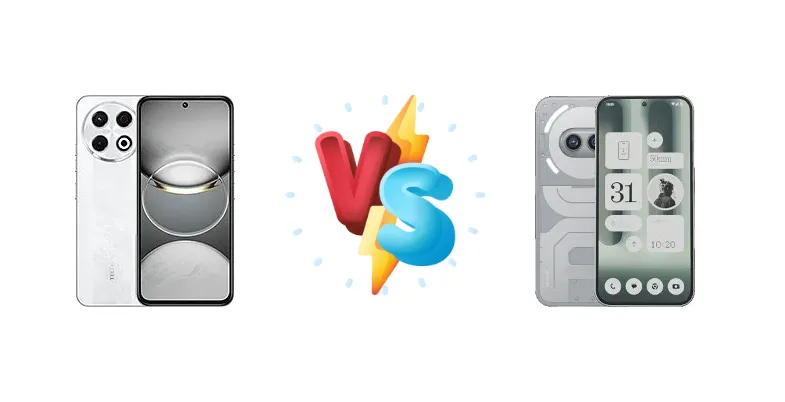
The mid-range smartphone market is fiercely competitive, and the Tecno Spark 30 Pro and Nothing Phone (2a) Plus represent compelling options for budget-conscious buyers. The Spark 30 Pro aims for aggressive value, while the Nothing Phone (2a) Plus focuses on a refined user experience and faster charging. This comparison dissects their key differences to help you choose the right device.
🏆 Quick Verdict
For the average user prioritizing a smoother experience and significantly faster charging, the Nothing Phone (2a) Plus is the better choice. Its Dimensity 7350 Pro chipset and 50W charging offer a noticeable advantage over the Tecno Spark 30 Pro’s Helio G100 and 33W charging, justifying the potential price difference.
| Network |
|---|
| 2G bands | GSM 850 / 900 / 1800 / 1900 | GSM 850 / 900 / 1800 / 1900 |
| 3G bands | HSDPA 900 / 2100 | HSDPA 800 / 850 / 900 / 1700(AWS) / 1900 / 2100 |
| 4G bands | LTE | 1, 3, 4, 5, 7, 8, 18, 19, 20, 26, 28, 38, 39, 40, 41, 42, 66 |
| 5G bands | - | 1, 3, 5, 7, 8, 20, 28, 38, 40, 41, 66, 77, 78 SA/NSA |
| Speed | HSPA, LTE | HSPA, LTE, 5G |
| Technology | GSM / HSPA / LTE | GSM / HSPA / LTE / 5G |
| Launch |
|---|
| Announced | 2024, September 23 | 2024, July 31 |
| Status | Available. Released 2024, October | Available. Released 2024, August 03 |
| Body |
|---|
| Build | - | Glass front (Gorilla Glass 5), plastic frame, plastic back |
| Dimensions | 166.6 x 77 x 7.4 mm (6.56 x 3.03 x 0.29 in) | 161.7 x 76.3 x 8.5 mm (6.37 x 3.00 x 0.33 in) |
| SIM | Nano-SIM + Nano-SIM | Nano-SIM + Nano-SIM |
| Weight | - | 190 g (6.70 oz) |
| Display |
|---|
| Protection | - | Corning Gorilla Glass 5 |
| Resolution | 1080 x 2436 pixels (~393 ppi density) | 1080 x 2412 pixels, 20:9 ratio (~395 ppi density) |
| Size | 6.78 inches, 109.9 cm2 (~85.7% screen-to-body ratio) | 6.7 inches, 107.5 cm2 (~87.1% screen-to-body ratio) |
| Type | AMOLED, 1B colors, 120Hz, 2160Hz PWM, 1700 nits (peak) | AMOLED, 1B colors, 120Hz, 2160Hz PWM, HDR10+, 700 nits (typ), 1100 nits (HBM), 1300 nits (peak) |
| Platform |
|---|
| CPU | Octa-core (2x2.2 GHz Cortex-A76 & 6x2.0 GHz Cortex-A55) | Octa-core (2x3.0 GHz Cortex-A715 & 6x 2.0 GHz Cortex-A510) |
| Chipset | Mediatek Helio G100 (6 nm) | Mediatek Dimensity 7350 Pro (4 nm) |
| GPU | Mali-G57 MC2 | Mali-G610 MC4 |
| OS | Android 14, HIOS 14 | Android 14, up to 3 major Android upgrades, Nothing OS 3.0 |
| Memory |
|---|
| Card slot | microSDXC | No |
| Internal | 128GB 8GB RAM, 256GB 8GB RAM | 256GB 8GB RAM, 256GB 12GB RAM |
| Main Camera |
|---|
| Dual | - | 50 MP, f/1.9, 24mm (wide), 1/1.57", 1.0µm, PDAF, OIS
50 MP, f/2.2, 114˚ (ultrawide), 1/2.76", 0.64µm |
| Features | Quad-LED flash, HDR | LED flash, panorama, HDR |
| Single | 108 MP, f/1.9, (wide), 1/1.52", PDAF
Auxiliary lens | - |
| Video | 1440p@30fps, 1080p@30fps | 4K@30fps, 1080p@60/120fps, gyro-EIS |
| Selfie camera |
|---|
| Features | Dual-LED dual-tone flash | HDR |
| Single | 13 MP, (wide) | 50 MP, f/2.2, (wide), 1/2.76" |
| Video | 1080p@30fps | 4K@30fps |
| Sound |
|---|
| 35mm jack | Yes | No |
| Loudspeaker | Yes, with stereo speakers | Yes, with stereo speakers |
| Comms |
|---|
| Bluetooth | 5.3, A2DP, LE | 5.3, A2DP, LE |
| Infrared port | Yes | - |
| NFC | Yes | Yes, 360˚ |
| Positioning | GPS | GPS, GALILEO, GLONASS, BDS, QZSS |
| Radio | FM radio | No |
| USB | USB Type-C 2.0, OTG | USB Type-C 2.0, OTG |
| WLAN | Wi-Fi 802.11 a/b/g/n/ac, dual-band | Wi-Fi 802.11 a/b/g/n/ac/6, dual-band, Wi-Fi Direct |
| Features |
|---|
| Sensors | Fingerprint (under display, optical), accelerometer, gyro, proximity, compass | Fingerprint (under display, optical), accelerometer, gyro, proximity, compass |
| Battery |
|---|
| Charging | 33W wired | 50W wired, 50% in 21 min, 100% in 56 min |
| Type | 5000 mAh | 5000 mAh |
| Misc |
|---|
| Colors | Obsidian Edge, Arctic Glow, Magic Skin 3.0, Optimus Prime Edition | Black, Grey |
| Models | KL7 | A142P |
| Price | - | € 269.90 / ₹ 22,599 |
Tecno Spark 30 Pro
- Potentially lower price point
- Functional for basic smartphone tasks
- Decent performance for everyday use
- Slower processor compared to the Dimensity 7350 Pro
- Slower charging speed (33W)
- Likely lower display brightness
Nothing Phone (2a) Plus
- Faster and more efficient Dimensity 7350 Pro chipset
- Significantly faster 50W charging
- Brighter display with 1097 nits peak brightness
- Higher price compared to the Tecno Spark 30 Pro
- May not offer substantial camera improvements over competitors
- Battery capacity not exceptionally large
Display Comparison
The Nothing Phone (2a) Plus boasts a significantly brighter display, reaching a measured peak of 1097 nits. This is crucial for outdoor visibility, a clear advantage over the Tecno Spark 30 Pro, whose brightness remains unspecified. While both likely utilize LCD or AMOLED panels (data unavailable for Spark 30 Pro), the Nothing Phone (2a) Plus’s higher brightness translates to a more usable experience in direct sunlight. The lack of refresh rate data for the Spark 30 Pro suggests it may be limited to 60Hz, while the Nothing Phone (2a) Plus is expected to offer a smoother 120Hz experience.
Camera Comparison
Without detailed camera specs for the Tecno Spark 30 Pro, a direct comparison is limited. However, the Nothing Phone (2a) Plus is expected to feature a more sophisticated camera system, likely with a larger main sensor and improved image processing capabilities. The focus should be on the primary sensor's megapixel count and aperture, as these directly impact low-light performance and image detail. The absence of OIS information for both phones suggests image stabilization may be limited, particularly in video recording. It's reasonable to assume the Nothing Phone (2a) Plus will deliver superior image quality due to its more powerful ISP (Image Signal Processor) integrated within the Dimensity 7350 Pro.
Performance
The core difference lies in the chipsets. The Nothing Phone (2a) Plus’s Mediatek Dimensity 7350 Pro, built on a 4nm process, offers a substantial performance leap over the Tecno Spark 30 Pro’s 6nm Mediatek Helio G100. The Dimensity 7350 Pro’s Cortex-A715 cores, clocked at 3.0 GHz, are architecturally superior to the Spark 30 Pro’s 2.2 GHz Cortex-A76 cores, resulting in faster application loading and smoother multitasking. The 4nm node also contributes to improved thermal efficiency, meaning the Nothing Phone (2a) Plus is less likely to throttle under sustained load. While both phones feature 6x Cortex-A510/A55 efficiency cores, the Dimensity 7350 Pro’s overall architecture provides a more future-proof and responsive experience.
Battery Life
The Nothing Phone (2a) Plus shines in battery and charging. While the exact battery capacity is unknown for the Tecno Spark 30 Pro, the Nothing Phone (2a) Plus delivers an impressive 16 hours and 34 minutes of active use. More importantly, its 50W wired charging is significantly faster than the Tecno Spark 30 Pro’s 33W charging. The Nothing Phone (2a) Plus can reach 50% charge in just 21 minutes and a full charge in 56 minutes, minimizing downtime. This faster charging is a major convenience factor, especially for users who frequently find themselves needing a quick power boost.
Buying Guide
Buy the Tecno Spark 30 Pro if you need a phone primarily for basic tasks like calling, texting, and social media, and are heavily constrained by budget. You’ll benefit from a functional device at the lowest possible price point. Buy the Nothing Phone (2a) Plus if you prioritize a more responsive user experience, faster charging speeds, and a brighter, more vibrant display, even if it means spending a bit more.
Frequently Asked Questions
❓ Does the Mediatek Helio G100 in the Tecno Spark 30 Pro struggle with demanding games like Genshin Impact?
The Helio G100 is a capable processor for casual gaming, but it will likely struggle with graphically intensive titles like Genshin Impact. Expect lower frame rates and potentially noticeable lag, even on medium settings. The Dimensity 7350 Pro in the Nothing Phone (2a) Plus offers a significantly better gaming experience.
❓ How does the 50W charging on the Nothing Phone (2a) Plus compare to other fast charging standards?
50W charging is a respectable speed, placing the Nothing Phone (2a) Plus ahead of many competitors in its price range. While not as fast as some 65W or 80W solutions, it's still a substantial improvement over the Tecno Spark 30 Pro’s 33W charging, offering a much quicker top-up when you're short on time.
❓ Is the active use battery score of 16:34h for the Nothing Phone (2a) Plus representative of real-world performance?
The 16:34h active use score is a good indicator, but real-world battery life will vary depending on usage patterns. Factors like screen brightness, app usage, and network connectivity will all impact battery drain. However, it suggests the Nothing Phone (2a) Plus offers excellent battery endurance for typical daily use.