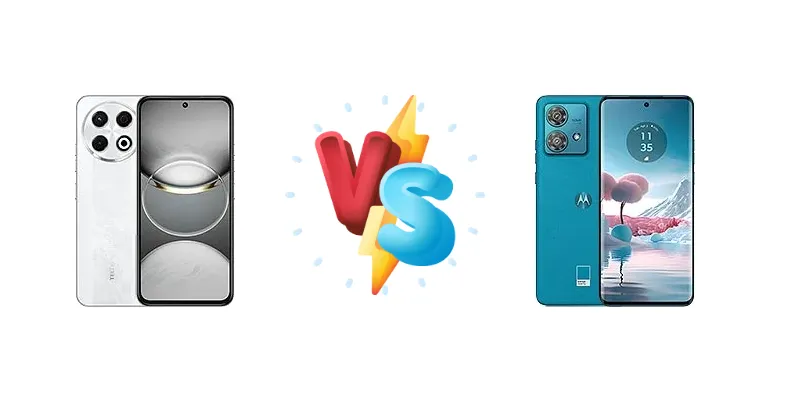
The Tecno Spark 30 Pro and Motorola Edge 40 Neo represent compelling options in the increasingly competitive mid-range smartphone market. The Spark 30 Pro aims for aggressive value, while the Edge 40 Neo prioritizes a more refined experience with faster charging and a more powerful chipset. This comparison dissects their key differences to help you choose the right device.
🏆 Quick Verdict
For the average user prioritizing a balance of performance, battery life, and convenience, the Motorola Edge 40 Neo is the stronger choice. Its Dimensity 7030 chipset and 68W charging significantly outperform the Tecno Spark 30 Pro’s Helio G100 and 33W charging, justifying the potential price difference.
| Network |
|---|
| 2G bands | GSM 850 / 900 / 1800 / 1900 | GSM 850 / 900 / 1800 / 1900 |
| 3G bands | HSDPA 900 / 2100 | HSDPA 800 / 850 / 900 / 1700(AWS) / 1900 / 2100 |
| 4G bands | LTE | 1, 2, 3, 4, 5, 7, 8, 12, 13, 17, 18, 19, 20, 25, 26, 28, 32, 38, 38, 39, 40, 41, 42, 43, 48, 66 |
| 5G bands | - | 1, 2, 3, 5, 7, 8, 20, 28, 38, 40, 41, 66, 77, 78 SA/NSA |
| Speed | HSPA, LTE | HSPA, LTE, 5G |
| Technology | GSM / HSPA / LTE | GSM / HSPA / LTE / 5G |
| Launch |
|---|
| Announced | 2024, September 23 | 2023, September 14 |
| Status | Available. Released 2024, October | Available. Released 2023, September 14 |
| Body |
|---|
| Build | - | Glass front (Gorilla Glass 3), plastic frame, plastic back |
| Dimensions | 166.6 x 77 x 7.4 mm (6.56 x 3.03 x 0.29 in) | 159.6 x 72 x 7.9 mm (6.28 x 2.83 x 0.31 in) |
| SIM | Nano-SIM + Nano-SIM | · Nano-SIM + eSIM· Nano-SIM + Nano-SIM |
| Weight | - | 170 g or 172 g (6.00 oz) |
| Display |
|---|
| Protection | - | Corning Gorilla Glass 3 |
| Resolution | 1080 x 2436 pixels (~393 ppi density) | 1080 x 2400 pixels, 20:9 ratio (~402 ppi density) |
| Size | 6.78 inches, 109.9 cm2 (~85.7% screen-to-body ratio) | 6.55 inches, 103.6 cm2 (~90.1% screen-to-body ratio) |
| Type | AMOLED, 1B colors, 120Hz, 2160Hz PWM, 1700 nits (peak) | P-OLED, 1B colors, 144Hz, HDR10+, 1300 nits (peak) |
| Platform |
|---|
| CPU | Octa-core (2x2.2 GHz Cortex-A76 & 6x2.0 GHz Cortex-A55) | Octa-core (2x2.5 GHz Cortex-A78 & 6x2.0 GHz Cortex-A55) |
| Chipset | Mediatek Helio G100 (6 nm) | MediaTek Dimensity 7030 (6 nm) |
| GPU | Mali-G57 MC2 | Mali-G610 MC3 |
| OS | Android 14, HIOS 14 | Android 13, up to 2 major Android upgrades |
| Memory |
|---|
| Card slot | microSDXC | No |
| Internal | 128GB 8GB RAM, 256GB 8GB RAM | 128GB 8GB RAM, 256GB 8GB RAM, 256GB 12GB RAM |
| Main Camera |
|---|
| Dual | - | 50 MP, f/1.8, (wide), 1/1.55", 1.0µm, multi-directional PDAF, OIS
13 MP, f/2.2, 120˚ (ultrawide), 1/3.0", 1.12µm, PDAF |
| Features | Quad-LED flash, HDR | LED flash, HDR, panorama |
| Single | 108 MP, f/1.9, (wide), 1/1.52", PDAF
Auxiliary lens | - |
| Video | 1440p@30fps, 1080p@30fps | 4K@30fps, 1080p@30/60/120/240fps, gyro-EIS |
| Selfie camera |
|---|
| Features | Dual-LED dual-tone flash | HDR |
| Single | 13 MP, (wide) | 32 MP, f/2.4, (wide), 1/3.0", 0.7µm |
| Video | 1080p@30fps | 4K@30fps, 1080p@30fps |
| Sound |
|---|
| 35mm jack | Yes | No |
| Loudspeaker | Yes, with stereo speakers | Yes, with stereo speakers |
| Comms |
|---|
| Bluetooth | 5.3, A2DP, LE | 5.4, A2DP, LE |
| Infrared port | Yes | - |
| NFC | Yes | Yes |
| Positioning | GPS | GPS, GLONASS, GALILEO |
| Radio | FM radio | No |
| USB | USB Type-C 2.0, OTG | USB Type-C 2.0, OTG |
| WLAN | Wi-Fi 802.11 a/b/g/n/ac, dual-band | Wi-Fi 802.11 a/b/g/n/ac/6e, tri-band, Wi-Fi Direct |
| Features |
|---|
| Sensors | Fingerprint (under display, optical), accelerometer, gyro, proximity, compass | Fingerprint (under display, optical), accelerometer, gyro, proximity, compass |
| Battery |
|---|
| Charging | 33W wired | 68W wired, 50% in 15 min |
| Type | 5000 mAh | Li-Po 5000 mAh |
| Misc |
|---|
| Colors | Obsidian Edge, Arctic Glow, Magic Skin 3.0, Optimus Prime Edition | Black, Soothing Sea, Caneel Bay, Peach Fuzz |
| Models | KL7 | XT2307-1 |
| Price | - | $ 299.00 / € 168.73 / ₹ 19,900 |
Tecno Spark 30 Pro
- Aggressive pricing offers excellent value.
- Acceptable performance for basic tasks.
- Likely large internal storage options.
- Slower charging speed (33W).
- Less powerful chipset compared to the competition.
- Potentially lower display brightness.
Motorola Edge 40 Neo
- Faster and more efficient Dimensity 7030 chipset.
- Significantly faster 68W charging.
- Brighter and potentially more color-accurate display.
- Likely a higher price point.
- May lack expandable storage.
- Camera performance relies heavily on software processing.
Display Comparison
The Motorola Edge 40 Neo boasts a significantly brighter display, reaching a measured 1073 nits. This is crucial for outdoor visibility, a clear advantage over the Tecno Spark 30 Pro, which lacks published brightness data. While both likely utilize AMOLED panels (based on market segment), the Edge 40 Neo’s higher peak brightness and potentially better color calibration (though unconfirmed) provide a superior viewing experience. Bezels are expected to be comparable, but the brightness difference is a key differentiator.
Camera Comparison
Detailed camera analysis is hampered by limited data. However, the Motorola Edge 40 Neo is expected to have a more sophisticated camera system, leveraging MediaTek’s Imagiq ISP capabilities. While megapixel counts aren’t specified, Motorola typically focuses on image processing and sensor quality. The Tecno Spark 30 Pro likely relies on software enhancements to compensate for a potentially less capable sensor. The absence of OIS information for either device suggests a reliance on software stabilization, but the Edge 40 Neo’s superior processing power could yield better results. We can safely assume the 2MP macro cameras on both devices offer limited utility.
Performance
The core difference lies in the chipsets. The Motorola Edge 40 Neo’s MediaTek Dimensity 7030, with its 2x2.5 GHz Cortex-A78 cores, offers a noticeable performance uplift over the Tecno Spark 30 Pro’s MediaTek Helio G100 (2x2.2 GHz Cortex-A76). The A78 cores in the Dimensity 7030 are architecturally superior, resulting in faster application loading and smoother multitasking. Both chips are fabricated on a 6nm process, but the Dimensity 7030’s more efficient design likely translates to better sustained performance under load. While both phones likely feature adequate RAM, the chipset difference will be the primary bottleneck for demanding tasks.
Battery Life
The Motorola Edge 40 Neo shines in battery and charging. Its 80-hour endurance rating (though an older metric) and 10:28h active use score demonstrate superior stamina compared to the Tecno Spark 30 Pro. Crucially, the 68W wired charging on the Edge 40 Neo can deliver a 50% charge in just 15 minutes, a massive convenience advantage over the Spark 30 Pro’s slower 33W charging. While the Spark 30 Pro’s battery capacity isn’t specified, the Edge 40 Neo’s faster charging effectively mitigates any potential capacity disadvantage.
Buying Guide
Buy the Tecno Spark 30 Pro if you need a smartphone that delivers acceptable performance for everyday tasks and social media, and your budget is extremely tight. You’ll be making compromises on speed and charging. Buy the Motorola Edge 40 Neo if you prefer a smoother, more responsive experience, faster charging to minimize downtime, and a display that’s easier to see in bright sunlight. It’s the better all-rounder for users who value convenience and longevity.
Frequently Asked Questions
❓ Does the MediaTek Dimensity 7030 in the Motorola Edge 40 Neo get hot during extended gaming sessions?
The Dimensity 7030 is a relatively efficient chipset fabricated on a 6nm process. While some heat generation is inevitable during prolonged gaming, the Edge 40 Neo’s thermal management system is expected to prevent significant throttling, providing a consistently smooth gaming experience. The 6nm process is more efficient than older nodes, reducing heat output.
❓ Is the 33W charging on the Tecno Spark 30 Pro slow compared to other phones in this price range?
Yes, 33W charging is comparatively slow in today’s market. The Motorola Edge 40 Neo’s 68W charging is significantly faster, allowing for a 50% charge in just 15 minutes. The Spark 30 Pro will take considerably longer to fully charge, potentially requiring over an hour.
❓ How does the Helio G100 perform with graphically demanding games like PUBG Mobile?
The Helio G100 can run PUBG Mobile, but you’ll likely need to lower the graphics settings to achieve a consistently smooth frame rate. The Dimensity 7030 in the Edge 40 Neo offers a more comfortable experience, allowing for higher graphics settings and more stable performance.