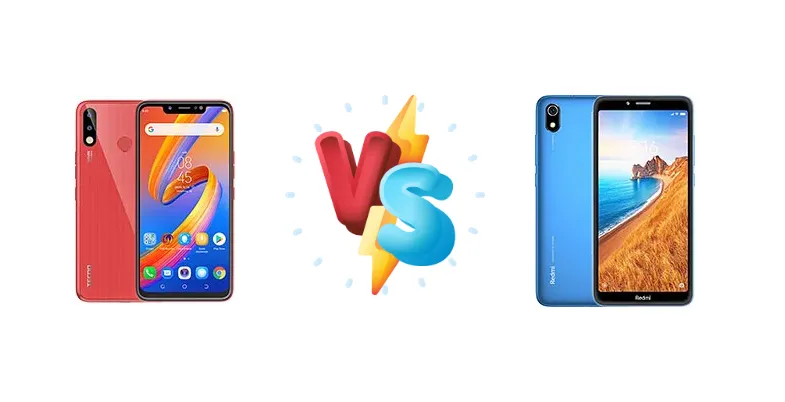
The Tecno Spark 3 and Xiaomi Redmi 7A represent the fiercely competitive sub-$100 smartphone market. Both aim to deliver essential smartphone functionality at an incredibly accessible price point. However, they take different approaches to achieving this, primarily through their chipset choices – MediaTek’s Helio A22 versus Qualcomm’s Snapdragon 439. This comparison will dissect these differences to determine which device offers the best value for your money.
🏆 Quick Verdict
For the average user prioritizing multitasking and a smoother overall experience, the Xiaomi Redmi 7A emerges as the better choice. Its octa-core Snapdragon 439 provides a significant performance advantage over the Tecno Spark 3’s quad-core Helio A22, making it more capable of handling everyday tasks and light gaming without noticeable lag.
| Network |
|---|
| 2G bands | GSM 900 / 1800 | GSM 850 / 900 / 1800 / 1900 |
| 3G bands | HSDPA 850 / 900 / 2100 | HSDPA 850 / 900 / 1900 / 2100 |
| 4G bands | - | 1, 2, 3, 4, 5, 7, 8, 20, 38, 40 - Global |
| Speed | HSPA 42.2/5.76 Mbps, LTE Cat4 150/50 Mbps | HSPA, LTE |
| Technology | GSM / HSPA | GSM / HSPA / LTE |
| | - | 1, 3, 5, 8, 34, 38, 39, 40, 41 - China |
| Launch |
|---|
| Announced | 2019, April. Released 2019, April | 2019, May 24. Released 2019, July 04 |
| Status | Discontinued | Discontinued |
| Body |
|---|
| Build | Glass front, plastic back, plastic frame | Glass front, plastic back, plastic frame |
| Dimensions | 155.3 x 75.8 x 8.2 mm (6.11 x 2.98 x 0.32 in) | 146.3 x 70.4 x 9.6 mm (5.76 x 2.77 x 0.38 in) |
| SIM | Nano-SIM + Nano-SIM | Nano-SIM + Nano-SIM |
| Weight | - | 165 g (5.82 oz) |
| | - | Splash resistant |
| Display |
|---|
| Resolution | 720 x 1500 pixels (~268 ppi density) | 720 x 1440 pixels, 18:9 ratio (~295 ppi density) |
| Size | 6.2 inches, 96.7 cm2 (~82.2% screen-to-body ratio) | 5.45 inches, 76.7 cm2 (~74.4% screen-to-body ratio) |
| Type | IPS LCD | IPS LCD |
| Platform |
|---|
| CPU | Quad-core 2.0 GHz Cortex-A53 | Octa-core (4x1.95 GHz Cortex-A53 & 4x1.45 GHz Cortex A53) |
| Chipset | Mediatek MT6761 Helio A22 (12 nm) | Qualcomm SDM439 Snapdragon 439 (12 nm) |
| GPU | PowerVR GE8320 | Adreno 505 |
| OS | Android 9.0 (Pie), HIOS 5.0 | Android 9.0 (Pie), upgradable to Android 10, MIUI 12 |
| Memory |
|---|
| Call records | Yes | - |
| Card slot | microSD | microSDXC (dedicated slot) |
| Internal | 16GB 2GB RAM | 16GB 2GB RAM, 32GB 2GB RAM, 32GB 3GB RAM |
| Phonebook | 2000 entries, Photocall | - |
| | eMMC 5.1 | eMMC 5.1 |
| Main Camera |
|---|
| Features | Dual-LED flash | LED flash, HDR |
| Single | 13 MP, AF | 13 MP, f/2.2, 1/3.1", 1.12µm, PDAF - China
or
12 MP, f/2.2, 1/2.9", 1.25µm, PDAF - Global, India |
| Video | 1080p@30fps | 1080p@30fps |
| Selfie camera |
|---|
| Features | LED flash | HDR |
| Single | 8 MP | 5 MP, f/2.2, 1/5.0", 1.12µm |
| Video | 1080p@30fps | 1080p@30fps |
| Sound |
|---|
| 3.5mm jack | Yes | Yes |
| 35mm jack | Yes | Yes |
| Loudspeaker | Yes | Yes |
| Comms |
|---|
| Bluetooth | 5.0, A2DP, LE | 4.2, A2DP, LE |
| NFC | No | No |
| Positioning | GPS | GPS, GLONASS, BDS |
| Radio | FM radio | FM Radio, built-in antenna |
| USB | microUSB 2.0 | microUSB 2.0, OTG |
| WLAN | Wi-Fi 802.11 b/g/n | Wi-Fi 802.11 b/g/n, Wi-Fi Direct |
| Features |
|---|
| Browser | HTML | - |
| Games | Yes | - |
| Java | No | - |
| Messaging | SMS(threaded view), MMS, Email, Push Email, IM | - |
| Sensors | Fingerprint (rear-mounted), accelerometer, proximity | Accelerometer, proximity, compass |
| Battery |
|---|
| Charging | - | 10W wired |
| Stand-by | Up to 388 h | - |
| Talk time | Up to 6 h 40 min | - |
| Type | Li-Ion 3500 mAh, non-removable | Li-Po 4000 mAh, non-removable |
| Misc |
|---|
| Colors | Midnight Black, Champagne Gold, Aqua Blue, Bordeaux Red | Matte Black, Morning blue, Matte Blue, Matte Gold, Gem Red, Gem Blue |
| Models | - | MZB7995IN, M1903C3EG, M1903C3EH, M1903C3EI |
| Price | About 70 EUR | About 130 EUR |
| SAR | 1.15 W/kg (head) | 1.00 W/kg (head) 1.12 W/kg (body) |
| SAR EU | - | 0.56 W/kg (head) 1.17 W/kg (body) |
Tecno Spark 3
- Potentially slightly better battery life under light use due to the Helio A22.
- May be available at a lower price point in some markets.
- Simple and straightforward user experience.
- Significantly weaker performance compared to the Snapdragon 439.
- Struggles with multitasking and demanding apps.
- Limited gaming capabilities.
Xiaomi Redmi 7A
- Octa-core Snapdragon 439 offers a much smoother user experience.
- Better multitasking and app switching.
- More capable of handling light gaming.
- 10W charging support.
- May be slightly more expensive than the Tecno Spark 3.
- Battery life may be slightly shorter under heavy use.
Display Comparison
Neither device boasts a particularly impressive display. Both likely utilize LCD panels, typical for this price bracket. Specifics like brightness and color accuracy are unavailable, but we can infer that they prioritize cost-effectiveness over visual fidelity. The focus here is on functionality, not immersive viewing. Bezels are expected to be substantial on both models, maximizing screen real estate within a compact form factor.
Camera Comparison
Camera performance is likely to be similar, with both devices featuring basic camera setups geared towards casual photography. Without specific sensor details, it’s safe to assume both rely on relatively small sensors and limited image processing capabilities. The Redmi 7A may have a slight edge due to Qualcomm’s image signal processor (ISP) within the Snapdragon 439, potentially offering better dynamic range and noise reduction. However, don't expect flagship-level image quality from either device. The inclusion of a 2MP macro lens on either device is largely a marketing gimmick and unlikely to deliver significant improvements in image quality.
Performance
The core difference lies in the chipsets. The Xiaomi Redmi 7A’s Qualcomm Snapdragon 439 is an octa-core processor, featuring four cores clocked at 1.95 GHz and another four at 1.45 GHz. This configuration allows for more efficient multitasking and better performance in demanding applications compared to the Tecno Spark 3’s MediaTek Helio A22. The Spark 3 utilizes a quad-core Cortex-A53 processor clocked at 2.0 GHz. While the per-core clock speed is higher, the lack of additional cores means it will struggle with heavier workloads. The Snapdragon 439’s architecture is better suited for sustained performance, benefiting users who frequently switch between apps or play mobile games. Both chipsets are fabricated on a 12nm process, suggesting similar power efficiency, but the Snapdragon’s architecture is more efficient overall.
Battery Life
Battery capacity is not specified for either device, but given their target market, both likely feature batteries in the 3000-4000 mAh range. The Xiaomi Redmi 7A includes 10W wired charging, which is standard for this segment. The Tecno Spark 3’s charging capabilities are unknown, but likely similar. The Helio A22’s power efficiency might give the Spark 3 a slight edge in battery endurance under light usage, but the Snapdragon 439’s more efficient architecture will likely offset this during more intensive tasks.
Buying Guide
Buy the Tecno Spark 3 if you primarily need a phone for basic communication – calls, texts, and light social media – and battery life is your absolute top priority. It will handle these tasks adequately. Buy the Xiaomi Redmi 7A if you want a more responsive device capable of handling multiple apps simultaneously, enjoy occasional gaming, or simply prefer a smoother user experience. The Snapdragon 439 offers a noticeable step up in performance.
Frequently Asked Questions
❓ Will the Xiaomi Redmi 7A handle popular games like PUBG Mobile?
The Redmi 7A can run PUBG Mobile, but you'll likely need to play at the lowest graphics settings and frame rate to achieve a playable experience. The Snapdragon 439 isn't a gaming powerhouse, but it's significantly more capable than the Helio A22 in the Tecno Spark 3.
❓ Is the difference in performance between the Helio A22 and Snapdragon 439 noticeable in everyday use?
Yes, the difference is quite noticeable. The Snapdragon 439’s octa-core architecture allows for smoother app switching, faster loading times, and a more responsive user interface. The Helio A22 can feel sluggish when handling multiple tasks simultaneously.
❓ Which phone is better for someone who primarily uses WhatsApp and makes calls?
Both phones will handle WhatsApp and calls perfectly well. The Tecno Spark 3 might offer slightly longer battery life in this scenario due to the Helio A22’s efficiency, but the difference will be minimal.
❓ Does the Xiaomi Redmi 7A support fast charging?
The Xiaomi Redmi 7A supports 10W wired charging, which is standard for this price range. It's not 'fast charging' in the modern sense, but it's adequate for topping up the battery overnight.