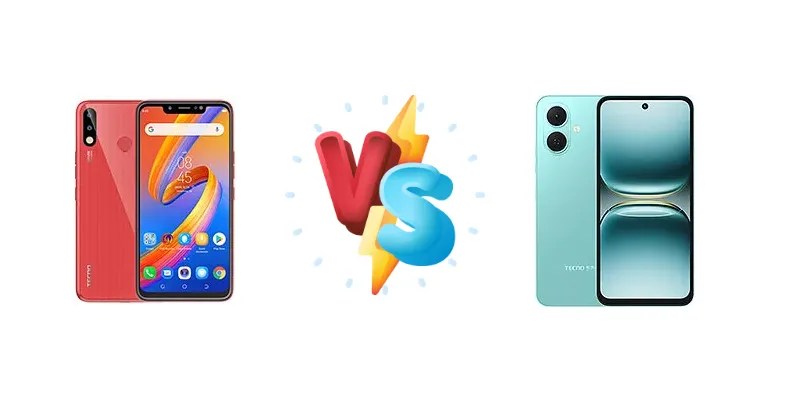
Tecno's Spark series consistently targets the ultra-budget segment, offering compelling features at incredibly low price points. The Spark 3 and Spark Go 2 represent two iterations of this strategy, but a generational leap doesn't always translate to a superior experience. We dissect the key differences between these two devices to determine which one delivers the best value for your money.
🏆 Quick Verdict
For most users, the Tecno Spark Go 2 is the better choice. Its octa-core Unisoc T7250 chipset provides a significantly more responsive experience for multitasking and app loading compared to the Spark 3's quad-core Helio A22. While neither phone excels in photography, the Go 2's faster charging is a welcome addition.
| Network |
|---|
| 2G bands | GSM 900 / 1800 | GSM 850 / 900 / 1800 / 1900 |
| 3G bands | HSDPA 850 / 900 / 2100 | HSDPA 900 / 2100 |
| 4G bands | - | LTE |
| Speed | HSPA 42.2/5.76 Mbps, LTE Cat4 150/50 Mbps | HSPA, LTE |
| Technology | GSM / HSPA | GSM / HSPA / LTE |
| Launch |
|---|
| Announced | 2019, April. Released 2019, April | 2025, June 24 |
| Status | Discontinued | Available. Released 2025, June |
| Body |
|---|
| Build | Glass front, plastic back, plastic frame | Glass front, plastic back, plastic frame |
| Dimensions | 155.3 x 75.8 x 8.2 mm (6.11 x 2.98 x 0.32 in) | 165.6 x 77 x 8.3 mm (6.52 x 3.03 x 0.33 in) |
| SIM | Nano-SIM + Nano-SIM | Nano-SIM + Nano-SIM |
| Weight | - | - |
| Display |
|---|
| Resolution | 720 x 1500 pixels (~268 ppi density) | 720 x 1600 pixels, 20:9 ratio (~263 ppi density) |
| Size | 6.2 inches, 96.7 cm2 (~82.2% screen-to-body ratio) | 6.67 inches, 107.4 cm2 (~84.2% screen-to-body ratio) |
| Type | IPS LCD | IPS LCD, 120Hz |
| Platform |
|---|
| CPU | Quad-core 2.0 GHz Cortex-A53 | Octa-core (2x1.8 GHz Cortex-A75 & 6x1.6 GHz Cortex-A55) |
| Chipset | Mediatek MT6761 Helio A22 (12 nm) | Unisoc T7250 (12 nm) |
| GPU | PowerVR GE8320 | Mali-G57 MP1 |
| OS | Android 9.0 (Pie), HIOS 5.0 | Android 15, HIOS 15 |
| Memory |
|---|
| Call records | Yes | - |
| Card slot | microSD | microSDXC |
| Internal | 16GB 2GB RAM | 64GB 3GB RAM, 64GB 4GB RAM, 128GB 3GB RAM, 128GB 4GB RAM, 256GB 4GB RAM |
| Phonebook | 2000 entries, Photocall | - |
| | eMMC 5.1 | - |
| Main Camera |
|---|
| Features | Dual-LED flash | Dual-LED flash, HDR |
| Single | 13 MP, AF | 13 MP, f/1.8, 27mm (wide), PDAF |
| Video | 1080p@30fps | 1080p@30fps |
| Selfie camera |
|---|
| Features | LED flash | Dual-LED flash |
| Single | 8 MP | 8 MP |
| Video | 1080p@30fps | Yes |
| Sound |
|---|
| 3.5mm jack | Yes | - |
| 35mm jack | Yes | Yes |
| Loudspeaker | Yes | Yes, with dual speakers |
| Comms |
|---|
| Bluetooth | 5.0, A2DP, LE | Yes |
| Infrared port | - | Yes |
| NFC | No | No |
| Positioning | GPS | GPS |
| Radio | FM radio | FM radio |
| USB | microUSB 2.0 | USB Type-C, OTG |
| WLAN | Wi-Fi 802.11 b/g/n | Yes |
| Features |
|---|
| Browser | HTML | - |
| Games | Yes | - |
| Java | No | - |
| Messaging | SMS(threaded view), MMS, Email, Push Email, IM | - |
| Sensors | Fingerprint (rear-mounted), accelerometer, proximity | Fingerprint (side-mounted); unspecified sensors |
| Battery |
|---|
| Charging | - | 15W wired |
| Stand-by | Up to 388 h | - |
| Talk time | Up to 6 h 40 min | - |
| Type | Li-Ion 3500 mAh, non-removable | 5000 mAh |
| Misc |
|---|
| Colors | Midnight Black, Champagne Gold, Aqua Blue, Bordeaux Red | Ink Black, Titanium Grey, Veil White, Turquoise Green |
| Models | - | KM4 |
| Price | About 70 EUR | About 80 EUR |
| SAR | 1.15 W/kg (head) | - |
Tecno Spark 3
- Potentially lower price point
- Simple and straightforward user experience
- Functional for basic communication
- Slow performance with multitasking
- Outdated processor architecture
- Likely slower charging speeds
Tecno Spark Go 2
- Significantly faster processor
- Octa-core CPU for smoother multitasking
- 15W fast charging for quicker top-ups
- May be slightly more expensive
- Camera performance likely similar to Spark 3
- Still an entry-level device with limitations
Display Comparison
Neither Tecno explicitly details display specifications beyond size. Given their market positioning, both likely utilize IPS LCD panels. The absence of information regarding brightness nits or color accuracy suggests both displays are geared towards basic visibility rather than media consumption. Bezels are expected to be substantial on both models, typical for this price bracket. The focus here isn't on display quality, but on functionality.
Camera Comparison
Detailed camera specifications are unavailable. However, given the price point, expectations should be tempered. Both phones likely feature a primary camera and potentially a depth sensor. The image processing capabilities will be limited, and low-light performance will likely be poor. Without specific sensor size or aperture information, it's difficult to definitively declare a winner. The focus here is on capturing basic memories, not professional-quality photography.
Performance
The core difference lies in the chipset. The Spark 3's MediaTek Helio A22 is a quad-core processor built on a 12nm process, adequate for very basic tasks. The Spark Go 2, however, features the Unisoc T7250, an octa-core chip (2x1.8 GHz Cortex-A75 & 6x1.6 GHz Cortex-A55) also on a 12nm process. This configuration provides a substantial performance uplift. The Cortex-A75 cores in the Go 2 offer significantly higher single-core performance, resulting in snappier app launches and smoother multitasking. While both use similar process nodes, the architectural advantage of the Go 2's CPU is undeniable. Users who frequently switch between apps or play casual games will see a marked improvement with the Spark Go 2.
Battery Life
Battery capacity isn't specified for either device. However, the Spark Go 2 introduces 15W wired charging, a significant advantage over the likely 10W or slower charging on the Spark 3. This translates to faster top-ups, reducing downtime. While a larger mAh capacity is always preferable, the faster charging speed of the Go 2 mitigates the impact of a potentially smaller battery, offering a more convenient user experience.
Buying Guide
Buy the Tecno Spark 3 if your primary need is a functional smartphone for basic tasks like calls, texts, and light social media, and you're operating on an extremely tight budget. Buy the Tecno Spark Go 2 if you prioritize smoother performance for everyday use, enjoy occasional gaming, and appreciate the convenience of faster 15W charging. The Go 2 is a small investment for a noticeable improvement in usability.
Frequently Asked Questions
❓ Will the Tecno Spark Go 2 handle popular apps like WhatsApp and Facebook smoothly?
Yes, the Unisoc T7250's octa-core architecture and Cortex-A75 cores provide ample processing power for smooth operation of common social media apps like WhatsApp and Facebook, even with multiple apps open simultaneously. The Spark 3 may struggle with responsiveness when multitasking.
❓ Is the 15W charging on the Spark Go 2 a significant improvement over the Spark 3?
Absolutely. While neither phone will charge at flagship speeds, 15W charging on the Spark Go 2 will noticeably reduce charging times compared to the likely 10W or slower charging on the Spark 3. This means less time tethered to a wall and more time using your phone.
❓ Can the Tecno Spark Go 2 handle basic mobile games?
The Spark Go 2 is capable of running basic mobile games, but don't expect high frame rates or demanding graphics settings. The Unisoc T7250 provides a better gaming experience than the Helio A22 in the Spark 3, allowing for smoother gameplay in less intensive titles.