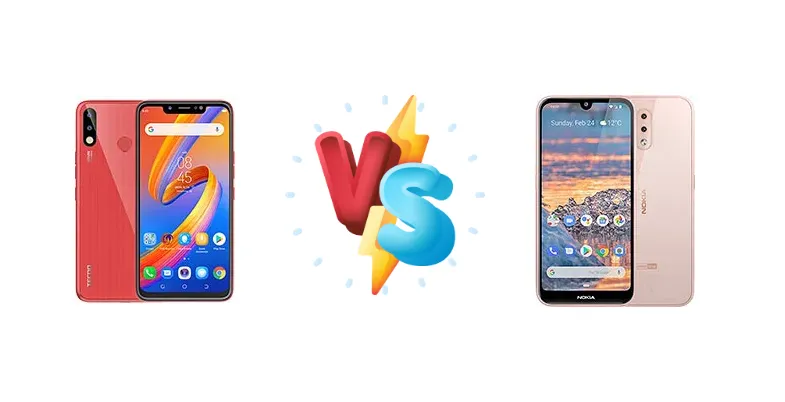
The Tecno Spark 3 and Nokia 4.2 represent two distinct approaches to the ultra-budget smartphone market. The Spark 3 aims for affordability with a MediaTek Helio A22, while the Nokia 4.2 leverages Qualcomm’s Snapdragon 439 for a potentially smoother experience. This comparison dissects their core components to determine which device delivers the best value for users prioritizing everyday tasks and light multimedia consumption.
🏆 Quick Verdict
For the average user seeking a reliable, if not blazing-fast, smartphone experience, the Nokia 4.2 emerges as the better choice. Its octa-core Snapdragon 439 offers a significant performance advantage over the Tecno Spark 3’s quad-core Helio A22, translating to snappier app loading and multitasking, despite both being built on a 12nm process.
| Network |
|---|
| 2G bands | GSM 900 / 1800 | GSM 850 / 900 / 1800 / 1900 |
| 3G bands | HSDPA 850 / 900 / 2100 | HSDPA 850 / 900 / 2100 - Global |
| 4G bands | - | 1, 3, 5, 7, 8, 20, 28, 38, 40, 41 - EMEA, APAC, MENA |
| Speed | HSPA 42.2/5.76 Mbps, LTE Cat4 150/50 Mbps | HSPA 42.2/5.76 Mbps, LTE Cat4 150/50 Mbps |
| Technology | GSM / HSPA | GSM / HSPA / LTE |
| | - | 1, 3, 5, 8, 40, 41 - India |
| Launch |
|---|
| Announced | 2019, April. Released 2019, April | 2019, February 24. Released 2019, May 07 |
| Status | Discontinued | Discontinued |
| Body |
|---|
| Build | Glass front, plastic back, plastic frame | Glass front, glass back, plastic frame |
| Dimensions | 155.3 x 75.8 x 8.2 mm (6.11 x 2.98 x 0.32 in) | 149 x 71.3 x 8.4 mm (5.87 x 2.81 x 0.33 in) |
| SIM | Nano-SIM + Nano-SIM | Nano-SIM + Nano-SIM |
| Weight | - | 161 g (5.68 oz) |
| Display |
|---|
| Resolution | 720 x 1500 pixels (~268 ppi density) | 720 x 1520 pixels, 19:9 ratio (~295 ppi density) |
| Size | 6.2 inches, 96.7 cm2 (~82.2% screen-to-body ratio) | 5.71 inches, 81.4 cm2 (~76.6% screen-to-body ratio) |
| Type | IPS LCD | IPS LCD |
| Platform |
|---|
| CPU | Quad-core 2.0 GHz Cortex-A53 | Octa-core (4x1.95 GHz Cortex-A53 & 4x1.45 GHz Cortex A53) |
| Chipset | Mediatek MT6761 Helio A22 (12 nm) | Qualcomm SDM439 Snapdragon 439 (12 nm) |
| GPU | PowerVR GE8320 | Adreno 505 |
| OS | Android 9.0 (Pie), HIOS 5.0 | Android 9.0 (Pie), upgradable to Android 11, Android One |
| Memory |
|---|
| Call records | Yes | - |
| Card slot | microSD | microSDXC (dedicated slot) |
| Internal | 16GB 2GB RAM | 16GB 2GB RAM, 32GB 3GB RAM |
| Phonebook | 2000 entries, Photocall | - |
| | eMMC 5.1 | eMMC 5.1 |
| Main Camera |
|---|
| Dual | - | 13 MP, f/2.2, 1/3.1", 1.12µm, PDAF
Auxiliary lens |
| Features | Dual-LED flash | LED flash |
| Single | 13 MP, AF | - |
| Video | 1080p@30fps | 1080p@30fps |
| Selfie camera |
|---|
| Features | LED flash | - |
| Single | 8 MP | 8 MP, f/2.0, 1/4.0", 1.12µm |
| Video | 1080p@30fps | 1080p@30fps |
| Sound |
|---|
| 3.5mm jack | Yes | Yes |
| 35mm jack | Yes | Yes |
| Loudspeaker | Yes | Yes |
| Comms |
|---|
| Bluetooth | 5.0, A2DP, LE | 4.2, A2DP, LE, aptX |
| NFC | No | Yes (market dependent) |
| Positioning | GPS | GPS, GLONASS, BDS |
| Radio | FM radio | FM radio |
| USB | microUSB 2.0 | microUSB 2.0, OTG |
| WLAN | Wi-Fi 802.11 b/g/n | Wi-Fi 802.11 b/g/n |
| Features |
|---|
| Browser | HTML | - |
| Games | Yes | - |
| Java | No | - |
| Messaging | SMS(threaded view), MMS, Email, Push Email, IM | - |
| Sensors | Fingerprint (rear-mounted), accelerometer, proximity | Fingerprint (rear-mounted), accelerometer, proximity |
| Battery |
|---|
| Stand-by | Up to 388 h | - |
| Talk time | Up to 6 h 40 min | - |
| Type | Li-Ion 3500 mAh, non-removable | Li-Ion 3000 mAh, non-removable |
| Misc |
|---|
| Colors | Midnight Black, Champagne Gold, Aqua Blue, Bordeaux Red | Black, Pink Sand |
| Models | - | TA-1184, TA-1133, TA-1149, TA-1150, TA-1157, TA-1152 |
| Price | About 70 EUR | About 130 EUR |
| SAR | 1.15 W/kg (head) | 0.43 W/kg (head) 1.08 W/kg (body) |
| SAR EU | - | 0.45 W/kg (head) 1.53 W/kg (body) |
Tecno Spark 3
- Potentially lower price point
- May offer slightly longer battery life due to simpler processing needs
- Simple and straightforward user experience
- Significantly slower performance compared to the Nokia 4.2
- Struggles with multitasking and demanding apps
- Limited gaming capabilities
Nokia 4.2
- Faster and more responsive performance thanks to the Snapdragon 439
- Better multitasking capabilities
- Improved image processing for slightly better camera results
- May be slightly more expensive than the Tecno Spark 3
- Potentially slightly shorter battery life under heavy load
- Still a budget device with inherent limitations
Display Comparison
Neither device boasts a standout display. Both likely utilize LCD panels, common in this price bracket. The focus here isn't on visual fidelity, but on basic usability. Without specific display specs, it's reasonable to assume similar resolutions and brightness levels. The real difference lies in the processing power needed to drive the UI, where the Nokia 4.2 has an advantage.
Camera Comparison
Without detailed camera specifications, a direct comparison is difficult. However, it’s safe to assume both phones feature basic camera setups geared towards casual photography. The Nokia 4.2, benefiting from its more powerful processor, likely has better image processing capabilities, resulting in slightly sharper and more vibrant photos. The Tecno Spark 3 may struggle with complex scenes or low-light conditions due to its limited processing power. The presence of a 2MP macro lens on either device is largely a marketing gimmick and shouldn’t be a deciding factor.
Performance
The core difference lies in the chipset. The Nokia 4.2’s Qualcomm Snapdragon 439 is an octa-core processor, featuring four Cortex-A53 cores clocked at 1.95 GHz and another four at 1.45 GHz. This contrasts sharply with the Tecno Spark 3’s MediaTek Helio A22, a quad-core processor with all cores clocked at 2.0 GHz. While the Helio A22 has a higher clock speed, the Snapdragon 439’s eight cores provide superior multitasking capabilities. The architectural advantage of having more cores, even at slightly lower individual clock speeds, will result in smoother performance when switching between apps. Both are built on a 12nm process, suggesting similar power efficiency, but the Snapdragon’s optimized architecture will likely yield better sustained performance.
Battery Life
Battery life will largely depend on usage patterns. While specific mAh capacities are unknown, the Snapdragon 439’s power efficiency, coupled with Qualcomm’s optimization, could potentially offset a slightly smaller battery capacity compared to the Tecno Spark 3. The 12nm process node used by both chipsets contributes to reasonable power management. Charging wattage is also a critical factor, but without that information, it’s difficult to determine which phone will charge faster.
Buying Guide
Buy the Tecno Spark 3 if you absolutely need the lowest possible price point and are willing to compromise on performance. It’s suitable for basic communication – calls, texts, and light social media. Buy the Nokia 4.2 if you prioritize a more responsive user experience, even for simple tasks, and anticipate occasional multitasking or light gaming. The Snapdragon 439 provides a noticeable uplift in usability.
Frequently Asked Questions
❓ Will the Tecno Spark 3 struggle with popular apps like WhatsApp and Facebook?
While the Tecno Spark 3 can run these apps, expect slower loading times and occasional lag, especially when multitasking. The Helio A22 is a basic processor and isn't designed for demanding applications. The Nokia 4.2 will provide a noticeably smoother experience with these apps.
❓ Can I play games like PUBG Mobile on either of these phones?
PUBG Mobile is likely playable on both devices, but only at the lowest graphics settings and with significant frame rate drops. The Tecno Spark 3 will struggle considerably more than the Nokia 4.2. Expect a less-than-ideal gaming experience on both.
❓ Does the Nokia 4.2 support software updates, and for how long?
The Nokia 4.2, being part of the Android One program, is guaranteed at least two years of Android version updates and three years of security patches. The Tecno Spark 3’s update schedule is less predictable and typically shorter, potentially leaving it vulnerable to security risks over time.