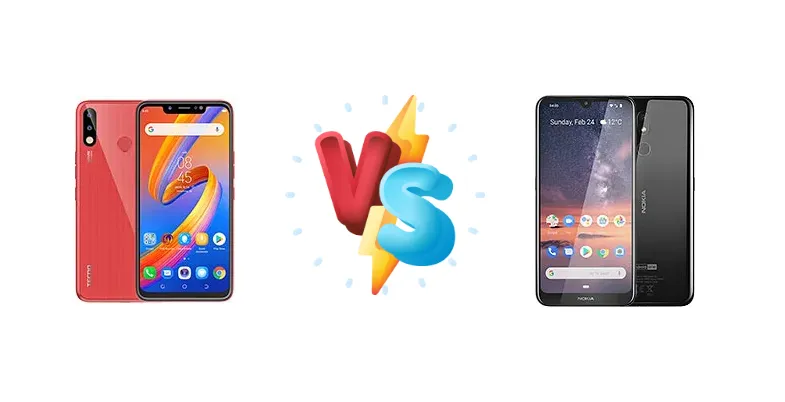
The Tecno Spark 3 and Nokia 3.2 represent the lower end of the smartphone market, targeting first-time buyers or those seeking a reliable secondary device. Both aim to deliver a functional Android experience at an incredibly affordable price point, but they achieve this with different hardware approaches. This comparison dissects those differences, focusing on performance, battery, and overall value.
🏆 Quick Verdict
For the average user prioritizing consistent, if modest, performance, the Nokia 3.2 edges out the Tecno Spark 3. While the Spark 3 boasts a slightly higher clocked CPU, the Snapdragon 429’s architecture and Qualcomm’s software optimizations provide a smoother, more responsive experience in everyday tasks. The Nokia 3.2 also benefits from 10W charging, a feature absent from the Spark 3’s specifications.
| Network |
|---|
| 2G bands | GSM 900 / 1800 | GSM 850 / 900 / 1800 / 1900 |
| 3G bands | HSDPA 850 / 900 / 2100 | HSDPA 850 / 900 / 2100 |
| 4G bands | - | 1, 3, 5, 7, 8, 20, 28, 38, 40 - EMEA, APAC, MENA |
| Speed | HSPA 42.2/5.76 Mbps, LTE Cat4 150/50 Mbps | HSPA 42.2/5.76 Mbps, LTE Cat4 150/50 Mbps |
| Technology | GSM / HSPA | GSM / HSPA / LTE |
| | - | 1, 3, 5, 8, 40, 41 - India |
| Launch |
|---|
| Announced | 2019, April. Released 2019, April | 2019, February 24. Released 2019, May 22 |
| Status | Discontinued | Discontinued |
| Body |
|---|
| Build | Glass front, plastic back, plastic frame | Glass front, plastic back, plastic frame |
| Dimensions | 155.3 x 75.8 x 8.2 mm (6.11 x 2.98 x 0.32 in) | 159.4 x 76.2 x 8.6 mm (6.28 x 3.00 x 0.34 in) |
| SIM | Nano-SIM + Nano-SIM | Nano-SIM + Nano-SIM |
| Weight | - | 181 g (6.38 oz) |
| Display |
|---|
| Resolution | 720 x 1500 pixels (~268 ppi density) | 720 x 1520 pixels, 19:9 ratio (~269 ppi density) |
| Size | 6.2 inches, 96.7 cm2 (~82.2% screen-to-body ratio) | 6.26 inches, 97.8 cm2 (~80.5% screen-to-body ratio) |
| Type | IPS LCD | IPS LCD |
| Platform |
|---|
| CPU | Quad-core 2.0 GHz Cortex-A53 | Quad-core 1.8 GHz Cortex-A53 |
| Chipset | Mediatek MT6761 Helio A22 (12 nm) | Qualcomm SDM429 Snapdragon 429 (12 nm) |
| GPU | PowerVR GE8320 | Adreno 504 |
| OS | Android 9.0 (Pie), HIOS 5.0 | Android 9.0 (Pie), upgradable to Android 11, Android One |
| Memory |
|---|
| Call records | Yes | - |
| Card slot | microSD | microSDXC (dedicated slot) |
| Internal | 16GB 2GB RAM | 16GB 2GB RAM, 32GB 3GB RAM, 64GB 3GB RAM |
| Phonebook | 2000 entries, Photocall | - |
| | eMMC 5.1 | eMMC 5.1 |
| Main Camera |
|---|
| Features | Dual-LED flash | LED flash |
| Single | 13 MP, AF | 13 MP, f/2.2, 1/3.1", 1.12µm, AF |
| Video | 1080p@30fps | 1080p@30fps |
| Selfie camera |
|---|
| Features | LED flash | - |
| Single | 8 MP | 5 MP, f/2.2, 27mm (wide), 1/5.0", 1.12µm |
| Video | 1080p@30fps | - |
| Sound |
|---|
| 3.5mm jack | Yes | Yes |
| 35mm jack | Yes | Yes |
| Loudspeaker | Yes | Yes |
| Comms |
|---|
| Bluetooth | 5.0, A2DP, LE | 4.2, A2DP, LE, aptX |
| NFC | No | No |
| Positioning | GPS | GPS, GLONASS, BDS |
| Radio | FM radio | FM radio |
| USB | microUSB 2.0 | microUSB 2.0, OTG |
| WLAN | Wi-Fi 802.11 b/g/n | Wi-Fi 802.11 b/g/n |
| Features |
|---|
| Browser | HTML | - |
| Games | Yes | - |
| Java | No | - |
| Messaging | SMS(threaded view), MMS, Email, Push Email, IM | - |
| Sensors | Fingerprint (rear-mounted), accelerometer, proximity | Fingerprint (rear-mounted, 32/3GB only), accelerometer, proximity |
| Battery |
|---|
| Charging | - | 10W wired |
| Stand-by | Up to 388 h | - |
| Talk time | Up to 6 h 40 min | - |
| Type | Li-Ion 3500 mAh, non-removable | Li-Ion 4000 mAh, non-removable |
| Misc |
|---|
| Colors | Midnight Black, Champagne Gold, Aqua Blue, Bordeaux Red | Black, Steel |
| Models | - | TA-1156, TA-1159, TA-1164 |
| Price | About 70 EUR | About 140 EUR |
| SAR | 1.15 W/kg (head) | - |
| SAR EU | - | 0.24 W/kg (head) 1.63 W/kg (body) |
Tecno Spark 3
- Potentially lower price point
- Higher CPU clock speed (on paper)
- May offer larger storage options
- Less refined chipset (Helio A22)
- No specified charging standard
- Likely less optimized software
Nokia 3.2
- More efficient chipset (Snapdragon 429)
- 10W wired charging support
- Generally better software optimization
- Slightly lower CPU clock speed
- Potentially higher price
- May have limited storage options
Display Comparison
Neither device is expected to deliver a stunning visual experience. Both likely utilize LCD panels, common in this price bracket. Without specific display specs, it's difficult to compare brightness or color accuracy. However, the Nokia 3.2’s brand reputation suggests a slightly more refined display calibration. Bezels are likely to be substantial on both, maximizing screen real estate within their respective form factors.
Camera Comparison
Camera performance is unlikely to be a strong suit for either device. Without sensor size or aperture information, it’s difficult to make a definitive judgment. However, the Nokia 3.2’s image processing algorithms are generally considered more refined than Tecno’s, potentially resulting in more natural-looking photos. The inclusion of a 2MP macro lens on either device is largely a marketing gimmick, offering limited practical benefit due to the low resolution and lack of optical image stabilization.
Performance
The core difference lies in the chipsets. The Tecno Spark 3 utilizes the Mediatek MT6761 Helio A22, featuring a quad-core Cortex-A53 CPU clocked at 2.0 GHz. The Nokia 3.2 employs the Qualcomm Snapdragon 429, also a quad-core Cortex-A53, but clocked at 1.8 GHz. While the Spark 3 has a higher clock speed, the Snapdragon 429 benefits from Qualcomm’s optimizations and a more efficient architecture. This translates to better sustained performance and smoother multitasking, despite the lower clock speed. Both utilize a 12nm process, suggesting similar power efficiency, but Qualcomm’s software integration often provides an edge.
Battery Life
Battery capacity is not specified for the Tecno Spark 3, but given its market segment, it’s likely around 3000-3500 mAh. The Nokia 3.2’s battery capacity is also not provided, but its inclusion of 10W wired charging is a significant advantage. The Spark 3 lacks any mention of charging capabilities, implying a slower, potentially less convenient charging experience. While a larger mAh rating sounds appealing, the Snapdragon 429’s efficiency could allow the Nokia 3.2 to achieve comparable or even better battery life with a slightly smaller battery.
Buying Guide
Buy the Tecno Spark 3 if you need a phone primarily for very basic tasks like calls, texts, and light social media, and are willing to accept occasional slowdowns. Its lower price point may be attractive for those on a strict budget. Buy the Nokia 3.2 if you prefer a more polished user experience, slightly better performance for multitasking, and the convenience of wired charging, even at a potentially higher cost.
Frequently Asked Questions
❓ Will the Tecno Spark 3 struggle with popular apps like WhatsApp and Facebook?
The Tecno Spark 3 should handle basic usage of apps like WhatsApp and Facebook, but expect occasional lag and slowdowns, especially when multitasking. The Helio A22 chipset is designed for light tasks and may struggle with more demanding applications.
❓ Is the Snapdragon 429 in the Nokia 3.2 capable of playing any mobile games?
The Nokia 3.2 can handle less demanding 2D games and older 3D titles at low settings. However, it’s not a gaming phone and will struggle with graphically intensive games like PUBG or Call of Duty. Expect low frame rates and potential stuttering.
❓ Does the Nokia 3.2 support fast charging beyond the 10W standard?
No, the Nokia 3.2 officially supports only 10W wired charging. While it might technically charge at a slightly faster rate with a more powerful charger, it won't utilize any advanced fast-charging protocols.
❓ Which phone is likely to receive more software updates?
Nokia generally provides more consistent and timely software updates than Tecno, even for their budget devices. This means the Nokia 3.2 is more likely to receive security patches and potentially even Android version upgrades.