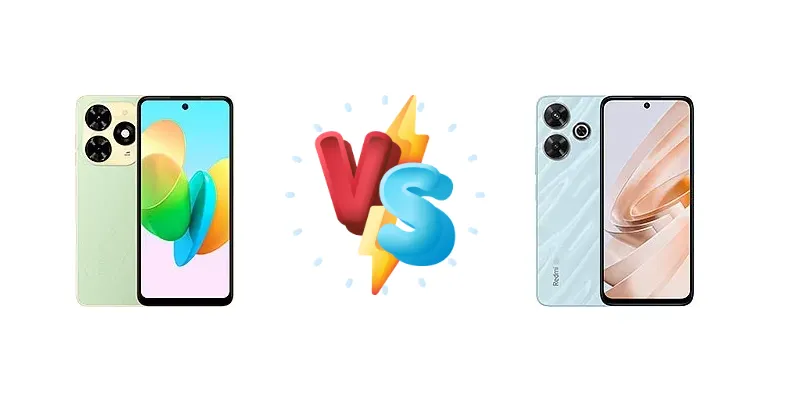
The sub-$200 smartphone market is fiercely competitive, and the Tecno Spark 20P and Xiaomi Redmi Note 13R are two contenders vying for your attention. While both aim to deliver essential smartphone functionality at an accessible price, they take distinctly different approaches to achieving this, primarily through their chipset choices and charging capabilities. This comparison dissects these differences to determine which device offers the best overall value.
🏆 Quick Verdict
For the average user prioritizing responsiveness and future-proofing, the Xiaomi Redmi Note 13R emerges as the stronger choice. Its Qualcomm Snapdragon 4+ Gen 2 chipset, built on a more efficient 4nm process, provides a noticeable performance advantage over the Tecno Spark 20P’s Mediatek processor, alongside significantly faster 33W charging.
| Network |
|---|
| 2G bands | GSM 850 / 900 / 1800 / 1900 | GSM 850 / 900 / 1800 / 1900 |
| 3G bands | HSDPA 900 / 2100 | HSDPA 850 / 900 / 2100 |
| 4G bands | LTE | 1, 3, 5, 8, 34, 38, 39, 40, 41 |
| 5G bands | - | 1, 5, 8, 28, 41, 78 SA/NSA |
| Speed | HSPA, LTE | HSPA, LTE, 5G |
| Technology | GSM / HSPA / LTE | GSM / CDMA / HSPA / EVDO / LTE / 5G |
| Launch |
|---|
| Announced | 2024, June 13 | 2024, May 17 |
| Status | Available. Released 2024, June | Available. Released 2024, May 17 |
| Body |
|---|
| Build | Glass front, plastic back, plastic frame | Glass front, plastic frame, glass back |
| Dimensions | 163.7 x 75.6 x 8.6 mm (6.44 x 2.98 x 0.34 in) | 168.6 x 76.3 x 8.2 mm (6.64 x 3.00 x 0.32 in) |
| SIM | Nano-SIM + Nano-SIM | Nano-SIM + Nano-SIM |
| Weight | - | 205 g (7.23 oz) |
| Display |
|---|
| Resolution | 720 x 1612 pixels, 20:9 ratio (~267 ppi density) | 1080 x 2460 pixels (~396 ppi density) |
| Size | 6.6 inches, 104.6 cm2 (~84.6% screen-to-body ratio) | 6.79 inches, 109.5 cm2 (~85.1% screen-to-body ratio) |
| Type | IPS LCD, 90Hz | IPS LCD, 120Hz, 550 nits |
| Platform |
|---|
| CPU | Octa-core 2.2 GHz Cortex-A53 | Octa-core (2x2.3 GHz Cortex-A78 & 6x1.95 GHz Cortex-A55) |
| Chipset | Mediatek | Qualcomm SM4450 Snapdragon 4+ Gen 2 (4 nm) |
| GPU | - | Adreno 613 |
| OS | Android 13 | Android 14, HyperOS |
| Memory |
|---|
| Card slot | microSDXC | No |
| Internal | 256GB 4GB RAM | 128GB 6GB RAM, 128GB 8GB RAM, 256GB 8GB RAM, 256GB 12GB RAM, 512GB 12GB RAM |
| Main Camera |
|---|
| Dual | - | 50 MP, f/1.8, (wide), 1/2.76", 0.64µm, PDAF
2 MP (macro) |
| Features | Dual-LED flash, HDR | LED flash, HDR |
| Single | 50 MP, (wide), 1/2.8", PDAF
Auxiliary lens | - |
| Video | 1080p@30fps | 1080p@30fps |
| Selfie camera |
|---|
| Features | Dual-LED flash | - |
| Single | 8 MP | 8 MP, (wide), 1/4.0", 1.12µm |
| Video | Yes | 1080p@30fps |
| Sound |
|---|
| 35mm jack | Yes | Yes |
| Loudspeaker | Yes, with stereo speakers | Yes |
| Comms |
|---|
| Bluetooth | Yes | 5.3, A2DP, LE |
| Infrared port | - | Yes |
| NFC | Yes | Yes |
| Positioning | GPS | GPS, GLONASS, GALILEO, BDS |
| Radio | FM radio | No |
| USB | USB Type-C, OTG | USB Type-C |
| WLAN | Yes | Wi-Fi 802.11 a/b/g/n/ac, dual-band |
| Features |
|---|
| Sensors | Fingerprint (side-mounted), accelerometer, compass | Fingerprint (side-mounted), accelerometer, compass |
| Battery |
|---|
| Charging | 18W wired | 33W wired |
| Type | 5000 mAh | 5030 mAh |
| Misc |
|---|
| Colors | Alpenglow Gold, Magic Skin | Black, Blue, Silver |
| Models | - | 2406ERN9CC |
| Price | About 240 EUR | About 180 EUR |
Tecno Spark 20P
- Potentially lower price point
- Simple and straightforward user experience
- Adequate for basic smartphone tasks
- Older processor architecture
- Slower charging speed
- Likely less responsive performance
Xiaomi Redmi Note 13R
- More powerful and efficient Snapdragon 4+ Gen 2 chipset
- Faster 33W wired charging
- Smoother multitasking and gaming experience
- Slightly higher price
- May have more bloatware (typical of Xiaomi)
- Potentially less battery life if battery capacity is significantly smaller
Display Comparison
Neither device’s display specifications are provided, so we must rely on typical segment expectations. However, the Redmi Note 13R, given Xiaomi’s recent trends, likely features a higher resolution display than the Spark 20P. The absence of information on refresh rates or panel technology (IPS vs AMOLED) makes a direct comparison impossible, but the Redmi Note 13R’s positioning suggests a more modern display experience. Bezels are likely comparable, given the price bracket.
Camera Comparison
Without specific camera sensor details, a direct comparison is limited. However, Xiaomi generally prioritizes camera performance even in its budget offerings. It’s reasonable to assume the Redmi Note 13R has a more capable main sensor and potentially better image processing algorithms. The Tecno Spark 20P likely relies on software enhancements to compensate for potentially less advanced hardware. The presence of a 2MP macro camera on either device is largely inconsequential; these sensors typically produce low-quality images.
Performance
The core difference lies in the chipsets. The Xiaomi Redmi Note 13R’s Qualcomm Snapdragon 4+ Gen 2 (4nm) is a significant upgrade over the Tecno Spark 20P’s Mediatek processor. The 4nm fabrication process of the Snapdragon offers superior power efficiency, translating to less heat generation and sustained performance. Furthermore, the Snapdragon 4+ Gen 2 features a more modern CPU architecture – Cortex-A78 cores (2x2.3 GHz) alongside Cortex-A55 cores (6x1.95 GHz) – compared to the Spark 20P’s older Cortex-A53 cores (Octa-core 2.2 GHz). This architectural advantage will be most noticeable in demanding tasks like gaming and app switching. The Redmi Note 13R will deliver a smoother, more responsive experience.
Battery Life
The Redmi Note 13R’s 33W wired charging is a clear advantage over the Tecno Spark 20P’s 18W charging. This translates to significantly faster charging times – potentially reducing a full charge from over 2 hours on the Spark 20P to around 1 hour on the Redmi Note 13R. While battery capacity isn’t specified, the Snapdragon 4+ Gen 2’s efficiency means the Redmi Note 13R is likely to offer comparable or even better battery life despite potentially having a similar or smaller battery capacity.
Buying Guide
Buy the Tecno Spark 20P if you prioritize a lower upfront cost and are comfortable with a more basic user experience. It’s suitable for users who primarily need a phone for calls, messaging, and light social media use. Buy the Xiaomi Redmi Note 13R if you value smoother multitasking, a more responsive gaming experience, and quicker charging times, even if it means spending slightly more. This phone is ideal for users who want a device that feels more modern and capable.
Frequently Asked Questions
❓ Will the Snapdragon 4+ Gen 2 in the Redmi Note 13R handle demanding games like PUBG Mobile?
The Snapdragon 4+ Gen 2 is capable of running PUBG Mobile at medium settings with reasonable frame rates. While it won't deliver a flagship gaming experience, it provides a significantly smoother and more stable experience than the Mediatek processor in the Tecno Spark 20P, which may struggle with consistent performance.
❓ How much faster is the 33W charging on the Redmi Note 13R compared to the 18W charging on the Tecno Spark 20P?
Expect a substantial difference in charging times. The Redmi Note 13R’s 33W charging can potentially charge the phone from 0% to 100% in around 60-75 minutes, while the Tecno Spark 20P’s 18W charging will likely take over 2 hours for a full charge. This is a significant convenience factor for users who frequently need to top up their battery.
❓ Does the Redmi Note 13R have a noticeable advantage in multitasking compared to the Tecno Spark 20P?
Yes, the Redmi Note 13R’s more powerful processor and modern CPU architecture (Cortex-A78 cores) will result in a noticeably smoother multitasking experience. Switching between apps will be faster and more responsive, and the phone is less likely to experience lag or slowdowns when running multiple applications simultaneously.