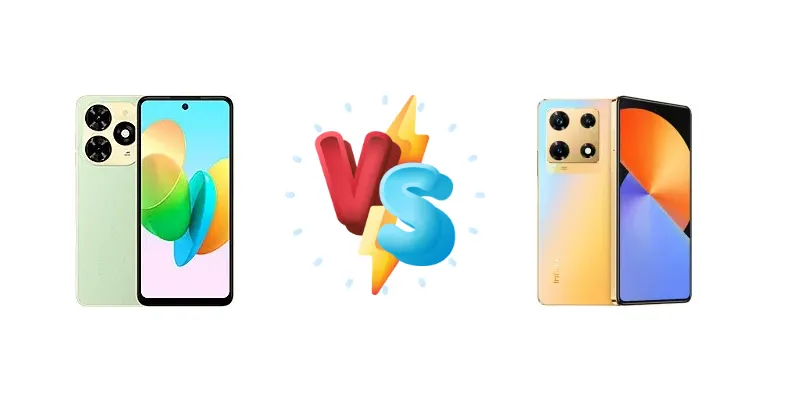
The Tecno Spark 20P and Infinix Note 30 Pro both target the budget-conscious smartphone user, but they approach the market with different strengths. The Spark 20P focuses on affordability, while the Note 30 Pro aims to deliver a more premium experience with faster charging and a more capable processor. This comparison dissects their key differences to determine which device best suits your needs.
🏆 Quick Verdict
For most users, the Infinix Note 30 Pro is the superior choice. Its Helio G99 chipset offers significantly better performance than the Spark 20P’s Mediatek processor, and the inclusion of 68W wired and 15W wireless charging provides a level of convenience the Spark 20P simply can’t match. While the Spark 20P is cheaper, the Note 30 Pro’s added features justify the price difference.
| Network |
|---|
| 2G bands | GSM 850 / 900 / 1800 / 1900 | GSM 850 / 900 / 1800 / 1900 |
| 3G bands | HSDPA 900 / 2100 | HSDPA 850 / 900 / 1700(AWS) / 1900 / 2100 |
| 4G bands | LTE | 1, 2, 3, 4, 5, 7, 8, 12, 17, 20, 28, 38, 40, 41, 66 |
| Speed | HSPA, LTE | HSPA, LTE |
| Technology | GSM / HSPA / LTE | GSM / HSPA / LTE |
| Launch |
|---|
| Announced | 2024, June 13 | 2023, May 22 |
| Status | Available. Released 2024, June | Available. Released 2023, May 22 |
| Body |
|---|
| Build | Glass front, plastic back, plastic frame | Glass front, plastic frame, glass back |
| Dimensions | 163.7 x 75.6 x 8.6 mm (6.44 x 2.98 x 0.34 in) | 162.7 x 76 x 8.2 mm (6.41 x 2.99 x 0.32 in) |
| SIM | Nano-SIM + Nano-SIM | Nano-SIM + Nano-SIM |
| Weight | - | 203 g (7.16 oz) |
| | - | IP53 |
| Display |
|---|
| Resolution | 720 x 1612 pixels, 20:9 ratio (~267 ppi density) | 1080 x 2400 pixels, 20:9 ratio (~395 ppi density) |
| Size | 6.6 inches, 104.6 cm2 (~84.6% screen-to-body ratio) | 6.67 inches, 107.4 cm2 (~86.9% screen-to-body ratio) |
| Type | IPS LCD, 90Hz | AMOLED, 1B colors, 120Hz, 900 nits (peak) |
| | - | * the display diagonal size and resolution is unconfirmed |
| Platform |
|---|
| CPU | Octa-core 2.2 GHz Cortex-A53 | Octa-core (2x2.2 GHz Cortex-A76 & 6x2.0 GHz Cortex-A55) |
| Chipset | Mediatek | Mediatek Helio G99 (6 nm) |
| GPU | - | Mali-G57 MC2 |
| OS | Android 13 | Android 13, XOS 13 |
| Memory |
|---|
| Card slot | microSDXC | microSDXC (dedicated slot) |
| Internal | 256GB 4GB RAM | 256GB 8GB RAM |
| Main Camera |
|---|
| Features | Dual-LED flash, HDR | Quad-LED flash, HDR, panorama |
| Single | 50 MP, (wide), 1/2.8", PDAF
Auxiliary lens | - |
| Triple | - | 108 MP, (wide), 1/1.67", PDAF
2 MP (macro)
Auxiliary lens |
| Video | 1080p@30fps | 1440p@30fps, 1080p@30fps |
| Selfie camera |
|---|
| Features | Dual-LED flash | LED flash, HDR |
| Single | 8 MP | 32 MP, f/2.0, (wide), 1/2.8" |
| Video | Yes | 1080p@30fps |
| Sound |
|---|
| 3.5mm jack | - | Yes |
| 35mm jack | Yes | Yes |
| Loudspeaker | Yes, with stereo speakers | Yes, with dual speakers |
| | - | Sound by JBL
24-bit/192kHz audio |
| Comms |
|---|
| Bluetooth | Yes | Yes |
| NFC | Yes | Yes (market/region dependent) |
| Positioning | GPS | GPS |
| Radio | FM radio | FM radio |
| USB | USB Type-C, OTG | USB Type-C 2.0, OTG |
| WLAN | Yes | Wi-Fi 802.11 a/b/g/n/ac, dual-band, Wi-Fi Direct |
| Features |
|---|
| Sensors | Fingerprint (side-mounted), accelerometer, compass | Fingerprint (side-mounted), accelerometer, gyro, proximity, compass |
| Battery |
|---|
| Charging | 18W wired | 68W wired, PD3.0, 80% in 30 min
15W wireless
Reverse wireless |
| Type | 5000 mAh | 5000 mAh |
| Misc |
|---|
| Colors | Alpenglow Gold, Magic Skin | Magic Black, Variable Gold |
| Models | - | X678B |
| Price | About 240 EUR | - |
Tecno Spark 20P
- More affordable price point
- Sufficient for basic smartphone tasks
- Potentially longer battery life due to less powerful processor
- Significantly slower processor
- Slow 18W charging
- Likely lower quality display
Infinix Note 30 Pro
- Faster and more efficient Mediatek Helio G99 processor
- 68W wired and 15W wireless charging
- Likely better display quality
- Higher price compared to the Tecno Spark 20P
- Potentially shorter battery life due to more powerful processor
- May require more frequent charging
Display Comparison
Neither device’s display specifications are provided, so a direct comparison is limited. However, given the Note 30 Pro’s positioning, it likely features a higher-quality panel with better color accuracy and potentially a higher refresh rate. The Spark 20P, being a more budget-oriented device, will likely utilize a simpler LCD panel. Bezels are also likely to be slimmer on the Note 30 Pro, contributing to a more immersive viewing experience.
Camera Comparison
Without specific camera sensor details, it’s difficult to make a definitive comparison. However, the Note 30 Pro, being a higher-tier device, likely features a larger main sensor and more sophisticated image processing algorithms. The Spark 20P likely relies on a more basic camera setup. The absence of OIS information for either device suggests both will rely heavily on software stabilization. It’s reasonable to assume the Note 30 Pro will deliver superior image quality, particularly in low-light conditions.
Performance
The Infinix Note 30 Pro’s Mediatek Helio G99 (6nm) represents a substantial upgrade over the Tecno Spark 20P’s Mediatek processor. The G99 utilizes more modern CPU cores – two Cortex-A76 cores clocked at 2.2 GHz and six Cortex-A55 cores at 2.0 GHz – compared to the Spark 20P’s all Cortex-A53 cores at 2.2 GHz. This architectural difference translates to significantly improved multi-core performance and better responsiveness in demanding applications. The 6nm process node of the G99 also contributes to better power efficiency and reduced thermal throttling during prolonged gaming sessions. The Note 30 Pro will handle graphically intensive games and multitasking with greater ease.
Battery Life
The charging capabilities are a major differentiator. The Infinix Note 30 Pro’s 68W wired charging, with a claimed 80% charge in 30 minutes, is dramatically faster than the Tecno Spark 20P’s 18W charging. The addition of 15W wireless charging and reverse wireless charging on the Note 30 Pro further enhances its convenience. While battery capacity isn’t specified, the faster charging speeds of the Note 30 Pro mitigate the impact of a potentially smaller battery, allowing for quicker top-ups throughout the day.
Buying Guide
Buy the Tecno Spark 20P if you prioritize absolute affordability and only need a phone for basic tasks like calls, messaging, and light social media use. Buy the Infinix Note 30 Pro if you value faster performance for gaming and multitasking, and if you want the convenience of rapid charging and wireless charging capabilities. The Note 30 Pro is the better option for users who want a phone that can keep up with a more demanding lifestyle.
Frequently Asked Questions
❓ Will the Infinix Note 30 Pro’s Helio G99 handle demanding games like PUBG Mobile smoothly?
Yes, the Helio G99 is a capable chipset for gaming. While it’s not a flagship processor, it’s significantly more powerful than the Spark 20P’s processor and should provide a smooth gaming experience in PUBG Mobile at medium to high settings. The 6nm process also helps to minimize thermal throttling during extended gaming sessions.
❓ How long does it *actually* take to fully charge the Infinix Note 30 Pro with the 68W charger?
Infinix claims 80% charge in 30 minutes, which is a realistic expectation. A full 0-100% charge will likely take around 45-50 minutes, depending on usage while charging. This is a substantial improvement over the Spark 20P’s much slower 18W charging.
❓ Is the reverse wireless charging on the Infinix Note 30 Pro useful for charging accessories like earbuds?
Yes, the 15W reverse wireless charging is convenient for topping up accessories like wireless earbuds or smartwatches. While it’s not as fast as wired charging, it provides a convenient way to charge small devices on the go without needing a separate charger.