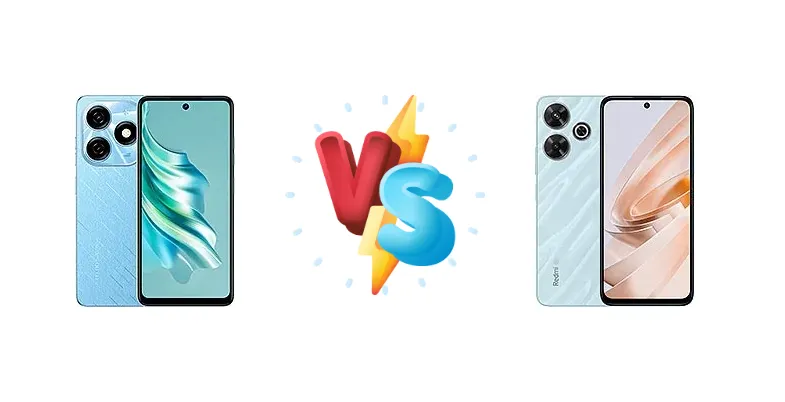
The Tecno Spark 20 and Xiaomi Redmi Note 13R represent compelling options in the increasingly competitive sub-$200 smartphone market. While both aim to deliver essential features at an accessible price, they diverge significantly in their core hardware, particularly in their chipset choices. This comparison dissects those differences to determine which device offers the best overall experience.
🏆 Quick Verdict
For the average user, the Xiaomi Redmi Note 13R emerges as the stronger contender. Its Snapdragon 4+ Gen 2, built on a more efficient 4nm process, provides a noticeable performance advantage and superior thermal management compared to the Tecno Spark 20’s Helio G85. The faster 33W charging is also a significant benefit.
| Network |
|---|
| 2G bands | GSM 850 / 900 / 1800 / 1900 | GSM 850 / 900 / 1800 / 1900 |
| 3G bands | HSDPA 900 / 2100 | HSDPA 850 / 900 / 2100 |
| 4G bands | LTE | 1, 3, 5, 8, 34, 38, 39, 40, 41 |
| 5G bands | - | 1, 5, 8, 28, 41, 78 SA/NSA |
| Speed | HSPA, LTE | HSPA, LTE, 5G |
| Technology | GSM / HSPA / LTE | GSM / CDMA / HSPA / EVDO / LTE / 5G |
| Launch |
|---|
| Announced | 2023, December 01 | 2024, May 17 |
| Status | Available. Released 2023, December | Available. Released 2024, May 17 |
| Body |
|---|
| Build | Glass front, plastic back, plastic frame | Glass front, plastic frame, glass back |
| Dimensions | 163.7 x 75.6 x 8.5 mm (6.44 x 2.98 x 0.33 in) | 168.6 x 76.3 x 8.2 mm (6.64 x 3.00 x 0.32 in) |
| SIM | Nano-SIM + Nano-SIM | Nano-SIM + Nano-SIM |
| Weight | - | 205 g (7.23 oz) |
| Display |
|---|
| Resolution | 720 x 1612 pixels, 20:9 ratio (~267 ppi density) | 1080 x 2460 pixels (~396 ppi density) |
| Size | 6.6 inches, 104.6 cm2 (~84.6% screen-to-body ratio) | 6.79 inches, 109.5 cm2 (~85.1% screen-to-body ratio) |
| Type | IPS LCD, 90Hz | IPS LCD, 120Hz, 550 nits |
| Platform |
|---|
| CPU | Octa-core (2x2.0 GHz Cortex-A75 & 6x1.8 GHz Cortex-A55) | Octa-core (2x2.3 GHz Cortex-A78 & 6x1.95 GHz Cortex-A55) |
| Chipset | Mediatek MT6769Z Helio G85 (12 nm) | Qualcomm SM4450 Snapdragon 4+ Gen 2 (4 nm) |
| GPU | Mali-G52 MC2 | Adreno 613 |
| OS | Android 13, HIOS 13 | Android 14, HyperOS |
| Memory |
|---|
| Card slot | microSDXC | No |
| Internal | 128GB 4GB RAM, 128GB 8GB RAM, 256GB 8GB RAM | 128GB 6GB RAM, 128GB 8GB RAM, 256GB 8GB RAM, 256GB 12GB RAM, 512GB 12GB RAM |
| Main Camera |
|---|
| Dual | - | 50 MP, f/1.8, (wide), 1/2.76", 0.64µm, PDAF
2 MP (macro) |
| Features | Dual-LED flash, HDR | LED flash, HDR |
| Single | 50 MP, f/1.6, (wide), 0.64µm, PDAF
Auxiliary lens | - |
| Video | 1440p@30fps, 1080p@30fps | 1080p@30fps |
| Selfie camera |
|---|
| Features | Dual-LED flash | - |
| Single | 32 MP, f/2.2, (wide) | 8 MP, (wide), 1/4.0", 1.12µm |
| Video | 1080p@30fps | 1080p@30fps |
| Sound |
|---|
| 35mm jack | Yes | Yes |
| Loudspeaker | Yes, with stereo speakers | Yes |
| Comms |
|---|
| Bluetooth | 5.2, A2DP, LE | 5.3, A2DP, LE |
| Infrared port | - | Yes |
| NFC | No | Yes |
| Positioning | GPS | GPS, GLONASS, GALILEO, BDS |
| Radio | FM radio | No |
| USB | USB Type-C, OTG | USB Type-C |
| WLAN | Wi-Fi 802.11 a/b/g/n/ac, dual-band | Wi-Fi 802.11 a/b/g/n/ac, dual-band |
| Features |
|---|
| Sensors | Fingerprint (side-mounted), accelerometer, proximity, compass | Fingerprint (side-mounted), accelerometer, compass |
| Battery |
|---|
| Charging | 18W wired | 33W wired |
| Type | 5000 mAh | 5030 mAh |
| Misc |
|---|
| Colors | Gravity Black, Cyber White, Neon Gold, Magic Skin 2.0 (Blue) | Black, Blue, Silver |
| Models | KJ5, KJ5n | 2406ERN9CC |
| Price | - | About 180 EUR |
Tecno Spark 20
- Lower upfront cost
- Functional for basic tasks
- Acceptable performance for light use
- Less efficient chipset
- Slower charging speed
- Potential for thermal throttling
Xiaomi Redmi Note 13R
- More efficient Snapdragon 4+ Gen 2
- Faster 33W charging
- Improved performance for gaming and multitasking
- Slightly higher price
- May not offer significantly better camera performance without further specs
- Still a budget device with inherent limitations
Display Comparison
Neither device boasts a standout display. While specific panel details (like peak brightness or color gamut coverage) are absent, the focus here is on the underlying processing power impacting UI smoothness. The Redmi Note 13R’s more capable chipset will contribute to a more responsive user interface, even if the panel technology itself is similar. Bezels are likely comparable given the price point, and color accuracy will likely be standard for this segment.
Camera Comparison
Without detailed camera specs, a direct comparison is limited. However, the chipset’s image signal processor (ISP) plays a crucial role. The Snapdragon 4+ Gen 2’s ISP is likely more advanced than the Helio G85’s, resulting in better image processing, noise reduction, and dynamic range. The Redmi Note 13R will likely produce more detailed and vibrant photos, especially in challenging lighting conditions. The presence of a larger main sensor (if present, based on Xiaomi’s typical strategy) would further enhance image quality.
Performance
The core difference lies in the chipsets. The Xiaomi Redmi Note 13R’s Qualcomm Snapdragon 4+ Gen 2 (4nm) is a clear upgrade over the Tecno Spark 20’s MediaTek Helio G85 (12nm). The 4nm fabrication process of the Snapdragon offers significantly improved power efficiency, translating to less heat generation and sustained performance. The Snapdragon’s CPU configuration – 2x2.3 GHz Cortex-A78 & 6x1.95 GHz Cortex-A55 – also provides a performance edge over the Helio G85’s 2x2.0 GHz Cortex-A75 & 6x1.8 GHz Cortex-A55. This means faster app loading times, smoother multitasking, and a better gaming experience on the Redmi Note 13R. While both utilize an octa-core configuration, the architectural improvements in the Snapdragon are substantial.
Battery Life
The Redmi Note 13R’s 33W wired charging is a significant advantage over the Tecno Spark 20’s 18W charging. This translates to considerably faster charging times – potentially reducing a full charge from over 2 hours on the Spark 20 to around 1 hour on the Redmi Note 13R. While battery capacity isn’t specified, the Snapdragon 4+ Gen 2’s efficiency means the Redmi Note 13R will likely achieve comparable or even better battery life despite potentially having a similar or smaller battery capacity.
Buying Guide
Buy the Tecno Spark 20 if your primary need is a functional smartphone for basic tasks like calling, texting, and light social media use, and you prioritize minimizing upfront cost. Buy the Xiaomi Redmi Note 13R if you value smoother multitasking, improved gaming performance, and faster charging, even if it means spending slightly more. The Redmi Note 13R is the better choice for users who anticipate heavier usage.
Frequently Asked Questions
❓ Will the Helio G85 in the Tecno Spark 20 struggle with demanding games like PUBG Mobile?
Yes, the Helio G85 is a budget chipset and will likely require significant graphics settings reductions to achieve playable frame rates in PUBG Mobile. Expect noticeable frame drops and potential stuttering, especially during intense action sequences. The Redmi Note 13R’s Snapdragon 4+ Gen 2 will provide a much smoother gaming experience.
❓ How much faster is the 33W charging on the Redmi Note 13R compared to the 18W charging on the Spark 20?
The 33W charging on the Redmi Note 13R will significantly reduce charging times. While exact figures depend on battery capacity, expect a full charge to take approximately 1 hour to 1 hour 30 minutes, compared to over 2 hours for the Tecno Spark 20. This is a substantial difference for users who frequently need to top up their battery.
❓ Is the Snapdragon 4+ Gen 2 in the Redmi Note 13R efficient enough to avoid overheating during prolonged use?
The Snapdragon 4+ Gen 2’s 4nm process is significantly more power-efficient than the Helio G85’s 12nm process. This means it generates less heat under load, reducing the likelihood of thermal throttling and maintaining consistent performance for longer periods. While it’s not a flagship chip, it’s well-suited for sustained everyday use.