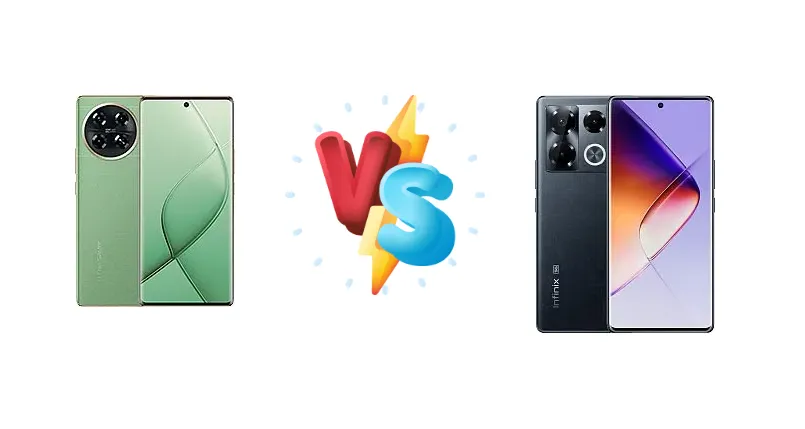
Tecno and Infinix, both under the Transsion Holdings umbrella, consistently deliver compelling value in the mid-range smartphone market. The Tecno Spark 20 Pro+ focuses on a balance of features, while the Infinix Note 40 Pro+ aggressively pushes the boundaries of charging speed and display quality. This comparison dissects their key differences to determine which device offers the best experience for your needs.
🏆 Quick Verdict
For the average user prioritizing a vibrant display and incredibly fast charging, the Infinix Note 40 Pro+ is the clear winner. Its Dimensity 7020 chipset and 100W charging significantly outperform the Tecno Spark 20 Pro+'s Helio G99 Ultimate and 33W charging, despite a slightly shorter active use battery life.
| Network |
|---|
| 2G bands | GSM 850 / 900 / 1800 / 1900 | GSM 850 / 900 / 1800 / 1900 |
| 3G bands | HSDPA 900 / 2100 | HSDPA 850 / 900 / 1700(AWS) / 1900 / 2100 |
| 4G bands | LTE | 1, 2, 3, 4, 5, 7, 8, 12, 17, 20, 28, 38, 40, 41, 42, 66 |
| 5G bands | - | 1, 3, 5, 7, 8, 12, 20, 28, 38, 40, 41, 66, 77, 78 SA/NSA |
| Speed | HSPA, LTE | HSPA, LTE, 5G |
| Technology | GSM / HSPA / LTE | GSM / HSPA / LTE / 5G |
| Launch |
|---|
| Announced | 2023, December 29 | 2024, March 18 |
| Status | Available. Released 2024, February 09 | Available. Released 2024, March 19 |
| Body |
|---|
| Build | Glass front (Gorilla Glass 5), plastic back, plastic frame | Glass front, plastic frame, silicone polymer (eco leather) back |
| Dimensions | 164.7 x 75 x 7.6 mm (6.48 x 2.95 x 0.30 in) | 164.3 x 74.5 x 8.1 mm (6.47 x 2.93 x 0.32 in) |
| SIM | Nano-SIM + Nano-SIM | Nano-SIM + Nano-SIM |
| Weight | 179 g (6.31 oz) | 190 g or 196 g (6.70 oz) |
| Display |
|---|
| Protection | Corning Gorilla Glass 5 | Corning Gorilla Glass |
| Resolution | 1080 x 2436 pixels (~393 ppi density) | 1080 x 2436 pixels (~393 ppi density) |
| Size | 6.78 inches, 109.9 cm2 (~89.0% screen-to-body ratio) | 6.78 inches, 109.9 cm2 (~89.8% screen-to-body ratio) |
| Type | AMOLED, 1B colors, 120Hz, 1000 nits (peak) | AMOLED, 1B colors, 120Hz, 1300 nits (peak) |
| Platform |
|---|
| CPU | Octa-core (2x2.2 GHz Cortex-A76 & 6x2.0 GHz Cortex-A55) | Octa-core (2x2.2 GHz Cortex-A78 & 6x2.0 GHz Cortex-A55) |
| Chipset | Mediatek Helio G99 Ultimate | Mediatek Dimensity 7020 (6 nm) |
| GPU | Mali-G57 MC2 | IMG BXM-8-256 |
| OS | Android 14 | Android 14, up to 2 major Android upgrades, XOS 14 |
| Memory |
|---|
| Card slot | No | No |
| Internal | 256GB 8GB RAM | 256GB 12GB RAM, 512GB 12GB RAM |
| Main Camera |
|---|
| Dual | 108 MP, f/1.8, (wide), 1/1.67", 0.64µm, PDAF
2 MP (macro) | - |
| Features | Quad-LED flash, HDR | Dual-LED flash, HDR, panorama |
| Triple | - | 108 MP, f/1.8, 24mm (wide), 1/1.67", 0.64µm, PDAF, OIS
2 MP, f/2.4
2 MP, f/2.4 |
| Video | 1440p@30fps, 1080p@30fps | 1440p@30fps, 1080p@30/60fps |
| Selfie camera |
|---|
| Features | Dual-LED flash | Dual-LED flash |
| Single | 32 MP, f/2.2, (wide), 1/3.1", 0.7µm | 32 MP, f/2.2, (wide), 1/3.1", 0.7µm |
| Video | 1440p@30fps, 1080p@30/60fps | 1440p@30fps, 1080p@30/60fps |
| Sound |
|---|
| 35mm jack | No | No |
| Loudspeaker | Yes, with stereo speakers | Yes, with stereo speakers |
| Comms |
|---|
| Bluetooth | 5.2, A2DP, LE | Yes |
| Infrared port | - | Yes |
| NFC | Yes | Yes (market/region dependent) |
| Positioning | GPS, GLONASS | GPS |
| Radio | FM radio | FM radio |
| USB | USB Type-C | USB Type-C 2.0, OTG |
| WLAN | Wi-Fi 802.11 a/b/g/n/ac, dual-band | Wi-Fi 802.11 a/b/g/n/ac, dual-band |
| Features |
|---|
| Sensors | Fingerprint (under display, optical), accelerometer, gyro, proximity, compass | Fingerprint (under display, optical), accelerometer, gyro, proximity, compass |
| Battery |
|---|
| Charging | 33W wired | 100W wired, 50% in 12 min
20W wireless MagCharge
Reverse wired
Reverse wireless |
| Type | 5000 mAh | 4600 mAh |
| Misc |
|---|
| Colors | Temporal Orbits, Lunar Frost, Radiant Starstream, Magic Skin 2.0 Green | Obsidian Black, Vintage Green, Racing Edition |
| Models | KJ7 | X6851B |
| Price | - | About 290 EUR |
Tecno Spark 20 Pro+
- Longer active use battery life
- Potentially more affordable price point
- Solid all-around performance for everyday tasks
- Significantly slower charging speed
- Dimmer display, less visible outdoors
- Less powerful processor compared to the Infinix
Infinix Note 40 Pro+
- Incredibly fast 100W charging
- Much brighter and more vibrant display
- More powerful Dimensity 7020 chipset
- Wireless charging and reverse charging capabilities
- Slightly shorter active use battery life
- Potentially higher price point
Display Comparison
The Infinix Note 40 Pro+ boasts a significantly brighter display, reaching a measured 1130 nits compared to the Tecno Spark 20 Pro+'s 549 nits. This difference is immediately noticeable in outdoor visibility, making the Infinix far superior in bright sunlight. While both likely utilize LCD panels (based on price point), the Infinix’s higher peak brightness and potentially better color calibration provide a more visually engaging experience. The Tecno’s lower brightness may be sufficient for indoor use, but it lacks the dynamic range of the Infinix.
Camera Comparison
Without detailed camera specs, a direct comparison is limited. However, both phones likely feature similar primary sensor resolutions within the mid-range segment. The Infinix Note 40 Pro+’s more powerful ISP (Image Signal Processor) within the Dimensity 7020 chipset will likely result in better image processing, particularly in low-light conditions. The absence of OIS (Optical Image Stabilization) information for either device suggests reliance on software stabilization, where the Infinix’s processing power could again provide an advantage. We’d advise ignoring the typical 2MP macro lenses found on both devices, as their image quality is generally subpar.
Performance
The chipset is where the most substantial difference lies. The Infinix Note 40 Pro+ features the Mediatek Dimensity 7020, built on a more efficient 6nm process, and utilizes Cortex-A78 cores. This contrasts with the Tecno Spark 20 Pro+'s Helio G99 Ultimate, which employs Cortex-A76 cores. The A78 cores in the Dimensity 7020 offer a noticeable performance uplift in CPU-intensive tasks and gaming. While both phones share 6x Cortex-A55 efficiency cores, the Dimensity 7020’s superior architecture translates to smoother multitasking and a more responsive user experience. The 6nm process also contributes to better thermal management, potentially reducing throttling during prolonged gaming sessions.
Battery Life
The Infinix Note 40 Pro+ achieves 12:23h of active use, slightly surpassing the Tecno Spark 20 Pro+'s 11:56h. However, the real differentiator is charging speed. The Infinix supports 100W wired charging, capable of reaching 50% charge in just 12 minutes, a massive advantage over the Tecno’s 33W charging. Furthermore, the Infinix adds 20W MagCharge wireless charging, reverse wired charging, and reverse wireless charging – features entirely absent on the Tecno. This makes the Infinix far more convenient for users who frequently need to top up their battery quickly or share power with other devices.
Buying Guide
Buy the Tecno Spark 20 Pro+ if you prioritize extended battery life during active use and are comfortable with slower charging speeds. It’s a solid all-rounder for everyday tasks. Buy the Infinix Note 40 Pro+ if you demand a brighter, more immersive display, lightning-fast 100W charging, and a more powerful processor for demanding applications and gaming.
Frequently Asked Questions
❓ Does the Dimensity 7020 in the Infinix Note 40 Pro+ get hot during extended gaming sessions?
The Dimensity 7020 is built on a 6nm process, which generally offers better thermal efficiency than the Helio G99 Ultimate's process. While some heat is inevitable during prolonged gaming, the Infinix Note 40 Pro+ is likely to experience less throttling and maintain higher frame rates for longer periods compared to the Tecno Spark 20 Pro+.
❓ How practical is the 20W MagCharge wireless charging on the Infinix Note 40 Pro+?
The 20W MagCharge is a convenient feature for users already invested in the magnetic wireless charging ecosystem. While not as fast as the 100W wired charging, it provides a reasonable top-up speed and eliminates the need for cables. The reverse charging capabilities are also useful for powering up accessories like earbuds or smartwatches.
❓ Is the difference in display brightness between the two phones noticeable in everyday use?
Yes, the 581-nit difference in peak brightness is significant. The Infinix Note 40 Pro+'s display will be much easier to see in direct sunlight and offer a more vibrant and immersive viewing experience overall. The Tecno Spark 20 Pro+'s display may be adequate indoors, but will struggle in brighter environments.
❓ Will I notice a performance difference between the Helio G99 Ultimate and the Dimensity 7020 in everyday tasks like browsing and social media?
For basic tasks, the difference may not be immediately apparent. However, the Dimensity 7020's more powerful CPU and GPU will result in smoother multitasking, faster app loading times, and a more responsive user experience, especially when switching between multiple apps or running demanding applications.