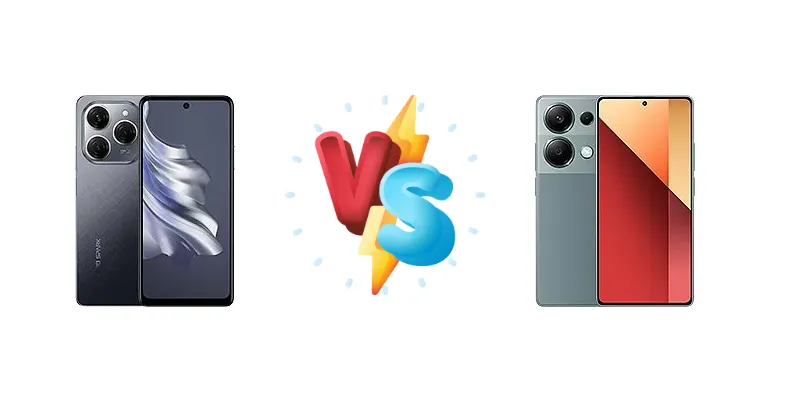
The Tecno Spark 20 Pro and Xiaomi Redmi Note 13 Pro 4G represent compelling options in the competitive sub-$250 4G smartphone market. Both leverage Mediatek’s Helio G99 series, but diverge significantly in charging speed and display capabilities, creating a clear trade-off between convenience and endurance. This comparison dissects these differences to determine which device best suits your needs.
🏆 Quick Verdict
For the average user prioritizing convenience and faster refueling, the Xiaomi Redmi Note 13 Pro 4G is the better choice. Its 67W charging, capable of a full charge in just 46 minutes, significantly outweighs the Tecno Spark 20 Pro’s slower 33W charging, despite the latter’s potentially slightly longer battery life due to the lack of measured battery capacity.
| Network |
|---|
| 2G bands | GSM 850 / 900 / 1800 / 1900 | GSM 850 / 900 / 1800 / 1900 |
| 3G bands | HSDPA 900 / 2100 | HSDPA 850 / 900 / 1700(AWS) / 1900 / 2100 |
| 4G bands | LTE | 1, 2, 3, 4, 5, 7, 8, 12, 13, 17, 18, 19, 20, 26, 28, 38, 40, 41, 66 |
| Speed | HSPA, LTE | HSPA, LTE |
| Technology | GSM / HSPA / LTE | GSM / HSPA / LTE |
| Launch |
|---|
| Announced | 2023, December 15 | 2024, January 15 |
| Status | Available. Released 2023, December | Available. Released 2024, January 15 |
| Body |
|---|
| Build | Glass front, plastic back, plastic frame | Glass front (Gorilla Glass 5), plastic frame, plastic back |
| Dimensions | 168.6 x 76.6 x 8.4 mm (6.64 x 3.02 x 0.33 in) | 161.1 x 75 x 8 mm (6.34 x 2.95 x 0.31 in) |
| SIM | Nano-SIM + Nano-SIM | Nano-SIM + Nano-SIM |
| Weight | - | 188 g (6.63 oz) |
| Display |
|---|
| Protection | - | Corning Gorilla Glass 5 |
| Resolution | 1080 x 2460 pixels (~396 ppi density) | 1080 x 2400 pixels, 20:9 ratio (~395 ppi density) |
| Size | 6.78 inches, 109.2 cm2 (~84.5% screen-to-body ratio) | 6.67 inches, 107.4 cm2 (~88.9% screen-to-body ratio) |
| Type | IPS LCD, 120Hz | AMOLED, 1B colors, 120Hz, 500 nits (typ), 1000 nits (HBM), 1300 nits (peak) |
| Platform |
|---|
| CPU | Octa-core (2x2.2 GHz Cortex-A76 & 6x2.0 GHz Cortex-A55) | Octa-core (2x2.2 GHz Cortex-A76 & 6x2.0 GHz Cortex-A55) |
| Chipset | Mediatek Helio G99 (6 nm) | Mediatek Helio G99 Ultra |
| GPU | Mali-G57 MC2 | Mali-G57 MC2 |
| OS | Android 13 | Android 13, up to 3 major Android upgrades, HyperOS |
| Memory |
|---|
| Card slot | microSDXC | microSDXC (uses shared SIM slot) |
| Internal | 256GB 4GB RAM, 256GB 8GB RAM, 256GB 12GB RAM | 128GB 8GB RAM, 256GB 8GB RAM, 256GB 12GB RAM, 512GB 8GB RAM, 512GB 12GB RAM |
| Main Camera |
|---|
| Dual | 108 MP, f/1.8, (wide), 1/1.67", 0.64µm, PDAF
2 MP (macro) | - |
| Features | Quad-LED flash, HDR | LED flash, HDR, panorama |
| Triple | - | 200 MP, f/1.7, 23mm (wide), 1/1.4", 0.56µm, multi-directional PDAF, OIS
8 MP, f/2.2, 15mm, 120˚ (ultrawide), 1/4.4", 1.0µm
2 MP (macro) |
| Video | 1440p@30fps, 1080p@30fps | 1080p@30/60fps |
| Selfie camera |
|---|
| Features | Dual-LED flash | - |
| Single | 32 MP, f/2.2, (wide) | 16 MP, f/2.4, (wide), 1/3.0", 1.0µm |
| Video | 1080p@30fps | 1080p@30/60fps |
| Sound |
|---|
| 35mm jack | Yes | Yes |
| Loudspeaker | Yes, with stereo speakers | Yes, with dual speakers |
| Comms |
|---|
| Bluetooth | 5.2, A2DP, LE | 5.2, A2DP, LE |
| Infrared port | - | Yes |
| NFC | Yes | Yes (market/region dependent) |
| Positioning | GPS, GLONASS | GPS, GLONASS, GALILEO, BDS |
| Radio | FM radio | FM radio |
| USB | USB Type-C | USB Type-C 2.0, OTG |
| WLAN | Wi-Fi 802.11 a/b/g/n/ac, dual-band | Wi-Fi 802.11 a/b/g/n/ac, dual-band |
| Features |
|---|
| Sensors | Fingerprint (side-mounted), accelerometer, proximity, compass | Fingerprint (under display, optical), accelerometer, gyro, compass |
| Battery |
|---|
| Charging | 33W wired | 67W wired, 50% in 16 min, 100% in 46 min |
| Type | 5000 mAh | 5000 mAh |
| Misc |
|---|
| Colors | Moonlit Black, Frosty Ivory, Sunset Blush, Magic Skin 2.0 Green | Midnight Black, Lavender Purple, Forest Green |
| Models | KJ6 | 23117RA68G, 2312FPCA6G |
| Price | About 50 EUR | € 92.00 / $ 269.99 / £ 299.99 |
| SAR | - | 1.09 W/kg (head) 1.09 W/kg (body) |
| SAR EU | - | 0.99 W/kg (head) 0.99 W/kg (body) |
Tecno Spark 20 Pro
- Potentially lower price point
- Mediatek Helio G99 provides adequate performance for everyday tasks
- Likely a large battery capacity (though unconfirmed)
- Significantly slower 33W charging
- Display brightness likely lower than the Redmi Note 13 Pro 4G
- Camera performance potentially inferior
Xiaomi Redmi Note 13 Pro 4G
- 67W fast charging (50% in 16 min, 100% in 46 min)
- Brighter 1047 nit display for better outdoor visibility
- Potentially superior camera performance
- Likely a higher price tag
- Helio G99 Ultra performance gains may be marginal
- Battery life, while good, may be slightly less than the Tecno (depending on capacity)
Display Comparison
The Xiaomi Redmi Note 13 Pro 4G boasts a significantly brighter display, reaching a measured peak of 1047 nits. This is crucial for outdoor visibility, offering a far superior experience in direct sunlight compared to the Tecno Spark 20 Pro, which lacks published brightness data. While both likely utilize IPS LCD panels (given the price point), the Redmi’s higher brightness suggests a more advanced backlight implementation. Bezels are expected to be comparable, but the Redmi’s brighter panel is a clear advantage for media consumption and general usability.
Camera Comparison
Detailed camera analysis is hampered by limited information. Both phones likely feature a multi-camera setup, but the Redmi Note 13 Pro 4G’s marketing emphasizes its photo and video capabilities, suggesting a more refined image processing pipeline. Sensor size and aperture are critical factors, but absent from the provided data. The presence of OIS (Optical Image Stabilization) on the Redmi would be a significant advantage for low-light photography and video recording. We can assume both will include standard features like portrait mode and HDR, but the Redmi’s potential for superior image quality is higher.
Performance
Both devices are powered by the Mediatek Helio G99, featuring an octa-core CPU with the same core configuration (2x2.2 GHz Cortex-A76 & 6x2.0 GHz Cortex-A55). However, the Redmi Note 13 Pro 4G utilizes the 'Ultra' variant of the G99. While the core architecture remains identical, the 'Ultra' designation often indicates slightly higher clock speeds or optimized power efficiency. In real-world usage, the performance difference will likely be minimal for everyday tasks. Thermal management will be key; the G99 is known to throttle under sustained load, and the Redmi’s potentially better cooling (speculation based on brand history) could offer a slight edge in prolonged gaming sessions. RAM configurations are not specified, but LPDDR4X is expected on both.
Battery Life
The Xiaomi Redmi Note 13 Pro 4G shines in the battery and charging department. Its 67W wired charging is a game-changer, delivering a 50% charge in just 16 minutes and a full charge in 46 minutes. This is nearly twice as fast as the Tecno Spark 20 Pro’s 33W charging. The Redmi also demonstrates impressive endurance, achieving an active use score of 11 hours and 36 minutes. While the Tecno’s battery capacity is unknown, the Redmi’s combination of fast charging and long battery life makes it the clear winner for users who demand all-day power and quick top-ups.
Buying Guide
Buy the Tecno Spark 20 Pro if you prioritize a lower upfront cost and are willing to accept slower charging speeds. It’s ideal for users who don’t mind overnight charging or infrequent top-ups. Buy the Xiaomi Redmi Note 13 Pro 4G if you value rapid charging and a brighter display, making it perfect for users who need to quickly power up their phone throughout the day and consume content outdoors.
Frequently Asked Questions
❓ Does the Helio G99 Ultra in the Redmi Note 13 Pro 4G offer a noticeable gaming performance boost over the standard G99 in the Tecno Spark 20 Pro?
While the 'Ultra' designation suggests optimizations, the core CPU architecture remains identical. Expect only a marginal performance increase in gaming, primarily due to potentially slightly higher clock speeds or improved thermal management. Both phones will likely struggle with demanding titles at high settings, and frame rate stability may be an issue due to the G99's tendency to throttle.
❓ How much faster is the 67W charging on the Redmi Note 13 Pro 4G compared to the 33W charging on the Tecno Spark 20 Pro in a typical use case?
The Redmi Note 13 Pro 4G’s 67W charging is significantly faster. It can deliver a full charge in 46 minutes, while the Tecno Spark 20 Pro will likely take well over an hour, potentially closer to 2 hours, to achieve a full charge. This means you can quickly top up the Redmi during short breaks, whereas the Tecno is better suited for overnight charging.
❓ Is the difference in display brightness between the two phones noticeable in everyday use?
Yes, the 1047 nits peak brightness of the Redmi Note 13 Pro 4G will be very noticeable, especially outdoors or in brightly lit environments. The Tecno Spark 20 Pro’s display will likely appear washed out in comparison, requiring you to seek shade or increase brightness, which will impact battery life.