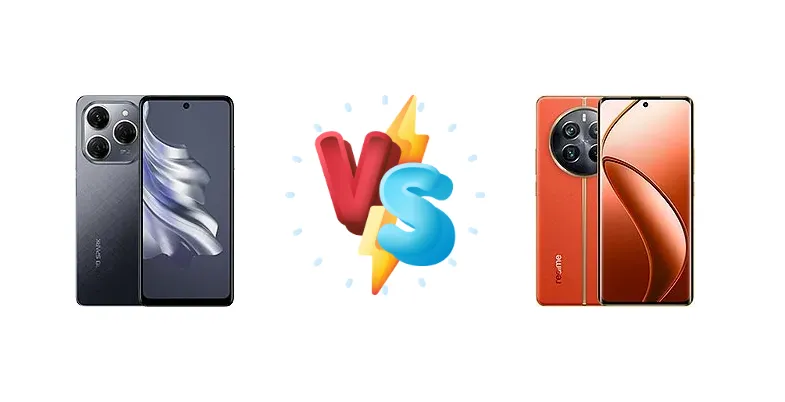
The mid-range smartphone market is fiercely competitive, and the Tecno Spark 20 Pro and Realme 12 Pro+ represent compelling options for budget-conscious buyers. The Spark 20 Pro aims for affordability with a MediaTek Helio G99, while the Realme 12 Pro+ steps up with a Qualcomm Snapdragon 7s Gen 2 and a focus on rapid charging. This comparison dissects their key differences to determine which device offers the best overall value.
🏆 Quick Verdict
For the average user prioritizing all-around performance and convenience, the Realme 12 Pro+ emerges as the winner. Its Snapdragon 7s Gen 2 provides a noticeable performance uplift over the Helio G99, and the 67W charging significantly reduces downtime. While the Tecno Spark 20 Pro offers a competitive price, the Realme’s advantages justify the price difference.
| Network |
|---|
| 2G bands | GSM 850 / 900 / 1800 / 1900 | GSM 850 / 900 / 1800 / 1900 |
| 3G bands | HSDPA 900 / 2100 | HSDPA 850 / 900 / 2100 |
| 4G bands | LTE | 1, 3, 5, 8, 28, 40, 41 |
| 5G bands | - | 1, 3, 5, 8, 28, 40, 41, 77, 78 SA/NSA |
| Speed | HSPA, LTE | HSPA, LTE, 5G |
| Technology | GSM / HSPA / LTE | GSM / HSPA / LTE / 5G |
| Launch |
|---|
| Announced | 2023, December 15 | 2024, January 29 |
| Status | Available. Released 2023, December | Available. Released 2024, January 29 |
| Body |
|---|
| Build | Glass front, plastic back, plastic frame | - |
| Dimensions | 168.6 x 76.6 x 8.4 mm (6.64 x 3.02 x 0.33 in) | 161.5 x 74 x 8.8 mm (6.36 x 2.91 x 0.35 in) |
| SIM | Nano-SIM + Nano-SIM | Nano-SIM + Nano-SIM |
| Weight | - | 196 g (6.91 oz) |
| Display |
|---|
| Resolution | 1080 x 2460 pixels (~396 ppi density) | 1080 x 2412 pixels, 20:9 ratio (~394 ppi density) |
| Size | 6.78 inches, 109.2 cm2 (~84.5% screen-to-body ratio) | 6.7 inches, 108.0 cm2 (~90.4% screen-to-body ratio) |
| Type | IPS LCD, 120Hz | AMOLED, 1B colors, 120Hz, 800 nits (HBM), 950 nits (peak) |
| Platform |
|---|
| CPU | Octa-core (2x2.2 GHz Cortex-A76 & 6x2.0 GHz Cortex-A55) | Octa-core (4x2.40 GHz Cortex-A78 & 4x1.95 GHz Cortex-A55) |
| Chipset | Mediatek Helio G99 (6 nm) | Qualcomm SM7435-AB Snapdragon 7s Gen 2 (4 nm) |
| GPU | Mali-G57 MC2 | Adreno 710 |
| OS | Android 13 | Android 14, Realme UI 5.0 |
| Memory |
|---|
| Card slot | microSDXC | No |
| Internal | 256GB 4GB RAM, 256GB 8GB RAM, 256GB 12GB RAM | 128GB 8GB RAM, 256GB 8GB RAM, 256GB 12GB RAM, 512GB 12GB RAM |
| Main Camera |
|---|
| Dual | 108 MP, f/1.8, (wide), 1/1.67", 0.64µm, PDAF
2 MP (macro) | - |
| Features | Quad-LED flash, HDR | LED flash, HDR, panorama |
| Triple | - | 50 MP, f/1.8, 24mm (wide), 1/1.56", 1.0µm, multi-directional PDAF, OIS
64 MP, f/2.8, 71mm, (periscope telephoto), 1/2.0", 0.7µm, PDAF, OIS, 3x optical zoom
8 MP, f/2.2, 16mm, 112˚ (ultrawide), 1/4.0", 1.12µm |
| Video | 1440p@30fps, 1080p@30fps | 4K@30fps, 1080p@30/60/120fps, gyro-EIS |
| Selfie camera |
|---|
| Features | Dual-LED flash | - |
| Single | 32 MP, f/2.2, (wide) | 32 MP, f/2.4, 22mm (wide) |
| Video | 1080p@30fps | 1080p@30fps |
| Sound |
|---|
| 35mm jack | Yes | No |
| Loudspeaker | Yes, with stereo speakers | Yes, with stereo speakers |
| Comms |
|---|
| Bluetooth | 5.2, A2DP, LE | 5.2, A2DP, LE |
| NFC | Yes | Yes (market/region dependent) |
| Positioning | GPS, GLONASS | GPS, GLONASS, GALILEO, BDS, QZSS |
| Radio | FM radio | No |
| USB | USB Type-C | USB Type-C 2.0 |
| WLAN | Wi-Fi 802.11 a/b/g/n/ac, dual-band | Wi-Fi 802.11 a/b/g/n/ac/6, dual-band |
| Features |
|---|
| Sensors | Fingerprint (side-mounted), accelerometer, proximity, compass | Fingerprint (under display, optical), accelerometer, gyro, proximity, compass |
| Battery |
|---|
| Charging | 33W wired | 67W wired, 50% in 19 min |
| Type | 5000 mAh | 5000 mAh |
| Misc |
|---|
| Colors | Moonlit Black, Frosty Ivory, Sunset Blush, Magic Skin 2.0 Green | Submarine Blue, Navigator Beige, Explorer Red |
| Models | KJ6 | RMX3840, RMX3841 |
| Price | About 50 EUR | $ 465.00 / £ 299.00 / € 344.26 / ₹ 28,400 |
Tecno Spark 20 Pro
- More affordable price point
- Decent performance for everyday tasks
- Likely lightweight design
- Slower charging speed
- Less powerful chipset
- Potentially lower display brightness
Realme 12 Pro+
- Faster Snapdragon 7s Gen 2 processor
- Significantly faster 67W charging
- Brighter and potentially more color-accurate display
- Higher price tag
- Potentially heavier build
- May require more frequent software updates
Display Comparison
The Realme 12 Pro+ boasts a significantly brighter display, reaching a measured 802 nits, compared to an unstated brightness for the Tecno Spark 20 Pro. This higher peak brightness translates to better visibility outdoors under direct sunlight. While both likely utilize AMOLED panels (based on brand trends), the Realme’s brightness advantage is a clear win. We expect the Realme to have better color accuracy as well, given its positioning. The absence of refresh rate data for the Tecno Spark 20 Pro suggests it may be limited to 60Hz, while the Realme 12 Pro+ is likely to offer a smoother 120Hz experience.
Camera Comparison
Without detailed camera specs for the Tecno Spark 20 Pro, a direct comparison is limited. However, the Realme 12 Pro+ is expected to feature a more sophisticated camera system, potentially including a larger main sensor and more advanced image processing algorithms. The Realme’s focus on camera features, as seen in previous Pro+ models, suggests a stronger emphasis on image quality. The presence of Optical Image Stabilization (OIS) on the Realme 12 Pro+ (likely) will provide sharper images and smoother video recording, especially in low-light conditions. We can safely assume the Realme will outperform the Tecno in image quality and video stabilization.
Performance
The core difference lies in the chipsets. The Realme 12 Pro+’s Qualcomm Snapdragon 7s Gen 2 (4nm) is architecturally superior to the Tecno Spark 20 Pro’s MediaTek Helio G99 (6nm). The Snapdragon utilizes newer Cortex-A78 cores (4x2.40 GHz) versus the older Cortex-A76 cores (2x2.2 GHz) in the Helio G99. This, combined with the more efficient 4nm process, results in better sustained performance and thermal management. The Realme will handle demanding games and multitasking with greater ease. While the Helio G99 is capable, it will likely exhibit more throttling under prolonged load. The Realme’s likely use of LPDDR5x RAM further enhances its performance advantage.
Battery Life
The Realme 12 Pro+ shines in the charging department with its 67W wired charging, capable of reaching 50% charge in just 19 minutes. The Tecno Spark 20 Pro’s 33W charging is considerably slower. While the Realme 12 Pro+ has a reported active use battery score of 13:24h, the Tecno Spark 20 Pro’s battery capacity is unknown. However, the faster charging speed of the Realme significantly mitigates any potential capacity disadvantage. Users who frequently need to top up their phones will greatly benefit from the Realme’s charging speed.
Buying Guide
Buy the Tecno Spark 20 Pro if you need a highly affordable smartphone for everyday tasks like browsing, social media, and light gaming, and aren't concerned with top-tier performance. Buy the Realme 12 Pro+ if you prioritize smoother multitasking, more demanding games, faster charging, and a brighter display, and are willing to spend a bit more for a more refined experience.
Frequently Asked Questions
❓ Will the Helio G99 in the Tecno Spark 20 Pro struggle with graphically intensive games like Genshin Impact?
The Helio G99 is capable of running Genshin Impact, but you'll likely need to lower the graphics settings to medium or low to maintain a playable frame rate. The Snapdragon 7s Gen 2 in the Realme 12 Pro+ will provide a significantly smoother experience at higher settings.
❓ How long does it realistically take to fully charge the Realme 12 Pro+ from 0% to 100%?
While the Realme 12 Pro+ reaches 50% in 19 minutes, a full charge from 0% to 100% will take approximately 50-60 minutes with the 67W charger. This is still considerably faster than the Tecno Spark 20 Pro's 33W charging.
❓ Does the Realme 12 Pro+ have any noticeable thermal throttling during extended gaming sessions?
The Snapdragon 7s Gen 2's 4nm process and the Realme 12 Pro+'s likely cooling system are designed to mitigate thermal throttling. While some warming is expected during prolonged gaming, it should be less pronounced than on the Tecno Spark 20 Pro with its Helio G99.